
SUNPOL / Practical selection guide
Choose the lighting system around your displays—not simply around a wattage number.
Choosing commercial track lighting means matching the track interface, beam angle, light output and installation conditions to what people need to see. A fitting that works over a small product island may not be the right choice for a tall stone display or a changing retail wall.
01 / Define the task
Start with what you need to illuminate
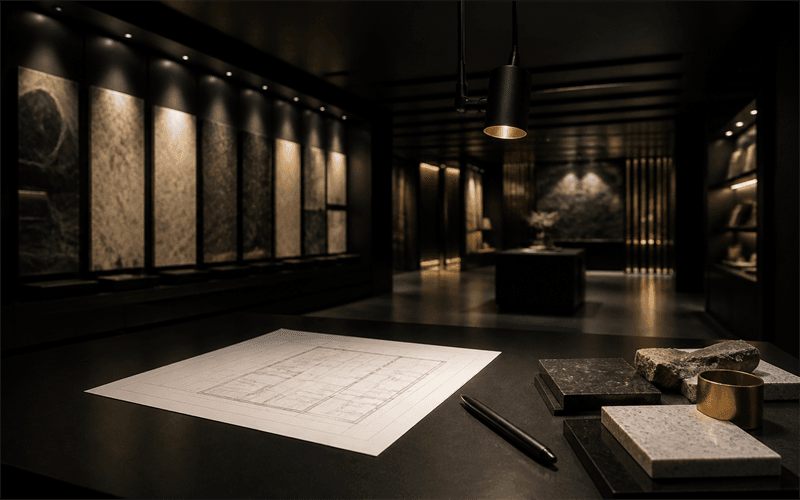
Before selecting track lighting for retail stores, mark the displays that need attention. Record the ceiling height, the distance from the proposed fixture position to the merchandise, and the customer’s main viewing directions. The distance to the target matters more than ceiling height alone.
Retail shelves and product islands
Identify hero products, shelf depths and seasonal merchandising changes. Plan where the accent light should land, and check that shelves or signs will not block it.
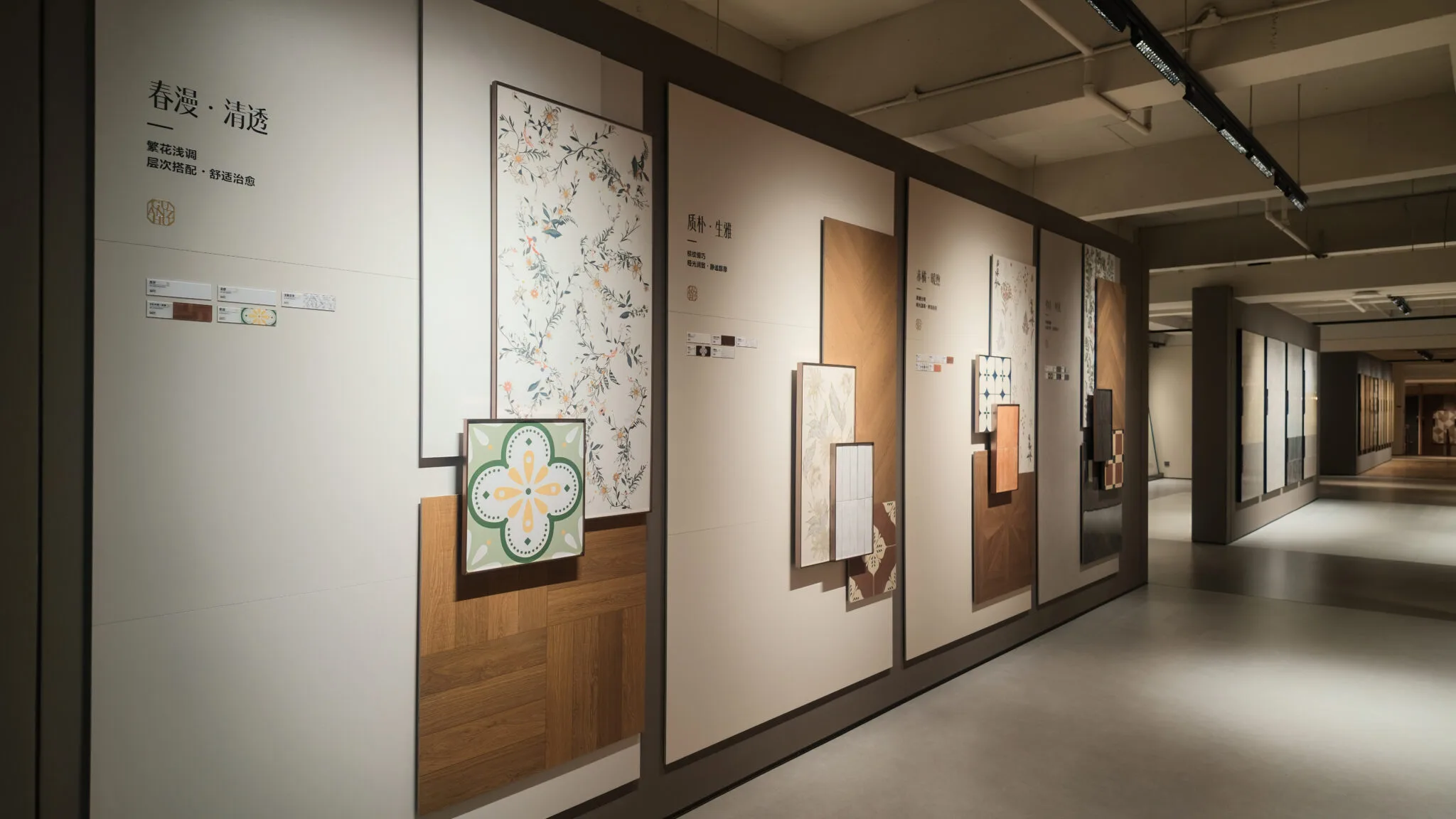
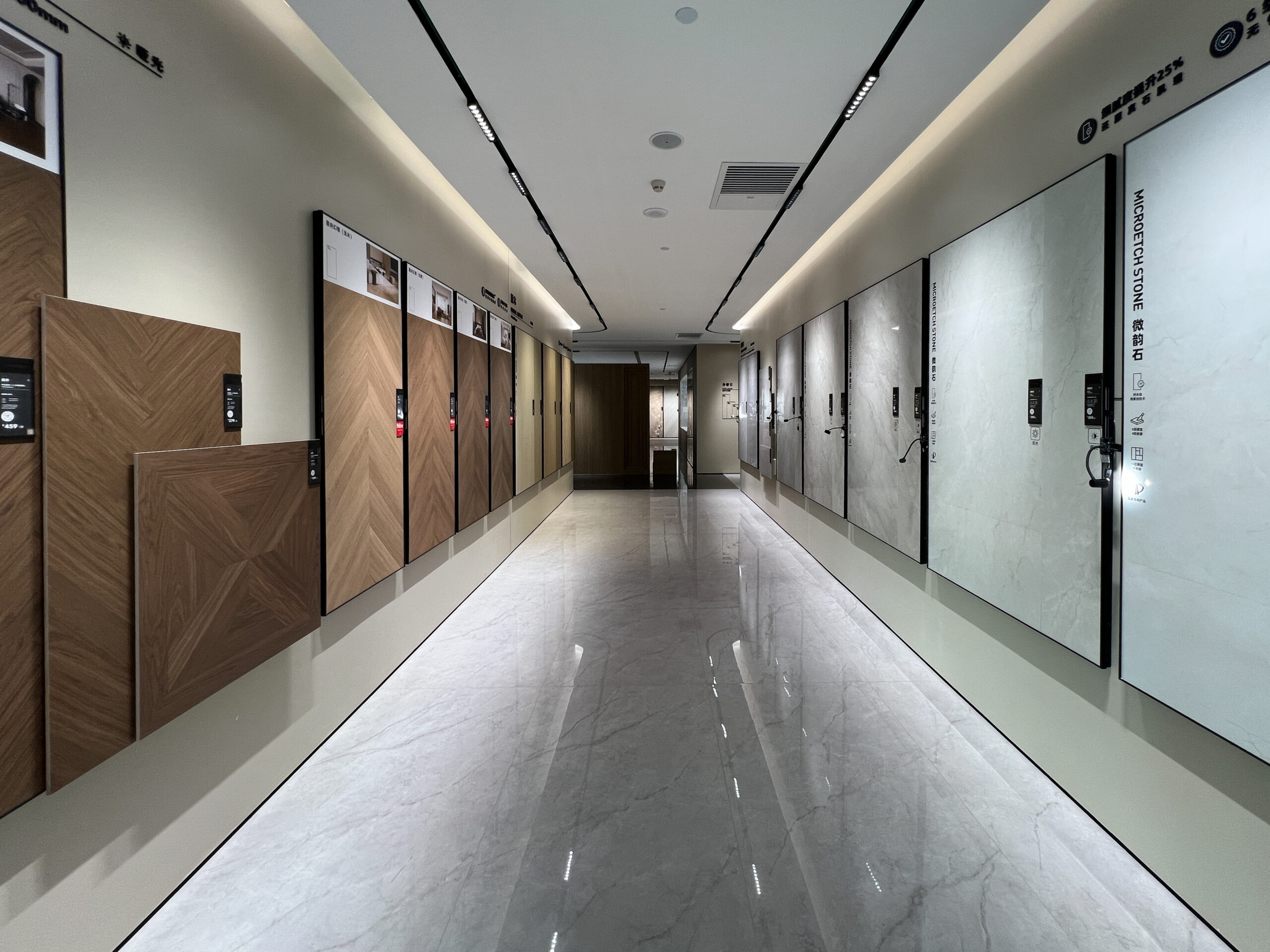
Tile and stone display walls
Record panel dimensions, surface texture and finish. Test the aiming direction on actual samples: polished and textured surfaces can respond differently to the same fixture position.
Furniture and bathroom displays
Consider the complete product setting and the visitor’s route. Check reflections in mirrors and glossy finishes, rather than judging the display only from directly below the track.
Use accent lighting alongside appropriate ambient and task lighting. Track spotlights do not need to provide every layer of light in the room. For a wider store-planning brief, explore SUNPOL retail store lighting solutions.
02 / Confirm the infrastructure
Check the track system before choosing fixtures
A similar-looking adapter does not prove that two products are compatible. For an existing installation, send the track brand, model, electrical information and clear photographs of the rail and adapter. For a new installation, specify the rail, power supply, fittings and fixtures as a coordinated system.
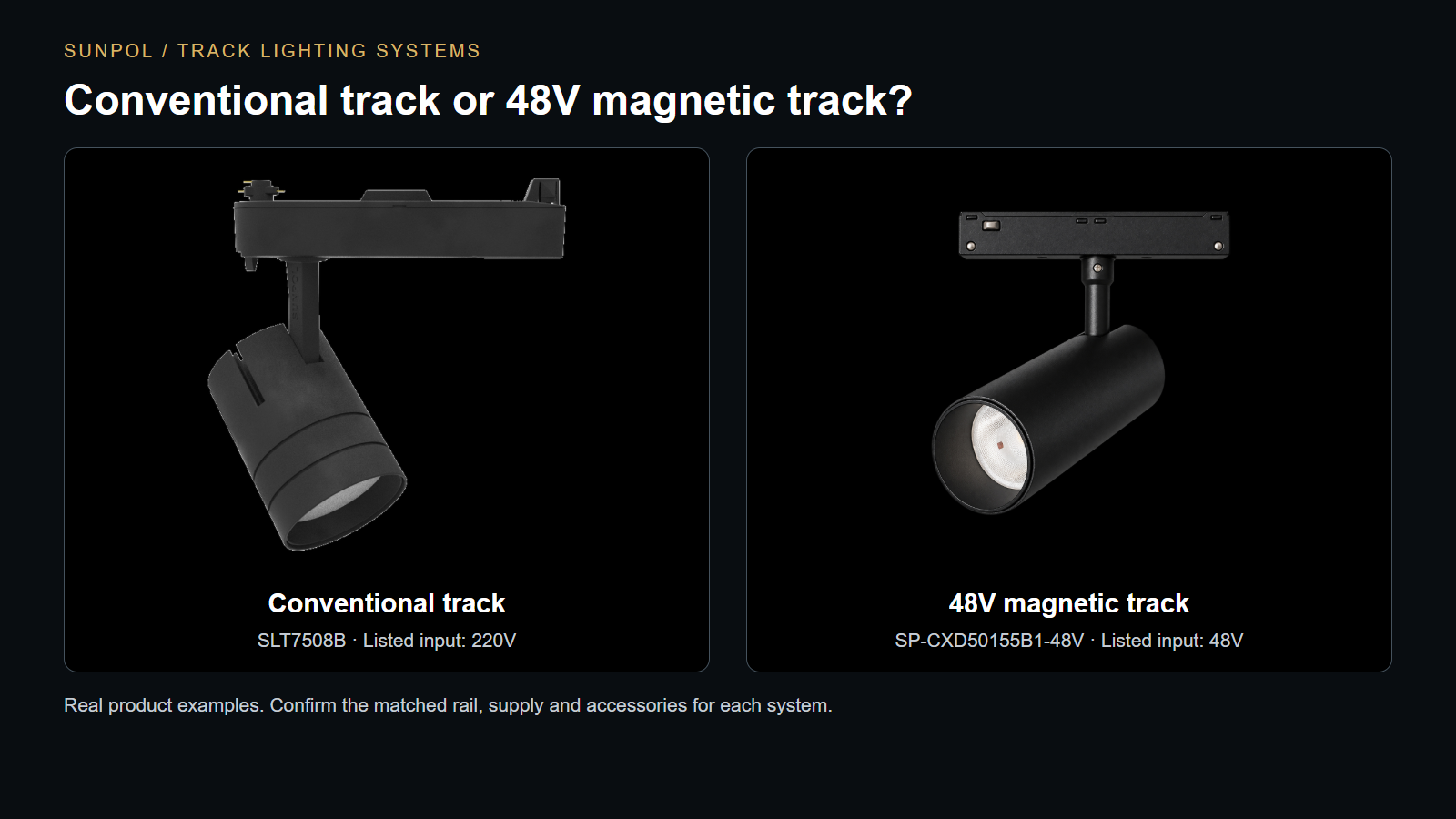
Conventional track-mounted fixtures
Check the exact adapter and track interface, supply requirements and any control requirements. The conventional models compared below are listed at 220V in the current SUNPOL parameter sheet. That voltage alone does not identify a compatible rail.
48V magnetic track fixtures
The magnetic models below are listed at 48V and use magnetic track mounting. Confirm the compatible rail, power-supply specification, total connected load and connection accessories before ordering. Do not connect them directly to a 220V supply.
Surface-mounted, suspended and recessed track installations also require different mounting details. Confirm which options the selected rail actually supports. If dimming or controls are needed, verify the driver and protocol for the exact configuration; do not infer these functions from the product family name.
Browse commercial track lighting or the magnetic cylinder track light range after the installation conditions are clear.
03 / Put the light where it belongs
Choose beam angles for the display layout
At the same distance, a narrower beam concentrates its coverage on a smaller area, while a wider beam spreads over a larger area. A narrow beam can suit an individual object; a wider distribution may suit broader merchandise or a larger display area. Neither is automatically better.
Take the target size and aiming direction into account. A tilted beam reaches a surface differently from a beam aimed straight at it, and several fixtures may need carefully planned overlap. Luminaire photometric files, sample testing and on-site aiming are more useful than choosing an angle from the ceiling height alone.

For reflected glare or uncomfortable viewing angles, combine beam selection with fixture position and optical shielding. Read how anti-glare track lights work for a separate explanation of visual comfort.
04 / Compare useful performance
Compare light output, color quality and color temperature
Use watts and lumens for different questions
Wattage describes electrical power; lumens describe luminous flux. Two commercial LED track lights with similar wattage can have different output and distributions. Compare the selected configuration, then assess the illuminance and uniformity at the actual merchandise—not just the largest lumen figure on a specification sheet.
Check color rendering on real merchandise
The four models below are listed with Ra ≥90. This is a useful specification to check, but it is not a complete description of how every material will look. Review actual tile, stone, fabric, wood or metal samples under the proposed light and assess color together with reflections and comfort. Our high-CRI track light selection guide develops this topic further.
Select color temperature deliberately
Choose a consistent lighting intention for each zone and compare samples before committing to an order. The current parameter sheet lists 3000K, 3500K, 4000K, 4500K, 5000K and 5500K for the models below; confirm the required option when requesting a quotation. Available options are not a promise of field-adjustable color temperature.
For an application-focused comparison, see 3000K vs 4000K for showroom lighting.
05 / Shortlist the right family
Compare suitable SUNPOL track light models
Use this shortlist to compare conventional cylinder fixtures with 48V magnetic cylinder and grille options. Select a mounting system first, then compare the optical and output choices within that system. A different housing shape does not establish different track compatibility.
| Model | Mounting / input | Power options | Beam options | Nominal luminous flux* |
|---|---|---|---|---|
| SLT7508B | Track-mounted 220V | 12 / 15 / 20 / 25W | 15° / 24° / 36° | 1,140 / 1,425 / 1,900 / 2,375 lm |
| SLT8308B | Track-mounted 220V | 15 / 20 / 25 / 30 / 35W | 15° / 24° / 36° | 1,350 / 1,800 / 2,250 / 2,700 / 3,150 lm |
| SP-CXD50155B1-48V | Magnetic track-mounted 48V | 12 / 15 / 20 / 25W | 36° | 1,080 / 1,350 / 1,800 / 2,250 lm |
| SP-CXG22223H26B2-48V | Magnetic track-mounted 48V | 12 / 15W | 36° | 1,080 / 1,350 lm |
*Power and luminous-flux values correspond in the same left-to-right order. Reference: the current SUNPOL 33-model parameter sheet. Confirm the required configuration and track compatibility with SUNPOL before ordering. The listed voltage does not establish the supply waveform or interface.
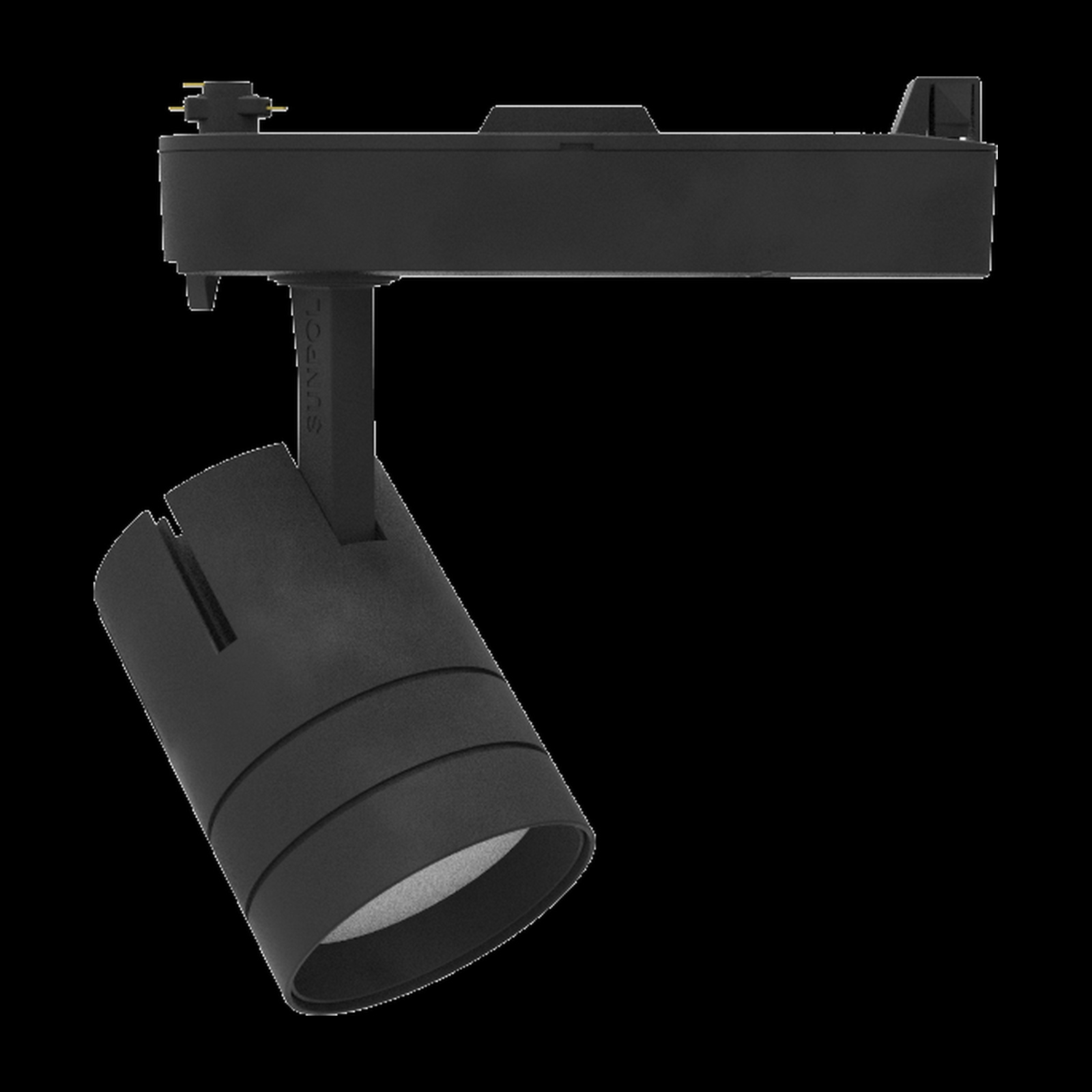
SLT7508B
Track-mounted · 12 / 15 / 20 / 25W · 15° / 24° / 36°
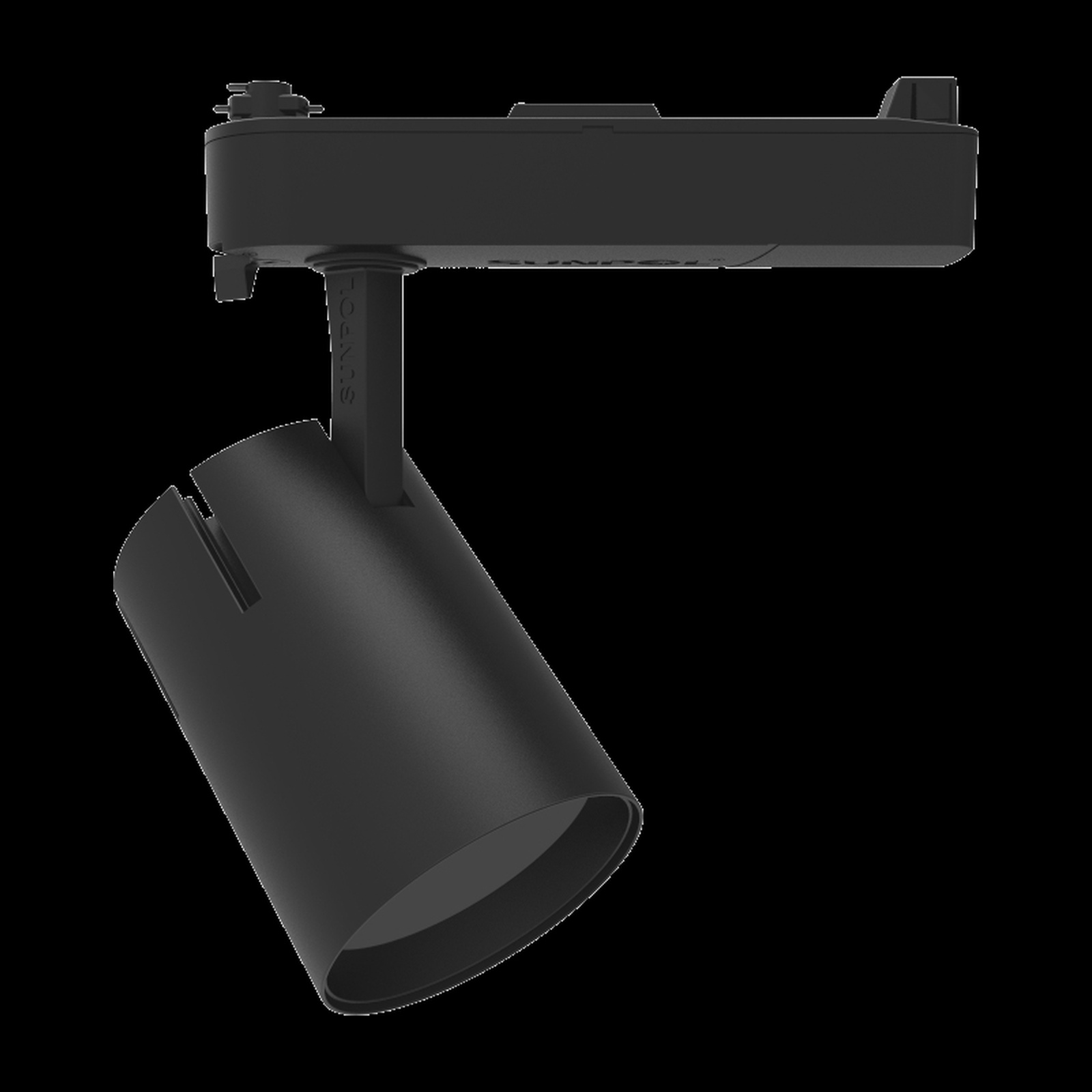
SLT8308B
Track-mounted · 15 / 20 / 25 / 30 / 35W · 15° / 24° / 36°
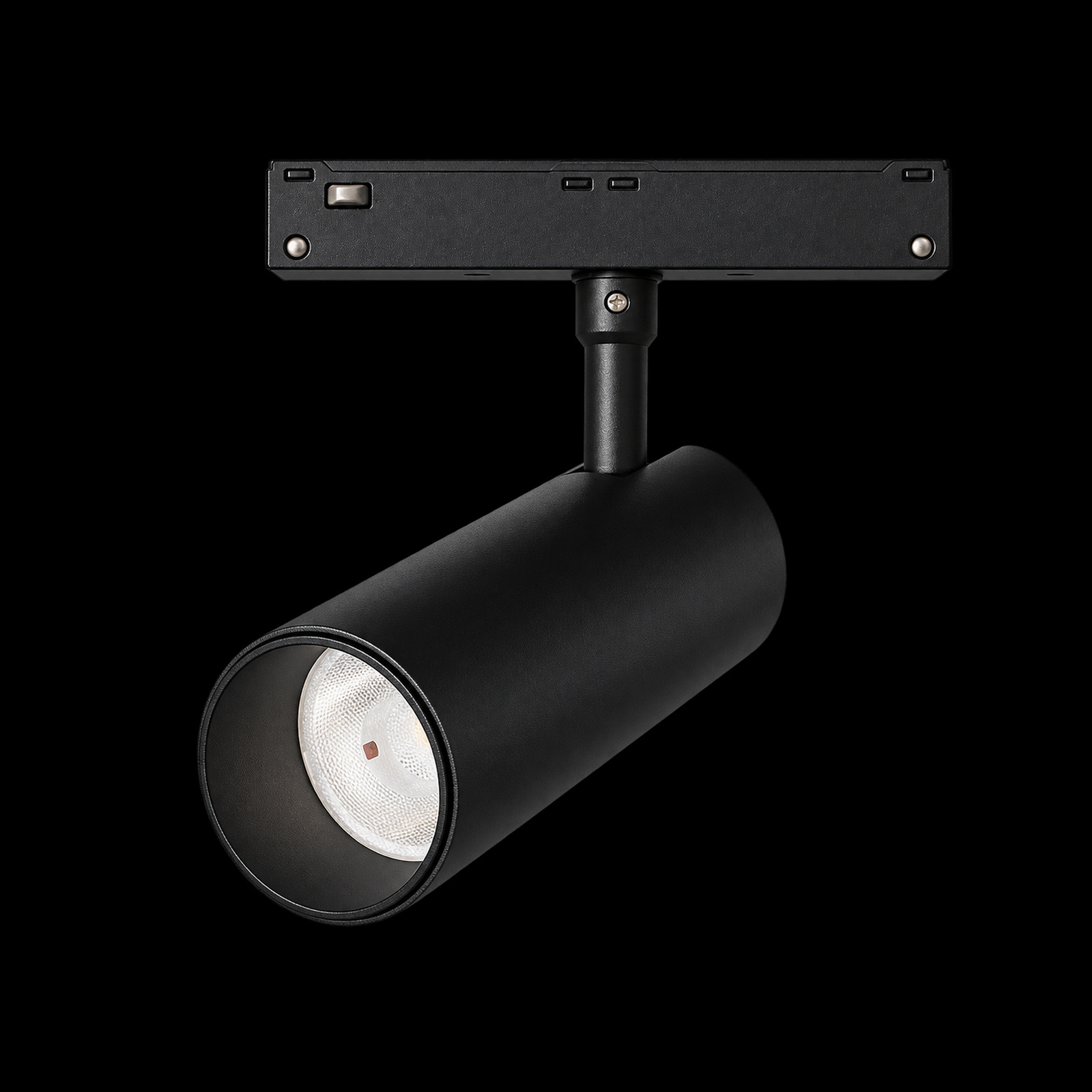
SP-CXD50155B1-48V
Magnetic track-mounted · 12 / 15 / 20 / 25W · 36°
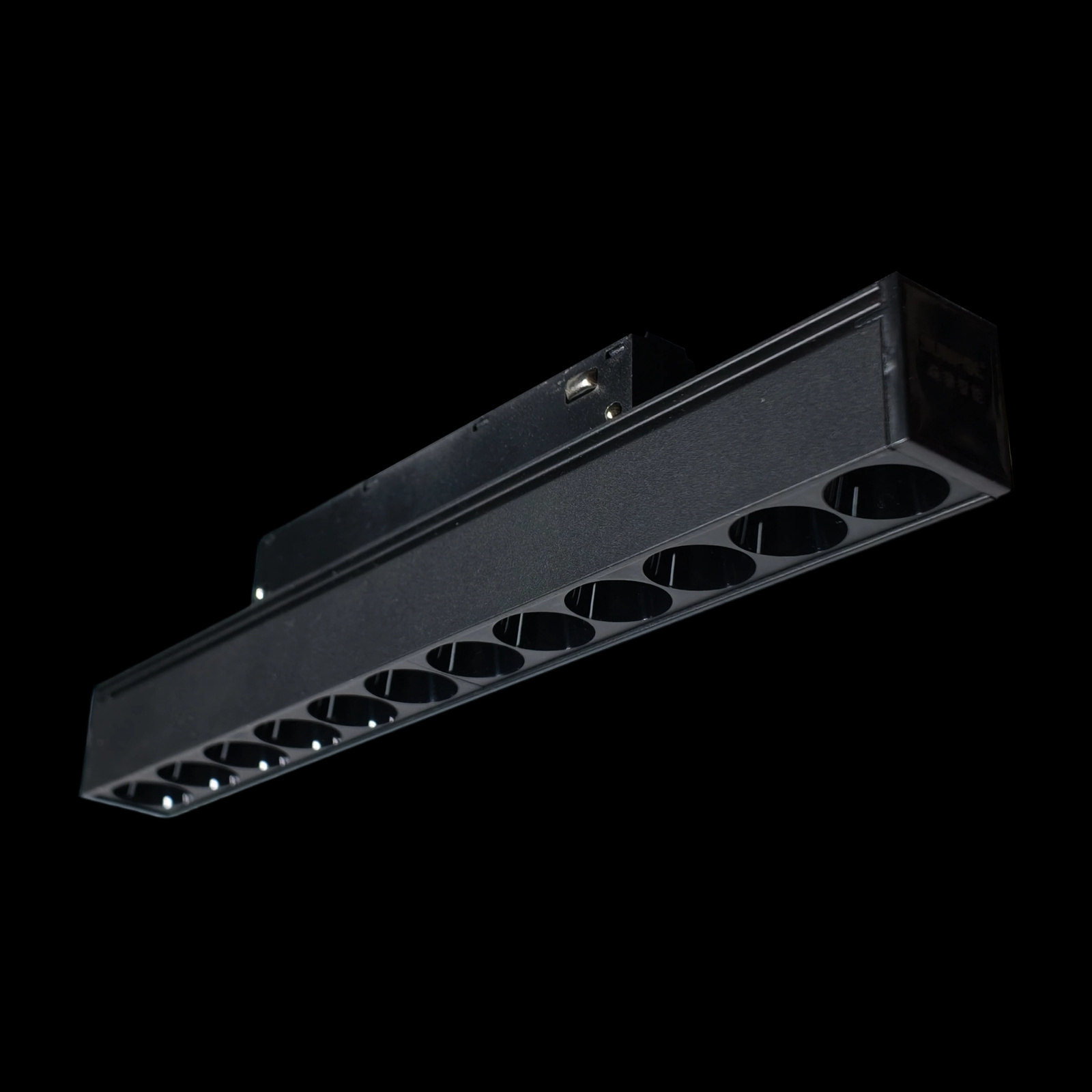
SP-CXG22223H26B2-48V
Magnetic track-mounted · 12 / 15W · 36°
This table excludes recessed spotlights: an adjustable recessed fixture is not automatically a track-mounted fixture. If your ceiling strategy is still undecided, compare track lights and recessed spotlights for showrooms.
06 / Turn the shortlist into a specification
Prepare these details before requesting a lighting proposal
A useful project brief allows the fixture choice, quantity and installation conditions to be reviewed together. Send:
- Layout and dimensions: a floor plan, ceiling height, proposed track positions and fixture-to-display distances.
- Display information: photographs, sample materials, shelf depths and key viewing directions.
- Installation details: new or existing track, rail and adapter information, mounting method and supply requirements.
- Lighting preferences: desired color temperature, accent zones, dimming and control requirements.
- Project requirements: quantities, destination, required delivery timing and any local documentation requirements.

Before a full order, review an appropriate sample configuration and plan a trial installation or mock-up where practical. Check the intended display, customer sightlines and reflections together. Final electrical design and installation should follow the approved equipment documentation and applicable local requirements.
Questions before ordering
Commercial track lighting FAQs
Can I use new track lights on my existing track?
Only after the rail, adapter, electrical requirements and controls have been checked. Send the track model and interface photographs; matching appearance or voltage does not establish compatibility.
How do I choose a beam angle for product displays?
Start with fixture-to-target distance, target size and aiming direction. Compare the selected fixture’s photometric distribution and check a sample on the actual display. The geometric illustration in this guide is a starting point, not a lighting calculation.
Should I compare track lights by wattage or lumen output?
Compare both, then assess the distribution and illumination on the merchandise. Wattage describes electrical power, while lumens describe luminous flux; neither alone determines the display result.
What information is needed for a showroom lighting proposal?
Provide the layout, ceiling height, display photographs, track and supply information, quantity, preferred color temperature, control requirements and project timing. Include the rail model when adapting an existing installation.
Build a track lighting shortlist for your space
Share your layout, display materials and installation conditions with SUNPOL. We can review the relevant fixture configurations and the information needed for a project quotation.
Further technical reading: ERCO: Precisely illuminating products. Product values in the comparison table come from SUNPOL’s current parameter sheet; the geometric diagram is calculated independently.