Lighting in a showroom does much more than make products visible. It shapes how customers perceive color, texture, depth, quality, and even the value of the products on display. For tile, stone, sanitaryware, furniture, and other material-focused showrooms, choosing the right accent lighting system can therefore have a direct impact on the overall presentation.
One of the most common decisions designers and showroom owners face is track light vs recessed spotlight.
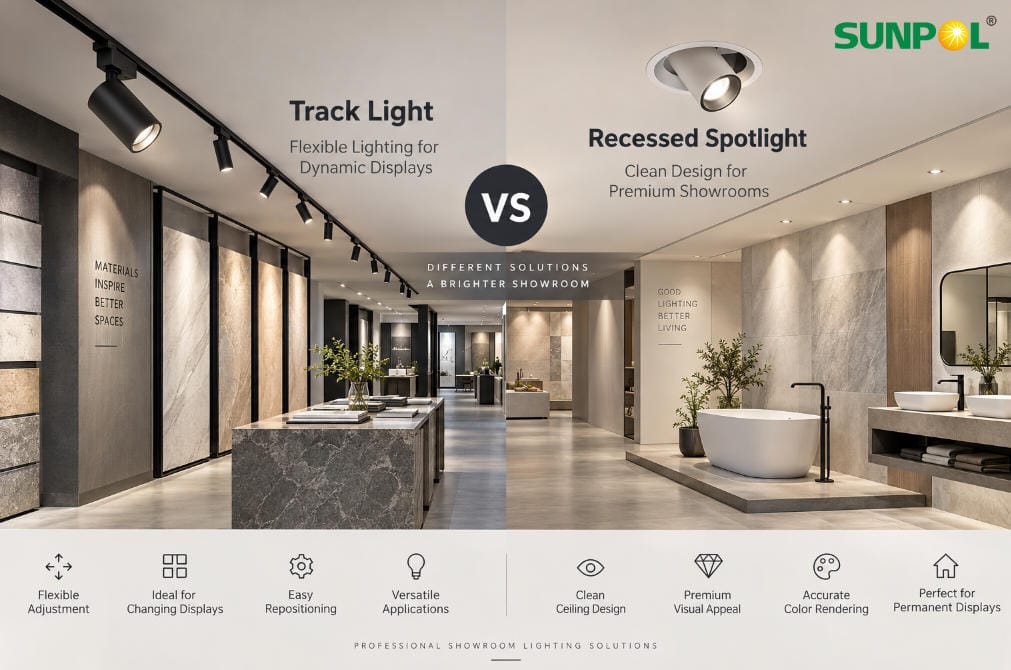
Both solutions can provide effective directional lighting, but they behave differently once installed. Track lighting prioritizes flexibility and easy repositioning, while recessed spotlights create a cleaner architectural ceiling and a more integrated visual appearance.
So, when considering track lighting or recessed lighting for a showroom, which option makes more sense?
The answer depends on how frequently displays change, the ceiling design, required beam flexibility, maintenance strategy, and the visual experience the showroom wants to create.
This guide provides a practical showroom spotlight comparison to help designers, retailers, contractors, and project owners choose the right solution.
What Is Track Lighting?
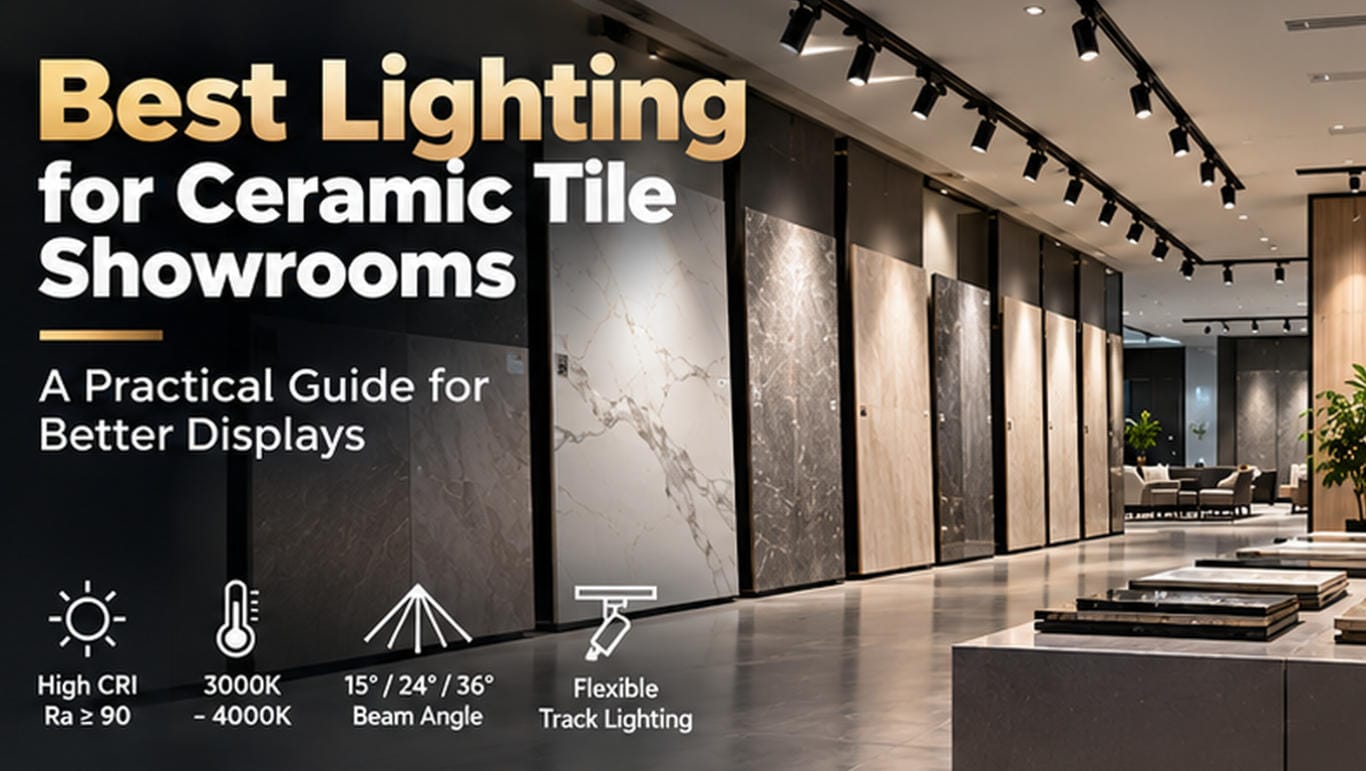
Track lighting consists of a ceiling-mounted track or rail that supplies power to multiple adjustable lighting fixtures. Individual track lights can normally be positioned along the track and aimed toward different products, walls, display panels, or architectural features.
This makes track lighting particularly useful in commercial environments where displays are not permanently fixed.
For example, a tile showroom may replace a large-format slab display, reorganize sample panels, or introduce a new collection. Instead of modifying the ceiling every time the display changes, the lighting heads can be repositioned and redirected.
That ability makes track systems an important form of flexible display lighting.
In professional showroom applications, track lighting can be used for:
- Tile and stone display walls
- Sanitaryware displays
- Furniture showrooms
- Retail shelving
- Feature displays
- Exhibition areas
- Frequently changing product zones
SUNPOL develops professional track lighting solutions specifically for commercial display environments where accurate beam control and adaptable product illumination are important.
What Is a Recessed Spotlight?
A recessed spotlight is installed partly or almost completely inside the ceiling, leaving a relatively clean and minimal appearance.
Unlike a visible track system, the electrical and mounting structure is concealed above the ceiling. Depending on the fixture design, the light source may be fixed, adjustable, or equipped with a pull-down mechanism that provides additional aiming flexibility.
A good example is SUNPOL’s SP-SX95105B2 Recessed Pull-Down Spotlight. It combines recessed installation with 350° horizontal rotation and 90° vertical tilt, helping designers maintain a clean ceiling while still directing light toward display walls and product zones.
The fixture is available with 15°, 24°, and 36° beam angles, CRI Ra ≥90, and several output options, making it suitable for different display distances and target sizes.
Recessed spotlights are commonly used in:
- Premium showrooms
- Reception areas
- Luxury retail environments
- Fixed product displays
- Galleries
- Hospitality interiors
- Areas where ceiling appearance is a major design consideration
Track Light vs Recessed Spotlight: Key Differences
The fundamental difference in the track light vs recessed spotlight discussion is not simply how the fixtures look. It is how easily the lighting system can adapt to the showroom over time.
1. Flexibility
Track lighting generally provides the greatest flexibility.
Fixtures can be repositioned along a compatible track, redirected, and in many systems added or removed as the display layout evolves. This is especially useful in showrooms where product displays change frequently.
Recessed spotlights can also provide directional adjustment, but their installation points remain fixed.
An adjustable recessed spotlight can redirect its beam, but it cannot normally be moved to another part of the ceiling without additional installation work.
Best suited for frequent display changes: Track lighting.
Best suited for relatively stable layouts: Recessed spotlights.
2. Ceiling Appearance
This is where recessed lighting has a clear architectural advantage.
Because most of the fixture is integrated into the ceiling, recessed spotlights create a cleaner ceiling plane. This can be particularly attractive in minimalist interiors, luxury retail spaces, premium bathroom showrooms, reception areas, and carefully designed architectural environments.
Track lighting remains visible.
However, this is not necessarily a disadvantage. In contemporary commercial interiors, a well-designed track system can become part of the visual language of the space.
The choice therefore depends on whether the lighting equipment should visually disappear or become part of the showroom’s technical aesthetic.
3. Display Adaptability
Showrooms are rarely static.
A ceramic tile retailer may change wall displays every season. A sanitaryware showroom may replace basins, faucets, mirrors, and bathroom settings. Furniture displays can move even more frequently.
This makes adaptability one of the most important considerations when choosing track lighting or recessed lighting for a showroom.
Track lighting allows the lighting layout to follow the merchandise.
Recessed lighting requires the merchandise layout to remain reasonably compatible with predetermined fixture positions.
For businesses expecting regular merchandising changes, track systems can therefore reduce future lighting modifications.
4. Beam Control and Accent Lighting
Both systems can provide excellent accent lighting when equipped with appropriate optics.
The more important questions are:
- What is the distance between the fixture and the display?
- How large is the illuminated object?
- Is the goal to create a narrow accent or broader illumination?
- How much contrast is required between the product and surrounding space?
Narrow beams can emphasize individual objects or details, while wider beams can illuminate larger display surfaces.
For example, SUNPOL’s recessed pull-down spotlight offers 15°, 24°, and 36° beam options. Selecting between these angles allows designers to adapt the lighting effect to different display sizes and mounting distances.
The same principle applies to track lighting: fixture type, beam angle, output, positioning, and aiming should be selected as a complete optical system rather than treating wattage as the only specification.
5. Color Rendering
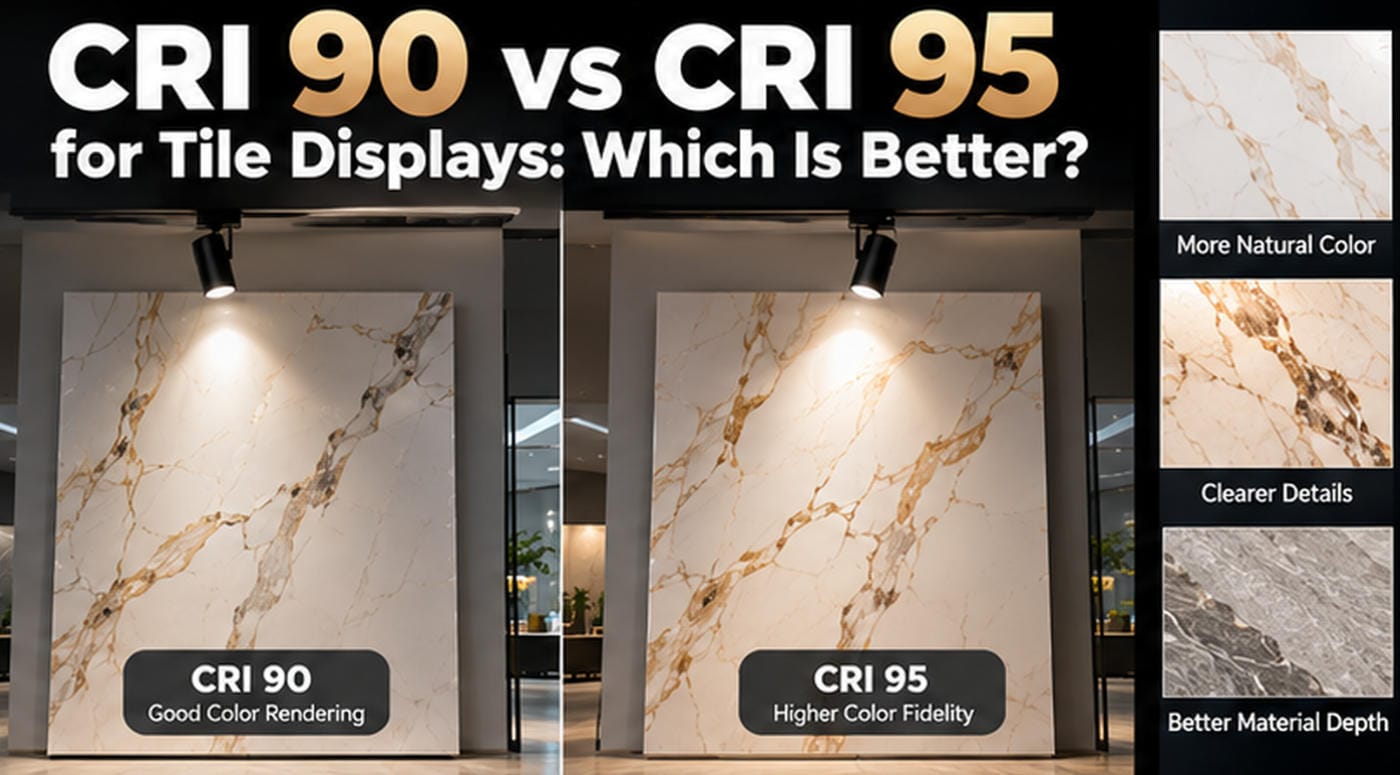
For material-focused showrooms, color quality can be more important than raw brightness.
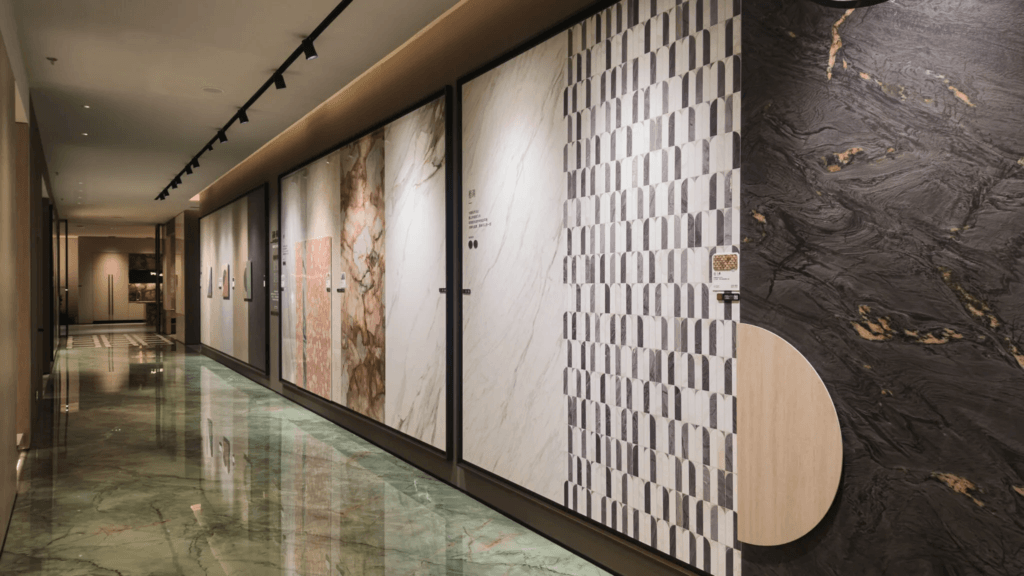
Tile, natural stone, wood, fabrics, metal finishes, ceramics, and sanitaryware all interact with light differently. Poor color rendering may make materials appear flatter or less accurate than they do under better-quality illumination.
For this reason, professional showroom lighting should consider CRI together with color temperature, beam distribution, glare control, and illuminance.
SUNPOL focuses on commercial showroom lighting with high color rendering, including fixtures with CRI Ra ≥90, helping colors and material finishes appear more natural.
This matters especially when customers are making decisions based on subtle differences in surface color, texture, or finish.
6. Glare Control
A powerful spotlight is not automatically a good showroom spotlight.
If customers can directly see an excessively bright light source while walking through a showroom, visual discomfort can distract attention from the products.
Effective showroom lighting therefore requires control of both illumination and glare.
Fixture position, aiming angle, optical design, beam spread, mounting height, and display orientation should all be considered.
Track lighting gives designers considerable freedom to adjust aiming after installation, which can help correct uncomfortable viewing angles.
Recessed spotlights can offer excellent visual comfort as well, particularly when the optical system is deeply integrated or carefully shielded.
The final result depends more on optical engineering and lighting design than on the fixture category alone.
7. Installation
Track lighting usually requires a track system mounted to or integrated with the ceiling. Once the track infrastructure is installed, modifying individual fixture positions can be relatively straightforward.
Recessed spotlights require ceiling cut-outs and adequate installation space above the ceiling.
For example, SUNPOL’s SP-SX95105B2 uses a Ø95 mm cut-out. These physical requirements need to be coordinated with the ceiling design before installation.
This makes recessed lighting particularly suitable when the lighting layout is planned together with the architectural design.
Track lighting may offer greater freedom when the lighting system needs to accommodate future merchandising changes.
8. Maintenance and Future Changes
A showroom lighting system should be evaluated over its entire operating life rather than only at installation.
Imagine that a showroom renovates a display wall two years after opening.
With a track system, existing fixtures may simply be moved or re-aimed to suit the new display.
With recessed fixtures, the existing positions may no longer correspond with the new merchandise arrangement.
Additional ceiling work could then be necessary.
For long-term flexible display lighting, this is one of the strongest arguments for track lighting.
On the other hand, if the showroom architecture and product zones are designed to remain consistent for many years, recessed lighting can provide a refined and permanent solution.
Quick Showroom Spotlight Comparison
| Factor | Track Light | Recessed Spotlight |
|---|---|---|
| Fixture position | Highly flexible | Fixed installation point |
| Directional adjustment | Excellent | Good to excellent depending on fixture |
| Ceiling appearance | Visible track system | Clean, integrated appearance |
| Display changes | Excellent for frequent changes | Better for stable layouts |
| Installation planning | Relatively adaptable | Requires ceiling coordination |
| Future repositioning | Easier | More limited |
| Premium minimalist interiors | Good | Excellent |
| Flexible display lighting | Excellent | Moderate to good |
| Accent lighting | Excellent | Excellent |
| Maintenance access | Generally convenient | Depends on ceiling and fixture design |
There is therefore no universal winner in a showroom spotlight comparison. The correct system depends on the role each area plays within the showroom.
When Should a Showroom Use Track Lighting?
Track lighting is particularly effective when flexibility is a priority.
Consider track lights when:
- Product displays change regularly.
- Display walls are frequently redesigned.
- Different products require different aiming angles.
- The showroom needs to add or remove accent lights.
- Future merchandising layouts are difficult to predict.
- Flexible lighting is more important than concealing the fixture infrastructure.
Tile and stone showrooms are a good example.
Large slabs, vertical sample panels, room settings, and feature walls may change as manufacturers introduce new collections. A flexible track system allows the lighting to evolve with these displays.
When Should a Showroom Use Recessed Spotlights?
Recessed spotlights are particularly effective when architectural integration is a priority.
Consider recessed lighting when:
- The ceiling needs to remain visually clean.
- Product zones are relatively permanent.
- The interior uses a minimalist design language.
- Fixture locations can be determined during architectural planning.
- Premium visual presentation is a priority.
- Directional adjustment is needed without exposing a track system.
Adjustable or pull-down recessed spotlights can also reduce the traditional flexibility gap between recessed and track lighting.
A fixture that rotates and tilts allows designers to redirect the beam while retaining a recessed installation.
Can Track Lights and Recessed Spotlights Be Used Together?
Yes. In many professional showroom projects, a hybrid approach can be more effective than choosing only one fixture type.
Different showroom zones perform different functions.
For example, recessed spotlights can be used in reception areas, consultation spaces, corridors, or permanent feature displays where a clean ceiling is important.
Track lighting can then be installed above product walls and frequently changing merchandising zones.
Linear lighting or wall-washing solutions can provide another layer for general illumination or large vertical surfaces.
This layered approach separates lighting functions rather than forcing one fixture to perform every task.
A successful showroom may therefore combine:
ambient lighting + accent lighting + vertical lighting + decorative lighting.
The objective is not to maximize the number of fixtures. It is to put the right type of light in the right location.
How to Choose the Right Showroom Lighting System
Before selecting fixtures, showroom owners and designers should evaluate the actual display environment.
Start with the merchandise.
Large-format stone slabs require a different lighting strategy from faucets, bathroom accessories, furniture, or small decorative products.
Next, consider the display cycle.
If merchandising changes every few months, flexibility becomes much more valuable. If the layout will remain unchanged for years, architectural integration may deserve greater priority.
Then evaluate:
Ceiling height: This influences fixture output, beam angle, and aiming.
Display dimensions: A small product and a full-height display wall require different beam distributions.
Surface characteristics: Glossy surfaces can create reflections, while textured surfaces may benefit from directional lighting that reveals depth.
Color quality: High-quality color rendering helps customers evaluate materials more accurately.
Glare: Lighting should highlight products without creating uncomfortable brightness in common viewing directions.
Maintenance: Fixtures should remain practical to access, adjust, replace, or reconfigure.
These factors provide a more reliable basis for choosing between track light vs recessed spotlight than appearance alone.
Why Showroom Lighting Requires More Than Fixture Selection
Professional showroom lighting is ultimately a system-design problem.
A technically excellent fixture can still perform poorly if it is installed at the wrong distance, aimed incorrectly, or paired with an unsuitable beam angle.
SUNPOL approaches commercial lighting around the requirements of the display environment, particularly tile, stone, bathroom, and commercial showroom applications.
The company’s quality-control process includes optical evaluation, photometric testing, thermal and electrical checks, component review, in-process inspection, and final verification. This matters because consistent beam quality and output are essential when multiple fixtures are used across a large commercial project.
For showroom designers and retailers, fixture specifications should therefore be considered alongside lighting layout, optical performance, material characteristics, and long-term flexibility.
Final Thoughts: Track Light vs Recessed Spotlight
The decision between track light vs recessed spotlight should begin with the showroom’s display strategy.
Choose track lighting when the space needs maximum adaptability, frequent merchandising changes, easy repositioning, and flexible display lighting.
Choose recessed spotlights when architectural integration, a clean ceiling, and stable display positions are more important.
And when a showroom contains both permanent architectural zones and frequently changing product areas, combining the two systems may provide the most practical solution.
The best showroom lighting is not simply the brightest system or the fixture with the highest wattage. It is the system that directs attention accurately, presents materials naturally, controls glare, and remains compatible with how the showroom will evolve.
SUNPOL specializes in professional lighting solutions for tile, bathroom, and commercial showrooms, combining track lighting, recessed spotlights, grille lighting, linear lighting, and other display-focused solutions.
For a new showroom or renovation project, begin with the display layout, ceiling height, material types, and expected merchandising changes. From there, the appropriate beam angles, fixture types, outputs, and positions can be selected as one coordinated lighting system.