
Lighting can completely change the way a ceramic tile looks inside a showroom.
The same porcelain tile may appear warm under one light source and cool under another. A textured surface can look rich and three-dimensional under properly directed light but almost flat under diffuse illumination. Polished tiles may look premium when reflections are controlled—or uncomfortable when strong glare is directed toward customers.
That is why choosing the best lighting for ceramic tile showrooms is not simply a matter of installing enough LED fixtures.
The goal is to create a lighting system that helps customers accurately understand the color, texture, finish, scale and quality of every tile they see.
For ceramic tile manufacturers, distributors, showroom designers and contractors, this guide explains the most important lighting principles and how to select the right fixtures for different display areas.
What Is the Best Lighting for a Ceramic Tile Showroom?
For most professional ceramic tile showrooms, the best solution is a layered lighting system combining high-CRI adjustable track lighting, controlled vertical illumination and supplementary ambient lighting.
Rather than using one fixture throughout the entire space, different lighting tools should perform different jobs.
A well-designed tile showroom usually includes:
- high-CRI track lights for display walls;
- adjustable spotlights for featured collections;
- wall-washing or wide-distribution lighting for large-format tiles;
- controlled accent lighting for textured surfaces;
- comfortable ambient lighting for circulation areas;
- flexible track systems that can adapt when displays change.
The objective is not maximum brightness.
It is better material presentation.
A successful lighting system should allow customers to see the ceramic tile as close as possible to its intended appearance while still creating enough contrast and visual hierarchy to make the showroom attractive.
1. Start With High Color Rendering
Color accuracy is one of the most important factors in ceramic tile showroom lighting.
Customers frequently compare very small differences between:
- warm white and cool white;
- beige and grey;
- stone patterns;
- marble veining;
- wood-look finishes;
- cement textures;
- colored decorative tiles.
Poor color rendering can make these differences harder to recognize.
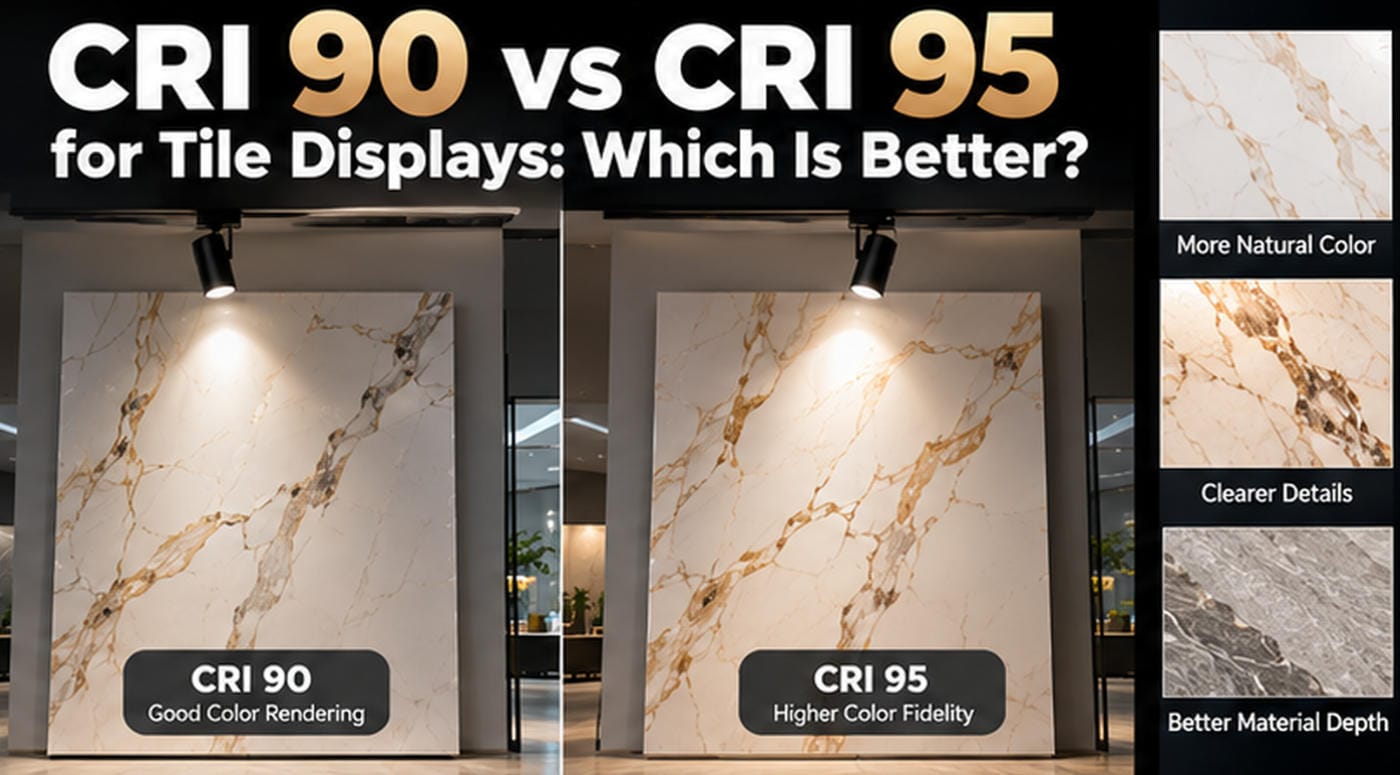
The U.S. Department of Energy notes that CRI is commonly used to describe color fidelity and that CRI 90 or above indicates excellent color fidelity, although more advanced metrics such as IES TM-30 can provide additional information about color rendering.
For this reason, SUNPOL generally recommends:
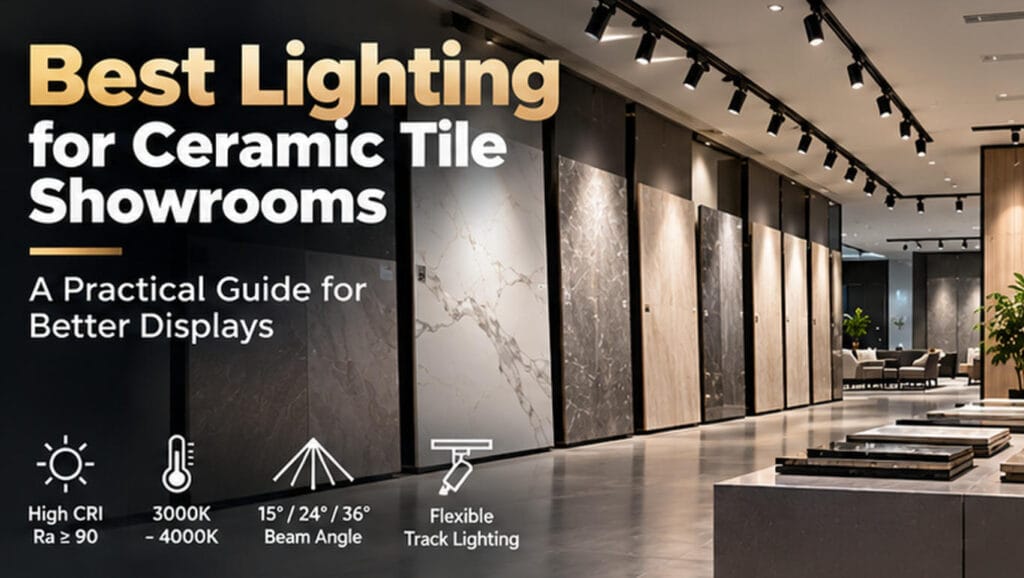
CRI Ra ≥90 for professional ceramic tile showroom lighting.
For premium applications where subtle color differences are especially important, higher color-rendering performance may be worth considering.
However, CRI should not be treated as the only measurement of quality.
Two fixtures with the same CRI can still produce noticeably different visual results because spectrum, optics, beam distribution and color consistency also matter.
Practical recommendation
Before finalizing a large order, test the actual fixture against real tile samples.
Evaluate at least:
- white tiles;
- beige or warm-toned materials;
- grey stone patterns;
- wood-look ceramic;
- marble-effect porcelain;
- glossy surfaces;
- matte surfaces.
This is more reliable than choosing lighting from specifications alone.
2. Choose the Right Color Temperature
There is no single perfect color temperature for every ceramic tile showroom.
In many projects, 3000K to 4000K provides a practical working range.
3000K
Warm white light can help create a more luxurious and comfortable atmosphere.
It often works well with:
- beige stone;
- warm marble;
- wood-look tiles;
- travertine;
- hospitality-inspired displays;
- residential bathroom scenes.
However, excessively warm illumination can change the perceived appearance of cool grey or white tiles.
3500K
For many material showrooms, 3500K offers a useful balance between warm atmosphere and relatively neutral material presentation.
It can work particularly well where the showroom contains both warm and cool collections.
4000K
Neutral white lighting can create a cleaner, more architectural impression.
It may suit:
- grey porcelain;
- concrete-effect tiles;
- white ceramic;
- contemporary stone finishes;
- minimalist showrooms.
The final decision should consider both the tile collection and the brand’s desired atmosphere.
Rather than asking:
“Which CCT is best?”
A better question is:
“Which CCT presents our actual materials most accurately while supporting the brand environment?”
3. Use Track Lighting for Flexibility
Ceramic tile showrooms change frequently.
New collections arrive. Feature walls are redesigned. Sample boards move. Large slabs are replaced. Seasonal products receive more attention.
Fixed lighting layouts can quickly become unsuitable.
This is why adjustable track lighting is one of the most practical choices for tile showrooms.
Track-mounted fixtures allow lighting teams to:
- reposition luminaires;
- change aiming direction;
- highlight new displays;
- adapt to different sample sizes;
- create new visual priorities without rebuilding the ceiling.
SUNPOL’s existing commercial track lighting range includes cylinder track lights, AI track lights and dedicated sintered-stone lighting products designed for adaptable commercial display applications.
For large showrooms that update their displays regularly, this flexibility can be more valuable than simply choosing the highest-output fixture.
4. Match Beam Angle to the Display
One of the most common mistakes in tile showroom lighting is using the same beam angle everywhere.
Different displays require different light distributions.
Narrow Beam: Approximately 15°
A narrow beam produces concentrated accent lighting.
It can be useful for:
- featured tile samples;
- decorative collections;
- small presentation areas;
- signage;
- focal points.
The disadvantage is that narrow beams can create obvious hotspots if they are used incorrectly on large surfaces.
Medium Beam: Approximately 24°
A medium beam is highly useful in commercial display environments because it balances concentration and coverage.
It may suit:
- individual tile panels;
- feature walls;
- medium-format display boards;
- general accent lighting.
Wider Beam: Approximately 36°
A wider beam is often more suitable for:
- large tile surfaces;
- broad display walls;
- general product presentation;
- areas requiring smoother illumination.
SUNPOL’s own tile showroom solution considers beam options such as 15°, 24° and 36°, selected according to tile size, mounting distance and desired presentation effect.
The exact beam should therefore be calculated according to the actual project—not selected purely from a catalogue.
5. Pay Special Attention to Vertical Illumination
Traditional lighting design often focuses heavily on horizontal illuminance at floor level.
That approach is insufficient for ceramic tile showrooms.
Why?
Because most of the merchandise customers evaluate is displayed vertically.
Large porcelain slabs may extend from close to floor level to several meters above it. If the fixture illuminates the upper section strongly but leaves the lower portion dark, the customer does not see the material evenly.
Vertical illumination therefore deserves special attention.
Good vertical lighting helps:
- maintain consistent brightness across tile walls;
- reveal patterns from top to bottom;
- make large-format materials easier to evaluate;
- increase the perceived brightness of the showroom without simply flooding the floor with light.
Lighting guidance has long recognized that illuminating vertical surfaces can contribute significantly to visual quality and uniformity rather than relying only on horizontal illumination.
For very large-format porcelain slabs and sintered stone, conventional spotlights alone may not always provide the ideal distribution.
This is where wider optics, wall washers, grille lighting or purpose-designed sintered stone lighting can become valuable.
SUNPOL’s dedicated tile showroom lighting solutions include vertical-lighting strategies specifically intended for ceramic tiles, porcelain and large-format slabs.
6. Control Glare on Glossy Tiles
Polished porcelain presents one of the biggest challenges in tile showroom lighting.
Its surface can behave almost like a mirror.
If a spotlight is installed at the wrong position, customers may see a bright reflected image of the luminaire instead of the tile itself.
This creates three problems:
- visual discomfort;
- reduced ability to see surface details;
- a lower-quality showroom appearance.
The solution is not simply to reduce brightness.
Glare control depends on the relationship between:
- fixture location;
- viewing position;
- beam angle;
- aiming direction;
- tile surface;
- display height.
Professional lighting design should therefore consider where customers are likely to stand when viewing the material.
Industry lighting projects frequently use mock-ups and aiming tests specifically to minimize unwanted reflections while maintaining accent lighting.
A simple rule
Do not aim a strong spotlight directly toward the most common customer viewing angle on highly polished tile.
Instead, position the fixture so that the useful light reaches the material while the strongest specular reflection is directed away from the viewer.
7. Reveal Texture, Not Just Color
Modern ceramic products increasingly imitate natural materials.
Examples include:
- stone;
- concrete;
- slate;
- wood;
- travertine;
- limestone;
- textured plaster.
Customers need to perceive both the color and the surface relief.
Uniform frontal illumination can sometimes make textured materials appear flatter than they really are.
Directional lighting can create subtle highlights and shadows that reveal depth.
This means textured display walls may benefit from light arriving at a considered angle rather than directly from the viewer’s position.
However, excessive grazing can exaggerate imperfections.
The correct solution depends on how strongly the manufacturer wants to emphasize surface structure.
For premium collections, physical mock-ups remain one of the safest methods of finding the right angle.
8. Large-Format Tiles Need a Different Approach
Large-format ceramic slabs and sintered stone have changed showroom lighting requirements.
A 300 × 300 mm sample and a 1.6 × 3.2 meter slab cannot be illuminated in the same way.
A single spotlight may create a bright area in the center while leaving the edges visibly darker.
For large slabs, designers should consider:
- greater vertical uniformity;
- appropriate setback distance;
- wider beam distributions;
- multiple coordinated fixtures;
- linear or grille lighting;
- dedicated large-surface illumination.
SUNPOL currently lists the SP-GD24062H62A1 Dual-Axis Sintered Stone Light within its tile showroom solution specifically for large-format vertical material displays, alongside track lights and grille track lighting for different display conditions.
This illustrates an important principle:
Do not select a fixture based only on wattage. Select it according to the geometry of the material being displayed.
9. Create Lighting Hierarchy
A showroom in which every square meter has the same brightness usually feels visually flat.
Premium retail lighting creates hierarchy.
There should be differences between:
- circulation areas;
- normal collections;
- feature collections;
- promotional zones;
- large architectural scenes;
- consultation areas.
Feature products can receive stronger contrast while background zones remain visually comfortable.
This guides attention naturally.
The Illuminating Engineering Society’s retail-lighting work specifically addresses techniques for highlighting merchandise while supporting overall retail presentation and brand image.
For ceramic brands, this means lighting can help communicate commercial priorities.
A flagship marble-effect collection does not have to receive the same visual emphasis as a standard sample rack.
Light can help tell customers where to look first.
10. Avoid Making the Whole Showroom Too Bright
More light does not always mean better presentation.
An excessively bright showroom can:
- reduce visual contrast;
- increase reflected glare;
- consume unnecessary energy;
- make premium display areas less distinctive;
- create visual fatigue.
Instead of maximizing lumens everywhere, design the showroom around contrast and controlled brightness.
Customers should comfortably move through the space while brighter focal areas attract their attention naturally.
This approach also gives architects and showroom designers more control over atmosphere.
11. Track Lights vs Recessed Spotlights: Which Is Better?
Both can work well, but they solve different design priorities.
Track Lights
Best when:
- displays change frequently;
- aiming flexibility is important;
- sample panels move;
- the showroom wants an industrial or technical ceiling language;
- future upgrades are expected.
Recessed Spotlights
Best when:
- the ceiling should look clean and minimal;
- display locations are relatively stable;
- the brand wants a premium architectural appearance;
- visual ceiling clutter should be minimized.
Many high-end showrooms use both.
Track lighting may serve flexible sample areas, while recessed lighting supports fixed lifestyle displays or reception zones.
12. Recommended Lighting Approach by Tile Type
| Tile Type | Main Lighting Priority | Recommended Approach |
|---|---|---|
| Polished porcelain | Glare control | Adjustable lighting with carefully controlled aiming |
| Matte ceramic | Color and texture | High-CRI medium-beam accent lighting |
| Marble-effect tile | Veining and color fidelity | CRI ≥90 with controlled directional lighting |
| Textured tile | Surface relief | Directional accent lighting |
| Large-format slab | Vertical uniformity | Wide-distribution or specialized slab lighting |
| Sintered stone | Texture + large-area coverage | Dedicated sintered-stone lighting / wall illumination |
| Wood-look tile | Warm material realism | High-CRI 3000–3500K depending on collection |
| Grey concrete tile | Neutral material appearance | High-CRI 3500–4000K depending on brand concept |
These should be treated as starting points rather than fixed rules.
Actual ceiling height, fixture setback, material reflectance and showroom layout can change the required solution considerably.
13. Common Ceramic Tile Showroom Lighting Mistakes
Several recurring problems can weaken an otherwise attractive showroom.
Mistake 1: Selecting Lights Only by Wattage
A 30W fixture is not automatically better than a 20W fixture.
Optics, beam distribution, efficiency and installation distance matter just as much.
Mistake 2: Ignoring Vertical Surfaces
Measuring only floor lux can completely miss poor tile-wall illumination.
Mistake 3: Using Low-CRI Lighting
Customers need to judge subtle material differences accurately.
Mistake 4: Using One Beam Angle Everywhere
Small samples and three-meter slabs require different optics.
Mistake 5: Installing Fixtures Before Testing Reflections
This is especially risky with polished porcelain.
Mistake 6: Making Everything Equally Bright
Without contrast, the showroom loses hierarchy.
Mistake 7: Designing a Fixed System for a Changing Showroom
Tile collections change frequently. The lighting system should be able to change with them.
14. How SUNPOL Approaches Ceramic Tile Showroom Lighting
SUNPOL focuses on professional lighting for tile, stone, bathroom and commercial display environments rather than treating ceramic showrooms as a generic retail application.
The process begins with the material and the space.
Key factors can include:
- showroom floor plan;
- ceiling height;
- tile dimensions;
- display-wall dimensions;
- surface finish;
- customer viewing positions;
- required color temperature;
- beam angle;
- collection hierarchy;
- future display changes.
SUNPOL then matches the application with suitable solutions such as adjustable track lights, high-CRI spotlights, grille track lights, recessed lighting and specialized large-format slab lighting.
The company currently shows ceramic tile projects including Dongpeng Tile and Marco Polo Tile within its project portfolio, supporting its specialization in this sector.
For buyers comparing suppliers rather than individual fixtures, our guide to the Top 10 Tile & Bathroom Showroom Lighting Manufacturers in China 2026 can also help explain what to evaluate when selecting a long-term showroom-lighting partner.
15. A Practical Specification Checklist
Before requesting a quotation from a lighting manufacturer, prepare the following information:
Showroom information
- floor plan;
- ceiling height;
- track or ceiling structure;
- display-wall height and width;
- customer circulation route.
Material information
- ceramic or porcelain;
- matte or polished finish;
- tile colors;
- surface texture;
- standard tile or large-format slab;
- sintered stone if applicable.
Lighting requirements
- preferred CCT;
- minimum CRI;
- dimming requirements;
- beam-angle preferences;
- control system;
- required certification.
Providing this information allows the lighting supplier to recommend an optical solution rather than simply quote a fixture.
Frequently Asked Questions
What CRI is best for a ceramic tile showroom?
CRI Ra ≥90 is a strong starting point for professional tile showrooms because accurate color rendering helps customers evaluate subtle differences in ceramic, porcelain and stone-look surfaces. The U.S. Department of Energy describes CRI 90+ as providing excellent color fidelity.
What color temperature is best for tile displays?
Most projects can start by evaluating 3000K, 3500K and 4000K. Warm collections often work well with warmer lighting, while grey and contemporary materials may benefit from more neutral light. Physical sample testing is recommended.
Are track lights good for ceramic tile showrooms?
Yes. Adjustable track lights are particularly useful because tile displays change frequently and track-mounted fixtures can be repositioned or re-aimed without major ceiling modifications.
What beam angle should be used for tile lighting?
There is no universal beam angle. Narrow beams such as 15° can highlight feature displays, medium beams such as 24° can serve individual display areas, and wider beams around 36° can support larger surfaces. Fixture distance and tile size should determine the final selection.
How do you reduce glare on polished tiles?
Control the relationship between the luminaire, tile and customer’s viewing position. Adjust fixture position and aiming so strong specular reflections are not directed toward the viewer.
What lighting is best for large porcelain slabs?
Large slabs generally require stronger vertical uniformity than small samples. Wider beam distributions, multiple coordinated fixtures, wall-washing solutions or purpose-designed sintered-stone lights may perform better than a single conventional spotlight.
Conclusion: The Best Tile Showroom Lighting Starts With the Material
The best lighting for a ceramic tile showroom is not necessarily the brightest fixture, the highest wattage or the most expensive spotlight.
It is the lighting system that allows the material to communicate its value.
For ceramic tile displays, that usually means combining:
- CRI ≥90 color quality;
- appropriate color temperature;
- carefully selected beam angles;
- strong vertical illumination;
- controlled glare;
- adjustable track lighting;
- dedicated solutions for large-format slabs;
- a clear hierarchy between general and featured collections.
Most importantly, lighting should be evaluated together with the actual tile.
A showroom sells materials through sight and touch. When customers can clearly see color, texture, gloss, depth and veining, they can understand the product more confidently.
That is where professional showroom lighting creates value.
At SUNPOL, our approach is simple:
Do not light the showroom first. Light the material first—and build the showroom experience around it.