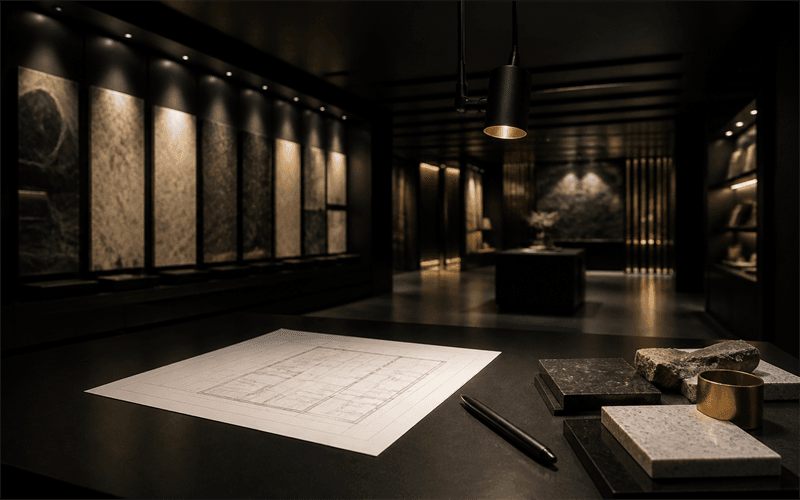
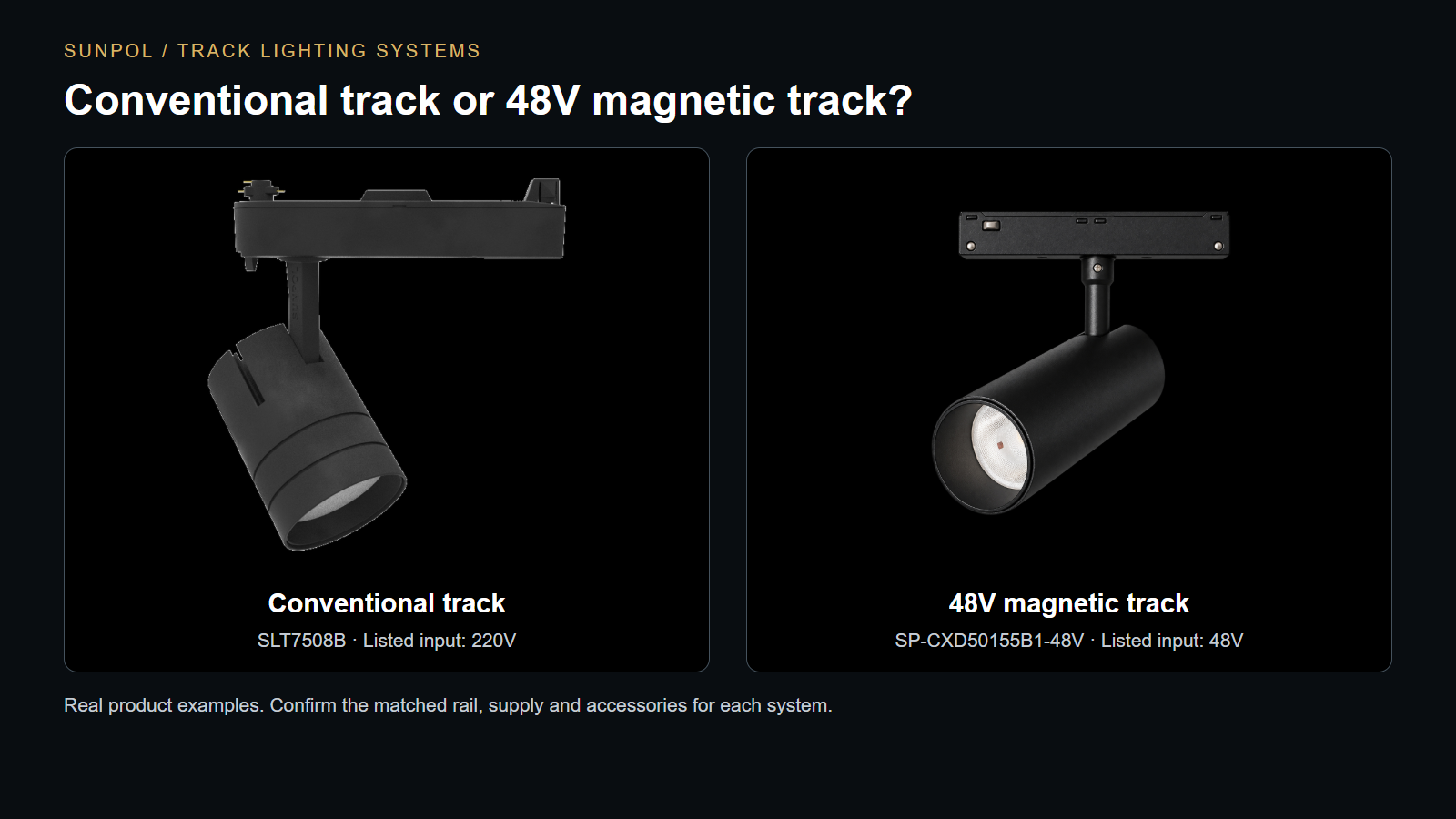

Choosing a track light for a commercial space involves more than comparing wattage, brightness or fixture design. In environments where customers evaluate products by color and material quality, the spectral characteristics of the light can make a noticeable difference.
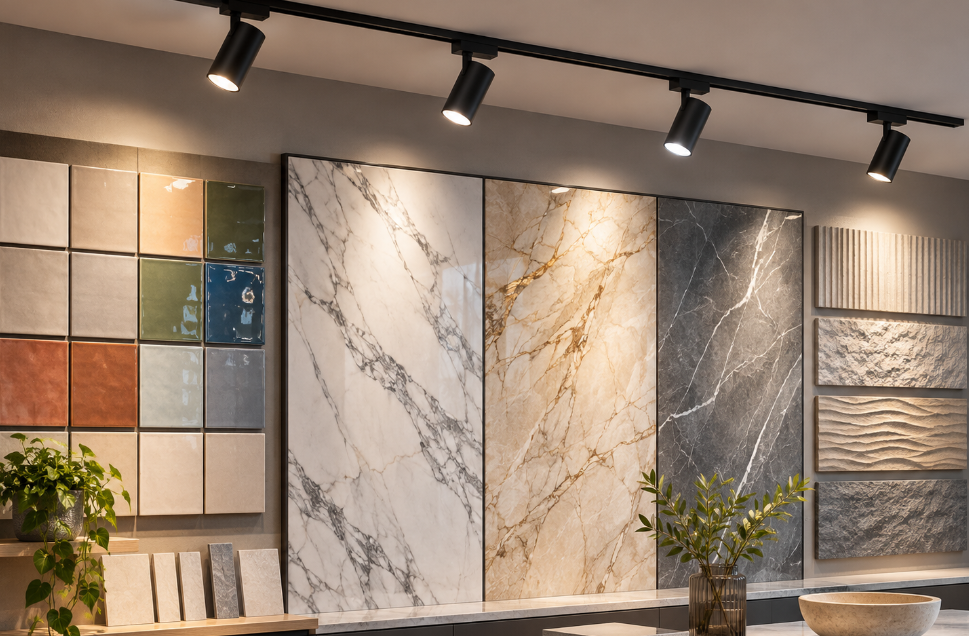
Consider a ceramic tile showroom. Two track lights may both offer 3000K color temperature and CRI 90, yet the same beige tile, marble-effect slab or wood-grain surface may look different under each fixture.
The reason is simple: a high CRI rating does not tell the entire story of color quality.
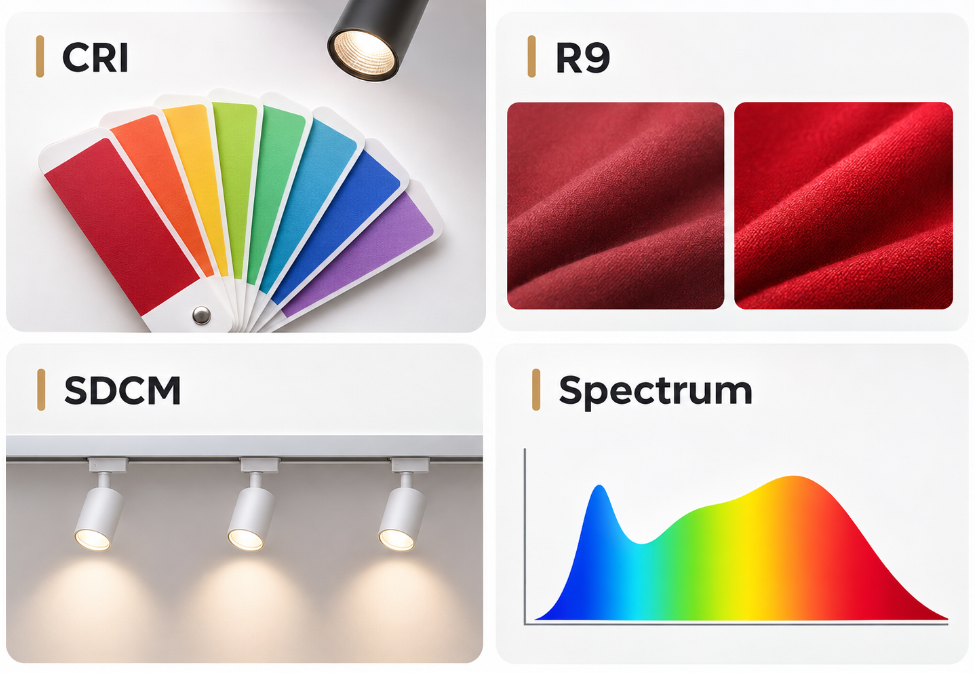
For lighting designers, distributors and commercial buyers, choosing the right high CRI track light means understanding several connected measurements: CRI Ra, R9, color consistency (SDCM) and spectral power distribution (SPD).
This guide explains how these measurements work, when they matter, and how to evaluate lighting for professional retail and showroom applications.

1. What Is a High CRI Track Light?
A high CRI track light is a track-mounted luminaire designed to reproduce object colors with relatively high fidelity compared with a standardized reference light source.
CRI stands for Color Rendering Index. The commonly quoted general color rendering index, Ra, summarizes the rendering performance of eight standardized, relatively low-saturation color samples.
Commercial LED track lights are often grouped into three broad performance categories:
| CRI Rating | General Interpretation | Typical Applications |
|---|---|---|
| Ra 80–89 | Standard color rendering | General commercial lighting |
| Ra 90–94 | High color rendering | Retail stores, showrooms, material displays |
| Ra 95+ | Very high color rendering | Color-critical displays, galleries, premium retail |
These categories are practical purchasing descriptions rather than strict guarantees of visual quality.
For many professional commercial displays, CRI Ra ≥90 is a useful starting requirement. However, a fixture with Ra 95 is not automatically superior to every Ra 90 fixture.
The actual result depends on the complete spectrum, the colors being illuminated and the surrounding lighting conditions.
2. Why CRI Alone Is Not Enough
Traditional CRI is an average measurement. This makes it convenient for product comparisons, but it also hides important differences.
Imagine two LED track lights:
- Light A: CRI Ra 90, with relatively weak saturated-red rendering.
- Light B: CRI Ra 90, with stronger saturated-red rendering.
Both meet the same general CRI requirement, but they may render certain red, brown, pink and warm-toned materials differently.
In a clothing boutique, these differences can affect how customers perceive garments.
In a tile showroom, they may influence the appearance of terracotta, beige stone, warm marble veining or wood-effect porcelain.
This is why a professional high CRI track light guide should examine individual color-rendering characteristics rather than relying exclusively on Ra.
CRI 90 vs CRI 95: Which Should You Choose?
CRI 95 may offer an advantage when subtle color differences are particularly important, provided the accompanying spectral performance supports that improvement.
However, moving from Ra 90 to Ra 95 should not be an automatic purchasing decision.
Compare the R9 value, available TM-30 data, color temperature, consistency and actual material appearance before paying for a higher CRI specification.
For many commercial showrooms, a carefully selected Ra 90 track light can provide excellent practical results.
3. Understanding R9: Why Red Rendering Matters
R9 is the special CRI test-color index for a saturated red sample.
Unlike the eight samples used to calculate general CRI Ra, R9 is not included in the traditional Ra average.
That distinction matters because a light source can achieve a high general CRI while performing less effectively with saturated reds.
Where R9 Makes a Difference
Red rendering deserves particular attention in environments displaying:
- Red and burgundy fabrics
- Leather furniture and accessories
- Terracotta and warm-toned ceramic tiles
- Wood finishes and reddish-brown materials
- Cosmetics, food and products involving skin-tone evaluation
For these applications, buyers should request the R9 measurement alongside the general CRI value.
An R9 value of 50 or higher can serve as a useful starting target for demanding commercial applications, while higher performance may be desirable for particularly color-sensitive displays.
These are project selection targets, not universal regulatory thresholds.
A key consideration: R9 measures fidelity for one specific red sample. It does not independently guarantee appealing or accurate rendering of every red or warm-toned material.
For more detailed analysis, TM-30 provides additional information about shifts in color fidelity and saturation.
4. SDCM: Why Identical Track Lights Can Look Different
Even when two track lights have the same wattage, nominal color temperature and CRI rating, their apparent white colors may not match perfectly.
This is where SDCM becomes important.
SDCM stands for Standard Deviation of Color Matching. It is commonly used to describe chromaticity variation through MacAdam ellipse steps.
A smaller SDCM specification generally indicates tighter chromaticity matching.
| SDCM | Practical Selection Consideration |
|---|---|
| ≤2 SDCM | Tight matching target for demanding installations |
| ≤3 SDCM | Common specification target for quality commercial lighting |
| 4–5 SDCM | Greater potential for noticeable differences |
| Above 5 SDCM | May be unsuitable for visually sensitive, uniform installations |
Perceptibility also depends on the viewing environment, fixture arrangement and color differences involved.
Why Color Consistency Matters in Showrooms
Picture a wall displaying several large white marble-effect porcelain slabs.
If adjacent track lights differ slightly in chromaticity, one section of the wall may appear warmer while another looks cooler.
Customers could interpret these differences as variations in the materials themselves.
This becomes especially problematic when comparing products side by side.
For premium showroom projects, specifying ≤3 SDCM is a reasonable starting point. A tighter target, such as ≤2 SDCM, may be appropriate when consistent appearance across many fixtures is critical.
Buyers should also distinguish initial color matching from long-term color stability. An initial SDCM specification does not guarantee that LED modules will age identically.
Ask suppliers about LED binning, production consistency and available color-maintenance test evidence.
5. Spectral Power Distribution: The Foundation of Color Rendering
CRI, R9 and color temperature are all connected to the spectrum produced by a light source.
Spectral Power Distribution, or SPD, describes how optical power is distributed across wavelengths.
Two LED lights can have the same nominal CCT and CRI while producing different spectral distributions.
For example, differences in the relative output across blue, green, yellow and red wavelengths can influence the appearance of colored surfaces.
This is particularly important because commercial displays contain materials with different spectral reflectance characteristics.
A spectrum that works well for white ceramic tiles may produce different visual results on dark wood, red fabrics or richly colored decorative stone.
Does Full-Spectrum LED Lighting Mean Better Color Quality?
Not necessarily.
The term “full spectrum” is frequently used in lighting marketing, but it does not by itself establish a standardized level of color fidelity.
A useful technical evaluation should consider measurable performance instead of relying on the phrase alone.
When selecting a high CRI track light, ask the manufacturer whether a measured SPD chart is available for the proposed LED configuration.
For demanding applications, compare spectra at the actual specified CCT rather than assuming all versions of a product family perform identically.
6. Why TM-30 Adds More Useful Color Information
For projects requiring detailed color evaluation, the ANSI/IES TM-30 method provides a broader description of light-source color rendition.
Two particularly useful measurements are:
TM-30 Rf — Color Fidelity
Rf describes the average similarity of rendered colors to their appearance under a reference illuminant.
Higher Rf generally indicates smaller average color differences relative to that reference.
TM-30 Rg — Color Gamut
Rg describes the average relative gamut area of rendered colors.
Values above 100 indicate an expanded average gamut relative to the reference, while values below 100 indicate a reduced average gamut.
A higher Rg value is not automatically better. The appropriate result depends on whether the project prioritizes fidelity, increased color vividness or a particular visual experience.
TM-30 also provides hue-specific information and a Color Vector Graphic, helping designers understand which color regions shift and in what direction.
For premium retail environments, these measurements can reveal meaningful differences between fixtures that share the same CRI rating.
The Illuminating Engineering Society provides detailed guidance on color rendition evaluation, including the practical use of TM-30.
7. Choosing the Right High CRI Track Light for Different Showrooms
Color quality requirements depend on the materials being displayed.
A single specification should not automatically be applied to every commercial project.
| Application | Recommended Evaluation Priorities |
|---|---|
| Ceramic tile showrooms | Ra ≥90, chromaticity consistency, spectral fidelity |
| Natural stone displays | Ra ≥90, SPD, CCT, controlled directional lighting |
| Fashion retail | Ra ≥90, R9, TM-30, material appearance |
| Furniture and wood displays | Ra ≥90, R9, warm-color rendering |
| Sanitaryware showrooms | Ra ≥90, SDCM, consistent white appearance |
| Art galleries | Object-specific fidelity, TM-30, illuminance and conservation requirements |
These are general project guidelines, not guarantees that a particular fixture will meet every application.
Ceramic Tile and Stone Showrooms
Tile displays are especially sensitive to lighting differences because customers often compare samples with small variations in hue, pattern and surface finish.
A high-CRI specification helps establish a suitable baseline, but appropriate lighting direction is equally important.
Textured surfaces need controlled highlights and shadows to reveal depth. Polished slabs require careful fixture positioning to avoid reflected glare.
For a complete application-based approach, explore SUNPOL’s commercial display lighting solutions, which address material presentation, beam distribution and showroom lighting layouts.
Retail and Fashion Stores
Fashion displays benefit from lighting that preserves important color distinctions across merchandise.
An R9 measurement can help identify weaknesses in saturated-red rendering, while TM-30 provides a more comprehensive assessment of color fidelity and gamut.
Adjustable track lighting is particularly useful when merchandise positions and promotional displays change regularly.
Furniture and Interior Material Displays
Wood, leather, textiles and decorative finishes respond differently to lighting spectra.
A warm color temperature may create an inviting atmosphere, but color temperature alone cannot establish accurate material reproduction.
For stores displaying multiple materials together, test sample fixtures under consistent viewing conditions before final selection.
8. SUNPOL High CRI Track Light Solutions
SUNPOL lighting focuses on professional illumination for commercial showrooms, retail spaces and material-focused displays.
Its published product range includes track lights with CRI Ra ≥90, offering flexible mounting and directional control.
Two examples illustrate different approaches to commercial display lighting.
SP-GD6290B2 Cylinder Track Light
The SUNPOL SP-GD6290B2 Cylinder Track Light offers several output and beam-angle configurations for commercial accent lighting.
Key published specifications include:
- Power options: 8W / 12W / 15W / 20W / 25W
- CRI: Ra ≥90
- Color temperature range: 2700K–6500K
- Beam angles: 15° / 24° / 36°
- Horizontal rotation: 350°
- Vertical tilt: 90°
- Maximum listed luminous flux: 2625 lm
These options allow lighting designers to select different distributions and outputs for product displays, tile showrooms and retail interiors.
The appropriate configuration should be chosen according to mounting distance, target dimensions and required illumination.
SP-GD8308B1AI 30W AI Track Light
For commercial projects requiring a 30W track-mounted luminaire, the SUNPOL SP-GD8308B1AI AI Track Light offers another option.
Its published specifications include:
- Rated power: 30W
- CRI: Ra ≥90
- Beam angle: 36°
- Luminous flux: 2250 lm
- Horizontal rotation: 350°
- Vertical tilt: 90°
- Compatible track options: T3, S3 and ultra-narrow track systems
The fixture is intended for applications including product display walls, commercial interiors and showrooms.
For either product, buyers requiring a specific R9 value, SDCM limit or TM-30 performance should request confirmation and supporting measurements for the exact configuration.
These additional metrics should not be assumed from the published Ra ≥90 rating.
Explore the broader SUNPOL commercial track lighting range to compare available fixture formats and configurations.
9. A Practical High CRI Track Light Buying Checklist
Before approving a commercial lighting supplier or placing a bulk order, ask for documentation covering the actual product configuration.
Color performance
- Confirm the rated CRI Ra value.
- Request R9 data for color-sensitive applications.
- Specify an acceptable SDCM target.
- Request the measured SPD and TM-30 report where needed.
- Verify that measurements correspond to the proposed CCT and LED module.
Optical and electrical performance
- Check beam angle and photometric distribution.
- Confirm actual luminous flux and efficacy.
- Evaluate glare and light uniformity.
- Verify track compatibility and electrical requirements.
- Review dimming and flicker performance where relevant.
Production quality
- Ask about LED binning and component traceability.
- Confirm whether production batches use consistent LED specifications.
- Request representative samples before bulk production.
- Establish acceptable color tolerances in the purchase specification.
For larger projects, buyers should evaluate multiple samples from the intended production configuration, not just a single demonstration fixture.
10. Common Mistakes When Buying High CRI Track Lights
The most expensive fixture is not necessarily the best choice.
Several selection mistakes are particularly common.
Choosing Ra 95 without checking additional metrics. A higher average CRI does not automatically guarantee superior rendering for every material.
Ignoring color consistency. Excellent individual fixtures can still create an uneven visual impression when adjacent luminaires have mismatched chromaticity.
Assuming all 3000K or 4000K LEDs look identical. Nominal CCT does not describe the complete spectral distribution.
Overlooking fixture positioning. Even a high-quality light source cannot compensate for severe glare or poor beam placement.
Buying without sample testing. Technical reports help narrow the options, but physical evaluation remains essential when customers must compare subtle material colors.
Color quality should always be considered alongside optical design, installation geometry and the intended viewing experience.
Frequently Asked Questions
Is CRI 90 good enough for commercial track lighting?
Yes. CRI Ra ≥90 is a useful starting specification for many premium commercial and showroom applications. However, buyers should also assess R9, color consistency and the actual appearance of displayed materials.
What is a good R9 value for LED track lights?
R9 ≥50 can serve as a practical starting target for applications where saturated-red rendering matters. More demanding projects may benefit from higher values and TM-30 analysis.
Is 2 SDCM better than 3 SDCM?
A 2 SDCM tolerance generally represents tighter chromaticity matching than 3 SDCM. It can be beneficial in premium installations where many adjacent luminaires illuminate uniform or light-colored surfaces.
Does full-spectrum lighting always have high CRI?
No. “Full spectrum” is not sufficient evidence of high color fidelity. Buyers should review measured CRI, SPD and, when available, TM-30 data.
Should I choose 3000K or 4000K for a showroom?
Both can work well. The correct choice depends on the displayed products, architectural atmosphere and desired viewing conditions.
For a more detailed comparison, read SUNPOL’s 3000K vs 4000K showroom lighting guide.
Conclusion: Look Beyond the CRI Number
A high CRI track light should do more than satisfy a specification on a product datasheet.
It should help customers evaluate colors, textures and finishes under reliable, well-controlled lighting conditions.
For professional commercial projects, the most effective selection process combines CRI Ra, R9, SDCM, spectral information and application-specific optical design.
This approach helps avoid mismatched fixtures, misleading material appearance and unnecessary upgrades based solely on headline specifications.
SUNPOL lighting supports commercial buyers and lighting designers with track lighting products and application-oriented showroom lighting solutions.
Whether the project involves ceramic tiles, sanitaryware, furniture or premium retail displays, the goal remains the same: select lighting based on how materials actually appear—not just the numbers printed on the packaging.
Looking for a high CRI track light for your next commercial project?
Contact SUNPOL to discuss your showroom layout, product materials, color quality requirements and suitable track lighting configurations. Request product samples and relevant test information before finalizing your lighting specification.