تدخل إضاءة صالات العرض التجارية مرحلة جديدة.
لسنوات عديدة، ركز تصميم إضاءة صالات العرض بشكل كبير على ثلاثة أسئلة: هل المساحة مضيئة بما فيه الكفاية؟ هل يبدو المنتج جاذباً؟ وهل يمكن لنظام الإضاءة أن يعمل بكفاءة؟
بحلول عام 2027، ستظل هذه الأسئلة مهمة، لكنها لن تكون كافية بعد الآن.
تتحول صالات العرض بشكل متزايد إلى بيئات تجارية مدفوعة بالتجربة حيث يجب أن تدعم الإضاءة عرض المنتجات وهوية العلامة التجارية والراحة البصرية وكفاءة الطاقة والمرونة في العرض وإدارة المباني الرقمية في الوقت نفسه.
تشير التطورات الأخيرة في تقنية LED وأنظمة التحكم في الإضاءة ومعايير جودة الألوان بالفعل في هذا الاتجاه. وفقاً لوكالة الطاقة الدولية (IEA)، استهلكت الإضاءة في المباني والتطبيقات الخارجية ما يقرب من 8% من الطلب العالمي على الكهرباء في عام 2024، أي ما يعادل حوالي 2,200 تيراواط ساعة. في الوقت نفسه، زادت مساحة المباني العالمية بأكثر من 20% خلال العقد الماضي بينما ظل استهلاك الكهرباء لإضاءة المباني مستقراً نسبياً، ويرجع ذلك largely إلى التحسينات في كفاءة الإضاءة.
مع أصبحت كفاءة LED خط الأساس بدلاً من عامل التمييز، يتحول سوق إضاءة صالات العرض التجارية نحو سؤال جديد:
كيف يمكن للضوء أن يصبح جزءاً أكثر ذكاءً من بيئة التجزئة والعرض؟
فيما يلي اتجاهات إضاءة صالات العرض التجارية التي من المرجح أن تشكل المشاريع في عام 2027.
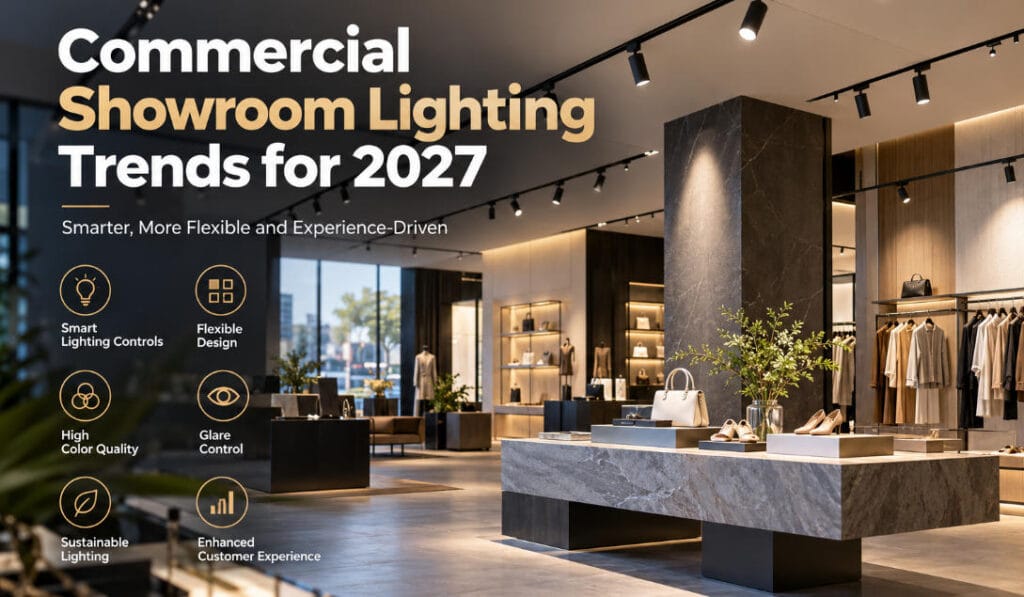
1. ستنتقل إضاءة صالات العرض من الإضاءة العامة إلى الإضاءة متعددة الطبقات
أحد أوضح التغييرات في تصميم صالات العرض الحديثة هو تراجع الإضاءة الموحدة.
غالباً ما اعتمدت المساحات التجارية التقليدية بشكل كبير على إضاءة السقف الموزعة بالتساوي. يوفر هذا النهج إضاءة كافية، لكنه يمكن أن يجعل المنتجات والتفاصيل المعمارية ومناطق العرض مسطحة بصرياً.
في عام 2027، سيتجه تصميم إضاءة صالات العرض بشكل متزايد إلى استخدام طبقات إضاءة متعددة.
قد يجمع مفهوم الإضاءة النموذجي بين:
- الإضاءة المحيطة للرؤية العامة؛;
- الإضاءة المركزة للبضائع والعروض؛;
- غسل الجدران للأسطح الرأسية؛;
- الإضاءة ذات الشعاع الضيق للمنتجات عالية القيمة؛;
- الإضاءة الزخرفية لأجواء العلامة التجارية؛;
- الإضاءة المعمارية للحركة وتحديد المساحة.
الهدف ليس ببساطة إنشاء المزيد من الضوء. بل هو إنشاء تسلسل هرمي بصري.
يجب أن يفهم العملاء بشكل حدسي أين ينظرون أولاً، وما هي المنتجات المهمة، وكيفية التنقل عبر صالة العرض.
هذا مهم بشكل خاص في صالات عرض الأزياء ومتاجر الأثاث ووكالات السيارات وعروض المجوهرات والمعارض وبيئات المنتجات الفاخرة.
التركيبات القابلة للتعديل مثل أضواء المسار التجارية مناسبة تماماً لهذا النهج لأن اتجاه الإضاءة يمكن تغييره مع تطور العروض والتخطيطات ومجموعات المنتجات.
2. ستبقى الإضاءة المرنة على المسار محورية في تصميم صالات العرض
أصبح من الصعب بشكل متزايد تبرير تخطيطات الإضاءة الدائمة في صالات العرض التجارية.
تتغير الحملات التجارية. تتحرك العروض. تصل مجموعات منتجات جديدة. يتم إعادة تنظيم مناطق المعارض.
لذلك تحتاج الإضاءة إلى التغيير مع البضائع.
توفر إضاءة المسار ميزة مهمة لأن التركيبات يمكن إعادة وضعها أو توجيهها أو استبدالها دون إعادة تصميم نظام إضاءة السقف بالكامل.
بالنسبة للمشاريع التجارية في عام 2027، ستصبح المرونة بشكل متزايد جزءاً من مواصفات الإضاءة بدلاً من كونها ميزة اختيارية.
بدلاً من السؤال فقط:
“كم واط تستهلك هذه التركيبة؟”
سيسأل المصممون والمقاولون بشكل متزايد:
“ما مدى سهولة تكيف نظام الإضاءة هذا خلال السنوات الخمس القادمة؟”
على سبيل المثال، التركيبات الأسطوانية القابلة للتعديل مثل SP-GD5068B2 ضوء مسار أسطواني يمكن دمجها في تخطيطات موجهة نحو العرض حيث تكون الإضاءة الاتجاهية والاتساق البصري مهمين.
بالنسبة للبيئات التجارية الأكبر أو المتغيرة بشكل متكرر، يمكن لأنظمة المسار أيضاً تقليل الحاجة إلى تعديلات متكررة على السقف عند تغير تخطيطات العرض.
النتيجة هي بنية تحتية للإضاءة مصممة حول التغيير بدلاً من الدوام.
3. ستصبح أنظمة التحكم الذكية في الإضاءة أكثر أهمية من كفاءة التركيبات وحدها
ركز التحول الأول في LED بشكل أساسي على استبدال مصادر الضوء غير الفعالة.
التحول التالي يتعلق بشكل متزايد بالتحكم في تلك المصابيح LED بذكاء.
وصفت وكالة الطاقة الدولية هذا التطور في عام 2026 بأنه بداية موجة ثانية من نشر الإضاءة تتمحور حول أنظمة أكثر ذكاءً وكفاءة واستدامة.
بالنسبة لصالات العرض، يعني هذا أن أنظمة الإضاءة المستقبلية قد تتضمن بشكل متزايد:
- التحكم في المشاهد؛;
- التعتيم المجدول؛;
- استشعار الإشغال؛;
- الاستفادة من ضوء النهار؛;
- العنونة الفردية لوحدات الإضاءة؛;
- مراقبة الطاقة؛;
- التشغيل عن بُعد؛;
- بيانات الصيانة التنبؤية؛;
- التكامل مع أنظمة إدارة المباني.
توضح تقنية DALI هذا التحول بوضوح. تسمح مواصفات بيانات DALI الحديثة لمشغلات LED المتوافقة بالإبلاغ عن معلومات موحدة تتعلق بأداء وحدة الإضاءة واستهلاك الطاقة والتشخيصات والصيانة.
تتطور الإضاءة الشبكية اللاسلكية بالتوازي مع ذلك.
على سبيل المثال، يتيح التحكم في الإضاءة الشبكية عبر Bluetooth وحدات إضاءة قابلة للعنونة فردياً وشبكات قائمة على الاستشعار يمكنها التفاعل مع ظروف الإشغال وضوء النهار مع تزويد أنظمة المباني بالبيانات التشغيلية.
بالنسبة لأصحاب صالات العرض، لذلك، قد تعتمد قيمة وحدة الإضاءة في عام 2027 بشكل متزايد ليس فقط على مدى كفاءة إنتاجها للضوء، بل أيضاً على مدى ذكاء إمكانية إدارة ذلك الضوء.
4. مشاهد الإضاءة الديناميكية ستدعم وظائف مختلفة لصالة العرض
نادراً ما تخدم صالة العرض التجارية غرضاً واحداً فقط على مدار اليوم.
قد تُستخدم المساحة نفسها لتصفح المنتجات العادي في الصباح، وعروض العملاء في فترة ما بعد الظهر، والفعاليات الترويجية في المساء.
قد يؤدي استخدام مستوى إضاءة ثابت واحد لكل سيناريو إلى الحد من التجربة البصرية وكفاءة الطاقة معاً.
توفر الإضاءة القائمة على المشاهد نهجاً آخر.
قد تستخدم صالة العرض إعدادات مختلفة مثل:
وضع العرض اليومي
إضاءة محيطة ومركزة متوازنة لحركة العملاء العادية.
وضع المنتجات المميزة
إضاءة محيطة مخففة مقترنة بإضاءة مركزة أقوى لزيادة التباين البصري.
وضع العرض التقديمي
مستويات إضاءة منخفضة حول الشاشات الرقمية مع الحفاظ على الإضاءة المناسبة للمنتجات ومسارات الحركة.
وضع الفعاليات
تباين أكثر دراماتيكية، وإضاءة مميزة مختارة، ودرجة حرارة لون معدلة.
وضع التنظيف أو الصيانة
إضاءة عامة عالية لعمليات الموظفين.
بدلاً من التعامل مع الإضاءة كخدمة بناء ثابتة، يمكن للمصممين بالتالي التعامل معها كجزء قابل للبرمجة من تجربة العملاء.
المنتجات المصممة للتحكم الذكي، مثل SP-GD8308B1AI 30W ضوء مسار ذكي, ، تعكس أيضاً الاتجاه الأوسع في السوق نحو الإضاءة التجارية القابلة للتحكم والتكيف.
5. جودة الألوان ستتجاوز مجرد رقم CRI بسيط
كان تجسيد الألوان دائماً مهماً في إضاءة صالات العرض.
يريد بائع تجزئة الملابس أن تبدو الأقمشة واقعية. تحتاج صالة عرض الأثاث إلى أن تحتفظ الأخشاب والحجر والتنجيد بطابعها. يجب أن تكشف طلاءات السيارات عن تغيرات دقيقة في الأسطح المعدنية. أما الأعمال الفنية ومستحضرات التجميل والمجوهرات فتُدخل متطلبات لونية أكثر صرامة.
تاريخياً، اعتمدت العديد من المواصفات بشكل أساسي على CRI.
ومع ذلك، يستخدم متخصصو الإضاءة بشكل متزايد أساليب أكثر تطوراً لتقييم تجسيد الألوان.
تُدرج جمعية الهندسة الإضاءة حالياً ANSI/IES TM-30-24 ضمن وثائقها التقنية النشطة المتعلقة بالألوان. بالإضافة إلى ذلك، يوفر دليل الممارسات الإضائية لعام 2026، ANSI/IES LP-30-26، إرشادات لدمج مقاييس TM-30 في مواصفات الإضاءة وعمليات التصميم.
يتيح TM-30 للمصممين تقييم خصائص مثل دقة الألوان ونطاق الألوان بدلاً من الاعتماد كلياً على قيمة CRI تقليدية واحدة.
بالنسبة لمشاريع صالات العرض، يعد هذا مهماً لأن مصدرين للضوء بقيم CRI رئيسية متشابهة يمكن أن يخلقا مع ذلك انطباعات بصرية مختلفة بشكل ملحوظ.
بحلول عام 2027، من المرجح بالتالي أن تركز مواصفات صالات العرض المهنية بشكل متزايد على السلوك الطيفي العام وتجسيد الألوان لمصدر الضوء, ، لا سيما بالنسبة للبضائع المميزة.
6. التحكم الأفضل في الوهج سيصبح علامة على إضاءة صالات عرض أعلى جودة
السطوع وحده لا يخلق إضاءة تجزئة جيدة.
يمكن لوحدات الإضاءة غير المُحكمة بشكل جيد أن تخلق وهجاً غير مريح، خاصة عندما تُثبَّت أضواء كاشفة عالية الإخراج على مستوى عين العميل أو تنعكس على الأسطح الزجاجية أو الحجر المصقول أو المعدن أو أسطح السيارات.
This becomes particularly important as showroom interiors increasingly use reflective materials and minimalist architectural finishes.
The trend toward better visual comfort is also visible in broader building standards. WELL lighting guidance, for example, includes considerations related to brightness management, electric-light glare control and visual comfort.
As a result, commercial lighting specifications are increasingly likely to consider:
- deep anti-glare optics;
- controlled cut-off angles;
- appropriate beam distributions;
- shielding accessories;
- fixture positioning;
- luminance contrast;
- reflected glare from merchandise.
The best showroom lighting in 2027 will not necessarily be the brightest.
It will be the lighting that directs brightness precisely where it adds value.
7. Smaller Fixtures and Cleaner Ceilings Will Gain Importance
Showroom architecture is becoming increasingly minimal.
Designers often want customers to notice merchandise and materials rather than bulky ceiling equipment.
This creates demand for smaller luminaires with more precise optical performance.
Compact track lights, recessed spotlights and cylinder fixtures can help reduce visual clutter while maintaining strong accent illumination.
The lighting fixture effectively becomes part of the architecture rather than an independent visual object.
For projects where designers want the lighting hardware to remain visible but visually restrained, products such as the SP-GD6290B2 إضاءة مسار أسطوانية can fit naturally within contemporary commercial environments.
At the same time, completely hiding fixtures is not always the objective.
Some brands intentionally use visible track systems as part of an industrial or technical aesthetic.
The key trend is therefore not invisibility itself, but greater integration between lighting hardware and interior architecture.
8. Material-Specific Lighting Will Become More Sophisticated
Different materials respond differently to light.
Stone needs texture.
Metal needs highlights.
Wood benefits from controlled warmth.
Textiles depend heavily on accurate color reproduction.
Glass requires careful glare and reflection management.
For this reason, future showroom projects will increasingly move away from choosing one universal beam angle and color temperature for an entire space.
Instead, lighting designers may select different optical strategies according to the displayed material.
A narrow beam can emphasize a small object.
A medium beam can illuminate furniture or mannequins.
Wall washing can improve vertical presentation.
Grazing light can reveal stone textures.
This approach is especially relevant for architectural-material showrooms.
For example, lighting solutions developed for surfaces such as sintered stone can help designers explore the relationship between directional light, texture and material presentation. SUNPOL’s SP-QD6290B1AI إضاءة الحجر الملبد is one example of a product positioned around this type of application.
In 2027, specifying fixtures by display material and visual objective rather than simply by room type is likely to become increasingly important.
9. Lighting Will Become Part of Building Data Infrastructure
One of the most important long-term developments in commercial lighting is easy to overlook.
A connected luminaire is no longer only a source of illumination.
It can also become a node within a building network.
DALI-enabled systems can provide standardized energy and diagnostic information, while networked lighting systems can incorporate occupancy, daylight and environmental sensing.
This information can support:
- energy management;
- predictive maintenance;
- occupancy analysis;
- space utilization;
- HVAC optimization;
- fault identification;
- facility management.
The convergence is already becoming visible. In August 2026, the Bluetooth SIG highlighted projects connecting networked lighting control with HVAC systems so that building services can respond dynamically to occupancy and environmental conditions.
For large commercial showrooms, dealerships and brand experience centers, this creates a significant shift.
Lighting infrastructure can become part of the wider smart-building nervous system.
10. Sustainability Will Move From “LED Efficiency” to Lifecycle Efficiency
Choosing LED lighting is no longer enough to establish a strong sustainability strategy.
LED has already become the dominant technology in many lighting applications.
The next stage involves considering the complete lifecycle of the lighting system.
That includes:
- luminaire efficacy;
- intelligent controls;
- replaceable components;
- driver accessibility;
- system interoperability;
- product lifespan;
- maintenance requirements;
- future reconfiguration;
- material use;
- end-of-life considerations.
This transition is particularly important for commercial interiors because refurbishment cycles can be relatively short.
If an entire luminaire system must be removed whenever a showroom layout changes, the environmental benefit of high operating efficiency may be partially offset by material waste.
Open and interoperable control systems may also help extend system life. The DALI Alliance, for example, emphasizes interoperability, upgradeability, energy monitoring and long-term system compatibility as important elements of modern lighting infrastructure.
For showroom owners, sustainability will therefore become increasingly connected to how long a system remains useful, not simply how many lumens per watt it produces.
11. Human-Centric Principles Will Influence Commercial Spaces—But With Greater Scientific Discipline
“Human-centric lighting” has been heavily marketed during the past decade.
In 2027, the concept is likely to become more technically disciplined.
The International Commission on Illumination (CIE) updated its position on integrative lighting in 2024, emphasizing that lighting for human well-being should be considered together with visual, energy, architectural and environmental requirements rather than treated as a standalone formula.
That distinction matters for commercial showrooms.
Instead of assuming that simply changing color temperature automatically creates healthier lighting, designers are likely to consider a broader combination of:
- الراحة البصرية؛;
- daylight exposure;
- glare;
- الإضاءة العمودية؛;
- time of exposure;
- intensity;
- spectral characteristics;
- customer and employee requirements.
In other words, 2027 showroom lighting will increasingly focus on appropriate light at the appropriate place and time, rather than relying on simplified marketing claims.
12. Showroom Lighting Will Be Designed Around Experience, Not Lux Alone
Lux remains essential.
But it cannot describe the entire experience of a commercial space.
Two showrooms can have exactly the same average illuminance while feeling completely different.
One may appear flat and visually tiring.
The other may feel premium, comfortable and carefully curated.
The difference often comes from contrast, vertical illumination, color quality, beam control, material interaction and lighting hierarchy.
This explains why the direction of commercial lighting is moving from quantitative illumination toward qualitative visual experience.
The goal is no longer simply:
Illuminate the showroom.
The goal is:
Use light to guide attention, communicate brand identity and make products easier to understand.
That principle is likely to define many of the strongest showroom lighting projects in 2027.
What Should Showroom Owners Consider for 2027 Projects?
For businesses planning a new showroom or renovation, the specification process should begin with the commercial objective rather than the fixture catalogue.
Consider:
- Which products should receive the highest visual priority?
- How frequently will displays change?
- Which materials require specialized lighting?
- Is high color fidelity important?
- Is glare likely to occur on reflective products?
- Will lighting scenes change during the day?
- Should the lighting system integrate with sensors or building controls?
- Can fixtures and drivers be maintained or replaced easily?
- Will the lighting layout remain useful if the showroom changes?
- Can energy consumption be measured and optimized?
Answering these questions early can produce a lighting system that remains relevant far longer than a system designed only around initial illuminance calculations.
الخاتمة
Commercial showroom lighting in 2027 will not be defined by one revolutionary luminaire.
Instead, the industry is moving toward a combination of better optics, flexible track systems, intelligent controls, advanced color evaluation, lower glare, data connectivity and lifecycle-oriented design.
LED efficiency remains important, but it is increasingly becoming the starting point.
The competitive difference will come from what happens after the LED is switched on: how accurately the light is controlled, where it is directed, how it interacts with products and materials, how easily it adapts to changing displays and how effectively it communicates with the wider building.
For retailers, designers, architects and commercial project contractors, this means lighting should increasingly be considered part of the complete showroom experience rather than simply another electrical system.
For companies developing new commercial display environments, سانبول لايتينغ provides commercial lighting solutions for applications ranging from track lighting and accent lighting to specialized product-display illumination.
Data & Industry Sources
1. International Energy Agency (IEA) — “The Next Wave of LED Lighting: Smarter, Circular and More Efficient,” March 6, 2026.
The IEA reports that lighting in buildings and outdoor applications represented approximately 8% of global electricity demand in 2024, or about 2,200 TWh. It also notes that global building floor area increased by more than 20% over the previous decade while lighting electricity use remained comparatively stable.
2. International Energy Agency — Energy Efficiency 2025.
The IEA reports that buildings account for approximately 30% of global energy demand, with commercial and public buildings accounting for roughly 30% of building energy demand.
3. DALI Alliance — DALI Data Specifications.
DALI Parts 251, 252 and 253 standardize luminaire, energy and diagnostic information that can be communicated through compatible lighting-control networks.
4. DALI Alliance — Sustainability and Lighting-Control Materials.
DALI documentation highlights occupancy sensing, daylight harvesting, automated dimming, energy monitoring and system interoperability as tools for improving commercial lighting efficiency and lifecycle management.
5. Bluetooth SIG — Bluetooth Networked Lighting Control.
Bluetooth NLC documentation describes individually addressable, sensor-rich commercial lighting networks capable of occupancy monitoring, daylight-responsive control and integration with wider building systems.
6. Bluetooth SIG — Networked Lighting Control and HVAC Integration, August 27, 2026.
The organization documents the growing integration of occupancy-aware lighting networks with HVAC and wider building-management functions.
7. Illuminating Engineering Society — ANSI/IES TM-30-24 and ANSI/IES LP-30-26.
IES technical materials demonstrate the industry’s continued development of more comprehensive methods for specifying and evaluating light-source color rendition beyond reliance on conventional CRI alone.
8. International Commission on Illumination (CIE) — Position Statement on Integrative Lighting, 2024.
CIE emphasizes balancing human well-being considerations with visual, architectural, environmental and energy requirements when applying integrative lighting principles.