Commercial showroom lighting is entering a new stage.
For years, showroom lighting design was largely focused on three questions: Is the space bright enough? Does the product look attractive? And can the lighting system operate efficiently?
By 2027, those questions will still matter, but they will no longer be enough.
Showrooms are increasingly becoming experience-driven commercial environments where lighting must support product presentation, brand identity, visual comfort, energy efficiency, flexible merchandising and digital building management at the same time.
Recent developments in LED technology, lighting controls and color-quality standards already point in this direction. According to the International Energy Agency (IEA), lighting in buildings and outdoor applications accounted for approximately 8% of global electricity demand in 2024, equivalent to around 2,200 TWh. At the same time, the global building floor area has increased by more than 20% over the past decade while electricity consumption for building lighting has remained comparatively stable, largely because of improvements in lighting efficiency.
As LED efficiency becomes the baseline rather than the differentiator, the commercial showroom lighting market is shifting toward a new question:
How can light become a more intelligent part of the retail and display environment?
Here are the commercial showroom lighting trends likely to shape projects in 2027.
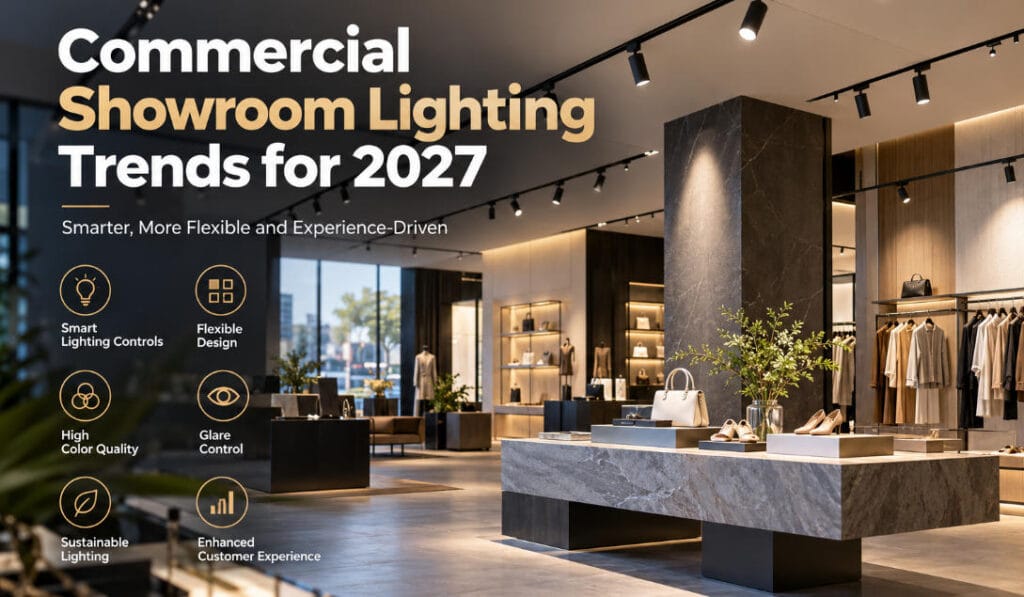
1. Showroom Lighting Will Move From General Illumination to Layered Lighting
One of the clearest changes in modern showroom design is the decline of uniform lighting.
Traditional commercial spaces often depended heavily on evenly distributed ceiling lighting. This approach provides sufficient illumination, but it can make products, architectural details and display zones visually flat.
In 2027, showroom lighting design will increasingly use multiple lighting layers.
A typical lighting concept may combine:
- ambient lighting for general visibility;
- accent lighting for merchandise and displays;
- wall washing for vertical surfaces;
- narrow-beam lighting for high-value products;
- decorative lighting for brand atmosphere;
- architectural lighting for circulation and spatial definition.
The objective is not simply to create more light. It is to create visual hierarchy.
Customers should intuitively understand where to look first, which products are important and how to move through the showroom.
This is particularly important in fashion showrooms, furniture stores, automobile dealerships, jewelry displays, galleries and premium product environments.
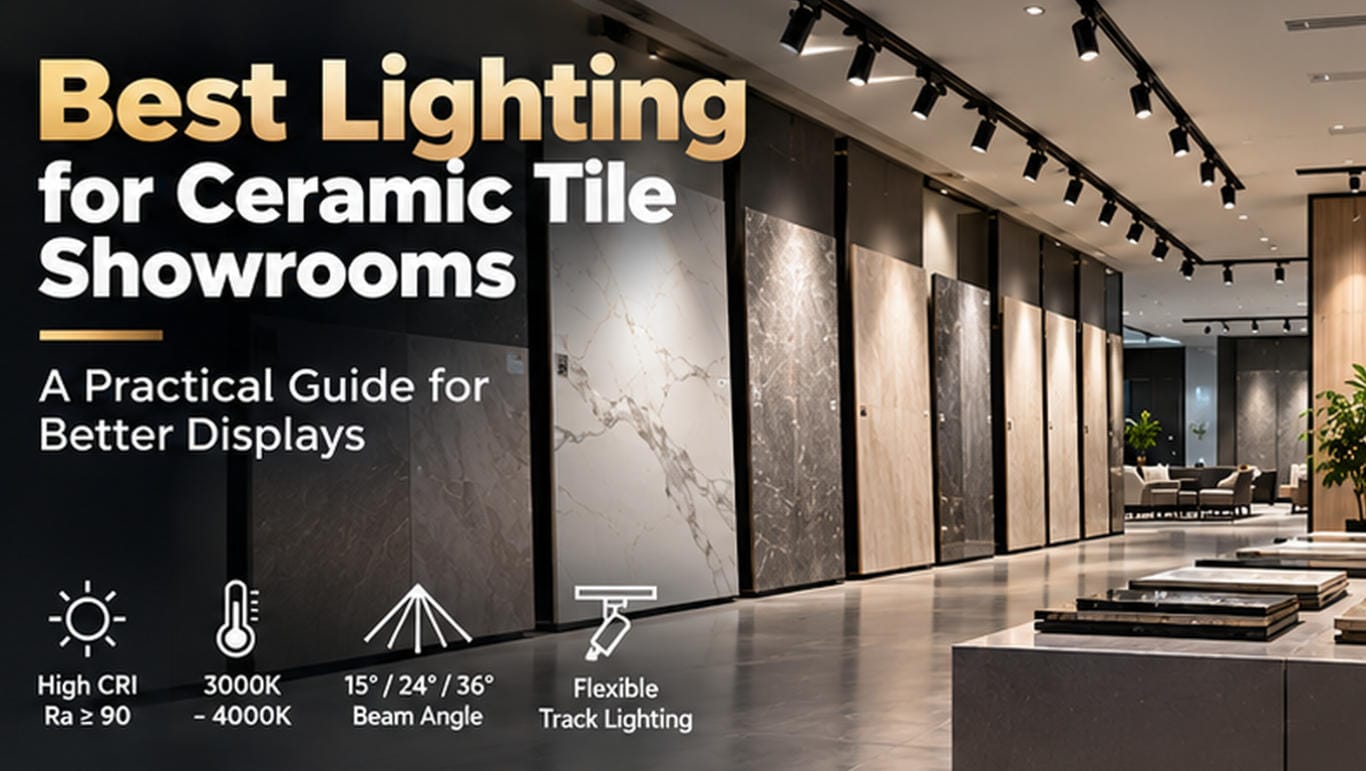
Adjustable fixtures such as commercial track lights are well suited to this approach because lighting direction can be changed as displays, layouts and product collections evolve.
2. Flexible Track Lighting Will Remain Central to Showroom Design
Permanent lighting layouts are becoming increasingly difficult to justify in commercial showrooms.
Retail campaigns change. Displays move. New product collections arrive. Exhibition areas are reorganized.
Lighting therefore needs to change with the merchandise.
Track lighting provides an important advantage because fixtures can be repositioned, redirected or replaced without redesigning the entire ceiling lighting system.
For commercial projects in 2027, flexibility will increasingly become part of the lighting specification rather than an optional benefit.
Instead of asking only:
“How many watts does this fixture use?”
designers and contractors will increasingly ask:
“How easily can this lighting system adapt during the next five years?”
For example, adjustable cylinder-style fixtures such as the SP-GD5068B2 Cylinder Track Light can be incorporated into display-oriented layouts where directional lighting and visual consistency are important.
For larger or frequently changing commercial environments, track systems can also reduce the need for repeated ceiling modifications when merchandising layouts change.
The result is a lighting infrastructure designed around change rather than permanence.
3. Smart Lighting Controls Will Become More Important Than Fixture Efficiency Alone
The first LED transformation focused primarily on replacing inefficient light sources.
The next transformation is increasingly about controlling those LEDs intelligently.
The IEA described this development in 2026 as the beginning of a second wave of lighting deployment centered on systems that are smarter, more efficient and more circular.
For showrooms, this means future lighting systems may increasingly include:
- scene control;
- scheduled dimming;
- occupancy sensing;
- daylight harvesting;
- individual luminaire addressing;
- energy monitoring;
- remote commissioning;
- predictive maintenance data;
- integration with building management systems.
DALI technology illustrates this shift clearly. Modern DALI data specifications allow compatible LED drivers to report standardized information related to luminaire performance, energy consumption, diagnostics and maintenance.
Wireless networked lighting is developing in parallel.
Bluetooth Networked Lighting Control, for example, enables individually addressable luminaires and sensor-based networks that can react to occupancy and daylight conditions while supplying operational data to building systems.
For showroom owners, therefore, the value of a luminaire in 2027 may increasingly depend not only on how efficiently it produces light, but also on how intelligently that light can be managed.
4. Dynamic Lighting Scenes Will Support Different Showroom Functions
A commercial showroom rarely serves only one purpose throughout the day.
The same space may be used for normal product browsing during the morning, customer presentations during the afternoon and promotional events in the evening.
Using one fixed lighting level for every scenario can limit both visual experience and energy efficiency.
Scene-based lighting provides another approach.
A showroom might use different settings such as:
Daily Display Mode
Balanced ambient and accent lighting for normal customer traffic.
Premium Product Mode
Reduced ambient illumination combined with stronger accent lighting to increase visual contrast.
Presentation Mode
Lower lighting levels around digital screens while maintaining appropriate illumination on products and circulation paths.
Event Mode
More dramatic contrast, selected feature lighting and adjusted color temperature.
Cleaning or Maintenance Mode
High general illumination for staff operations.
Instead of treating lighting as a static building service, designers can therefore treat it as a programmable part of the customer experience.
Products designed for intelligent control, such as the SP-GD8308B1AI 30W AI Track Light, also reflect the broader market direction toward controllable and adaptable commercial lighting.
5. Color Quality Will Move Beyond a Simple CRI Number
Color rendering has always been important in showroom lighting.
A clothing retailer wants fabrics to appear believable. A furniture showroom needs wood, stone and upholstery to retain their character. Automotive finishes must reveal subtle changes in metallic surfaces. Artwork, cosmetics and jewelry introduce even more demanding color requirements.
Historically, many specifications have relied primarily on CRI.
However, lighting professionals are increasingly using more sophisticated approaches to evaluating color rendition.
The Illuminating Engineering Society currently lists ANSI/IES TM-30-24 among its active color-related technical documents. In addition, its 2026 lighting practice guide, ANSI/IES LP-30-26, provides guidance for incorporating TM-30 metrics into lighting specification and design processes.
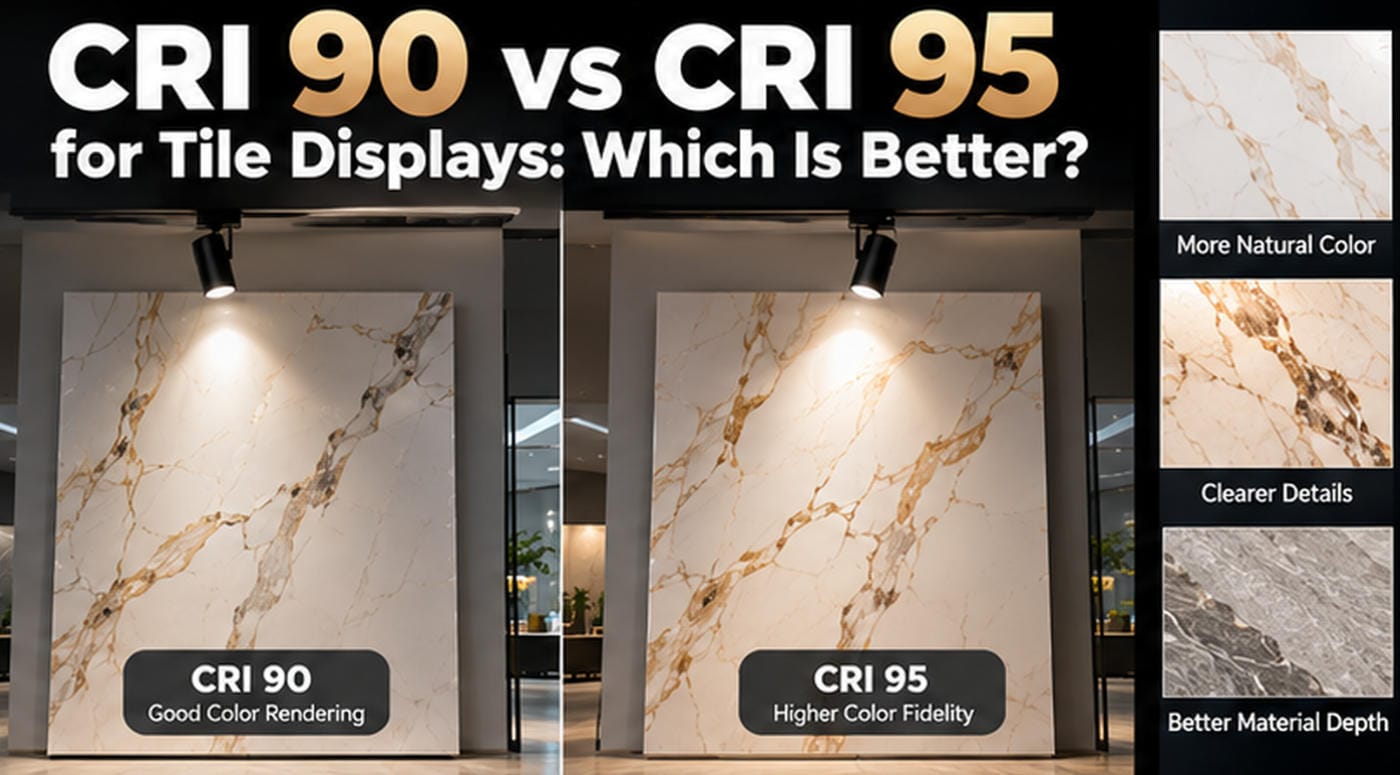
TM-30 allows designers to evaluate characteristics such as color fidelity and gamut rather than depending entirely on one traditional CRI value.
For showroom projects, this matters because two light sources with similar headline CRI values can still create noticeably different visual impressions.
By 2027, professional showroom specifications are therefore likely to place increasing emphasis on the overall spectral and color-rendering behavior of a light source, particularly for premium merchandise.
6. Better Glare Control Will Become a Sign of Higher-Quality Showroom Lighting
Brightness alone does not create good retail lighting.
Poorly controlled luminaires can create uncomfortable glare, especially when high-output spotlights are installed at customer eye level or reflected by glass, polished stone, metal or automotive surfaces.
This becomes particularly important as showroom interiors increasingly use reflective materials and minimalist architectural finishes.
The trend toward better visual comfort is also visible in broader building standards. WELL lighting guidance, for example, includes considerations related to brightness management, electric-light glare control and visual comfort.
As a result, commercial lighting specifications are increasingly likely to consider:
- deep anti-glare optics;
- controlled cut-off angles;
- appropriate beam distributions;
- shielding accessories;
- fixture positioning;
- luminance contrast;
- reflected glare from merchandise.
The best showroom lighting in 2027 will not necessarily be the brightest.
It will be the lighting that directs brightness precisely where it adds value.
7. Smaller Fixtures and Cleaner Ceilings Will Gain Importance
Showroom architecture is becoming increasingly minimal.
Designers often want customers to notice merchandise and materials rather than bulky ceiling equipment.
This creates demand for smaller luminaires with more precise optical performance.
Compact track lights, recessed spotlights and cylinder fixtures can help reduce visual clutter while maintaining strong accent illumination.
The lighting fixture effectively becomes part of the architecture rather than an independent visual object.
For projects where designers want the lighting hardware to remain visible but visually restrained, products such as the SP-GD6290B2 Cylinder Track Light can fit naturally within contemporary commercial environments.
At the same time, completely hiding fixtures is not always the objective.
Some brands intentionally use visible track systems as part of an industrial or technical aesthetic.
The key trend is therefore not invisibility itself, but greater integration between lighting hardware and interior architecture.
8. Material-Specific Lighting Will Become More Sophisticated
Different materials respond differently to light.
Stone needs texture.
Metal needs highlights.
Wood benefits from controlled warmth.
Textiles depend heavily on accurate color reproduction.
Glass requires careful glare and reflection management.
For this reason, future showroom projects will increasingly move away from choosing one universal beam angle and color temperature for an entire space.
Instead, lighting designers may select different optical strategies according to the displayed material.
A narrow beam can emphasize a small object.
A medium beam can illuminate furniture or mannequins.
Wall washing can improve vertical presentation.
Grazing light can reveal stone textures.
This approach is especially relevant for architectural-material showrooms.
For example, lighting solutions developed for surfaces such as sintered stone can help designers explore the relationship between directional light, texture and material presentation. SUNPOL’s SP-QD6290B1AI Sintered Stone Light is one example of a product positioned around this type of application.
In 2027, specifying fixtures by display material and visual objective rather than simply by room type is likely to become increasingly important.
9. Lighting Will Become Part of Building Data Infrastructure
One of the most important long-term developments in commercial lighting is easy to overlook.
A connected luminaire is no longer only a source of illumination.
It can also become a node within a building network.
DALI-enabled systems can provide standardized energy and diagnostic information, while networked lighting systems can incorporate occupancy, daylight and environmental sensing.
This information can support:
- energy management;
- predictive maintenance;
- occupancy analysis;
- space utilization;
- HVAC optimization;
- fault identification;
- facility management.
The convergence is already becoming visible. In August 2026, the Bluetooth SIG highlighted projects connecting networked lighting control with HVAC systems so that building services can respond dynamically to occupancy and environmental conditions.
For large commercial showrooms, dealerships and brand experience centers, this creates a significant shift.
Lighting infrastructure can become part of the wider smart-building nervous system.
10. Sustainability Will Move From “LED Efficiency” to Lifecycle Efficiency
Choosing LED lighting is no longer enough to establish a strong sustainability strategy.
LED has already become the dominant technology in many lighting applications.
The next stage involves considering the complete lifecycle of the lighting system.
That includes:
- luminaire efficacy;
- intelligent controls;
- replaceable components;
- driver accessibility;
- system interoperability;
- product lifespan;
- maintenance requirements;
- future reconfiguration;
- material use;
- end-of-life considerations.
This transition is particularly important for commercial interiors because refurbishment cycles can be relatively short.
If an entire luminaire system must be removed whenever a showroom layout changes, the environmental benefit of high operating efficiency may be partially offset by material waste.
Open and interoperable control systems may also help extend system life. The DALI Alliance, for example, emphasizes interoperability, upgradeability, energy monitoring and long-term system compatibility as important elements of modern lighting infrastructure.
For showroom owners, sustainability will therefore become increasingly connected to how long a system remains useful, not simply how many lumens per watt it produces.
11. Human-Centric Principles Will Influence Commercial Spaces—But With Greater Scientific Discipline
“Human-centric lighting” has been heavily marketed during the past decade.
In 2027, the concept is likely to become more technically disciplined.
The International Commission on Illumination (CIE) updated its position on integrative lighting in 2024, emphasizing that lighting for human well-being should be considered together with visual, energy, architectural and environmental requirements rather than treated as a standalone formula.
That distinction matters for commercial showrooms.
Instead of assuming that simply changing color temperature automatically creates healthier lighting, designers are likely to consider a broader combination of:
- visual comfort;
- daylight exposure;
- glare;
- vertical illumination;
- time of exposure;
- intensity;
- spectral characteristics;
- customer and employee requirements.
In other words, 2027 showroom lighting will increasingly focus on appropriate light at the appropriate place and time, rather than relying on simplified marketing claims.
12. Showroom Lighting Will Be Designed Around Experience, Not Lux Alone
Lux remains essential.
But it cannot describe the entire experience of a commercial space.
Two showrooms can have exactly the same average illuminance while feeling completely different.
One may appear flat and visually tiring.
The other may feel premium, comfortable and carefully curated.
The difference often comes from contrast, vertical illumination, color quality, beam control, material interaction and lighting hierarchy.
This explains why the direction of commercial lighting is moving from quantitative illumination toward qualitative visual experience.
The goal is no longer simply:
Illuminate the showroom.
The goal is:
Use light to guide attention, communicate brand identity and make products easier to understand.
That principle is likely to define many of the strongest showroom lighting projects in 2027.
What Should Showroom Owners Consider for 2027 Projects?
For businesses planning a new showroom or renovation, the specification process should begin with the commercial objective rather than the fixture catalogue.
Consider:
- Which products should receive the highest visual priority?
- How frequently will displays change?
- Which materials require specialized lighting?
- Is high color fidelity important?
- Is glare likely to occur on reflective products?
- Will lighting scenes change during the day?
- Should the lighting system integrate with sensors or building controls?
- Can fixtures and drivers be maintained or replaced easily?
- Will the lighting layout remain useful if the showroom changes?
- Can energy consumption be measured and optimized?
Answering these questions early can produce a lighting system that remains relevant far longer than a system designed only around initial illuminance calculations.
Conclusion
Commercial showroom lighting in 2027 will not be defined by one revolutionary luminaire.
Instead, the industry is moving toward a combination of better optics, flexible track systems, intelligent controls, advanced color evaluation, lower glare, data connectivity and lifecycle-oriented design.
LED efficiency remains important, but it is increasingly becoming the starting point.
The competitive difference will come from what happens after the LED is switched on: how accurately the light is controlled, where it is directed, how it interacts with products and materials, how easily it adapts to changing displays and how effectively it communicates with the wider building.
For retailers, designers, architects and commercial project contractors, this means lighting should increasingly be considered part of the complete showroom experience rather than simply another electrical system.
For companies developing new commercial display environments, SUNPOL Lighting provides commercial lighting solutions for applications ranging from track lighting and accent lighting to specialized product-display illumination.
Data & Industry Sources
1. International Energy Agency (IEA) — “The Next Wave of LED Lighting: Smarter, Circular and More Efficient,” March 6, 2026.
The IEA reports that lighting in buildings and outdoor applications represented approximately 8% of global electricity demand in 2024, or about 2,200 TWh. It also notes that global building floor area increased by more than 20% over the previous decade while lighting electricity use remained comparatively stable.
2. International Energy Agency — Energy Efficiency 2025.
The IEA reports that buildings account for approximately 30% of global energy demand, with commercial and public buildings accounting for roughly 30% of building energy demand.
3. DALI Alliance — DALI Data Specifications.
DALI Parts 251, 252 and 253 standardize luminaire, energy and diagnostic information that can be communicated through compatible lighting-control networks.
4. DALI Alliance — Sustainability and Lighting-Control Materials.
DALI documentation highlights occupancy sensing, daylight harvesting, automated dimming, energy monitoring and system interoperability as tools for improving commercial lighting efficiency and lifecycle management.
5. Bluetooth SIG — Bluetooth Networked Lighting Control.
Bluetooth NLC documentation describes individually addressable, sensor-rich commercial lighting networks capable of occupancy monitoring, daylight-responsive control and integration with wider building systems.
6. Bluetooth SIG — Networked Lighting Control and HVAC Integration, August 27, 2026.
The organization documents the growing integration of occupancy-aware lighting networks with HVAC and wider building-management functions.
7. Illuminating Engineering Society — ANSI/IES TM-30-24 and ANSI/IES LP-30-26.
IES technical materials demonstrate the industry’s continued development of more comprehensive methods for specifying and evaluating light-source color rendition beyond reliance on conventional CRI alone.
8. International Commission on Illumination (CIE) — Position Statement on Integrative Lighting, 2024.
CIE emphasizes balancing human well-being considerations with visual, architectural, environmental and energy requirements when applying integrative lighting principles.