Die Beleuchtung kommerzieller Ausstellungsräume tritt in eine neue Phase ein.
Jahrelang konzentrierte sich die Beleuchtungsplanung für Ausstellungsräume im Wesentlichen auf drei Fragen: Ist der Raum hell genug? Wirkt das Produkt attraktiv? Und kann das Beleuchtungssystem effizient betrieben werden?
Bis 2027 werden diese Fragen weiterhin relevant sein, aber sie werden nicht mehr ausreichen.
Ausstellungsräume entwickeln sich zunehmend zu erlebnisorientierten kommerziellen Umgebungen, in denen die Beleuchtung gleichzeitig Produktpräsentation, Markenidentität, visuellen Komfort, Energieeffizienz, flexible Warenpräsentation und digitales Gebäudemanagement unterstützen muss.
Jüngste Entwicklungen in der LED-Technologie, der Lichtsteuerung und den Farbqualitätsstandards weisen bereits in diese Richtung. Nach Angaben der Internationalen Energieagentur (IEA) entfielen auf die Beleuchtung in Gebäuden und im Außenbereich im Jahr 2024 etwa 8% des globalen Strombedarfs, was rund 2.200 TWh entspricht. Gleichzeitig ist die globale Gebäudegrundfläche im vergangenen Jahrzehnt um mehr als 20% gestiegen, während der Stromverbrauch für die Gebäudebeleuchtung vergleichsweise stabil geblieben ist, was größtenteils auf Verbesserungen der Beleuchtungseffizienz zurückzuführen ist.
Da die LED-Effizienz zunehmend die Grundlage statt das Unterscheidungsmerkmal bildet, verschiebt sich der Markt für die Beleuchtung kommerzieller Ausstellungsräume hin zu einer neuen Frage:
Wie kann Licht zu einem intelligenteren Bestandteil der Einzelhandels- und Ausstellungsumgebung werden?
Im Folgenden werden die Trends in der Beleuchtung kommerzieller Ausstellungsräume vorgestellt, die voraussichtlich Projekte im Jahr 2027 prägen werden.
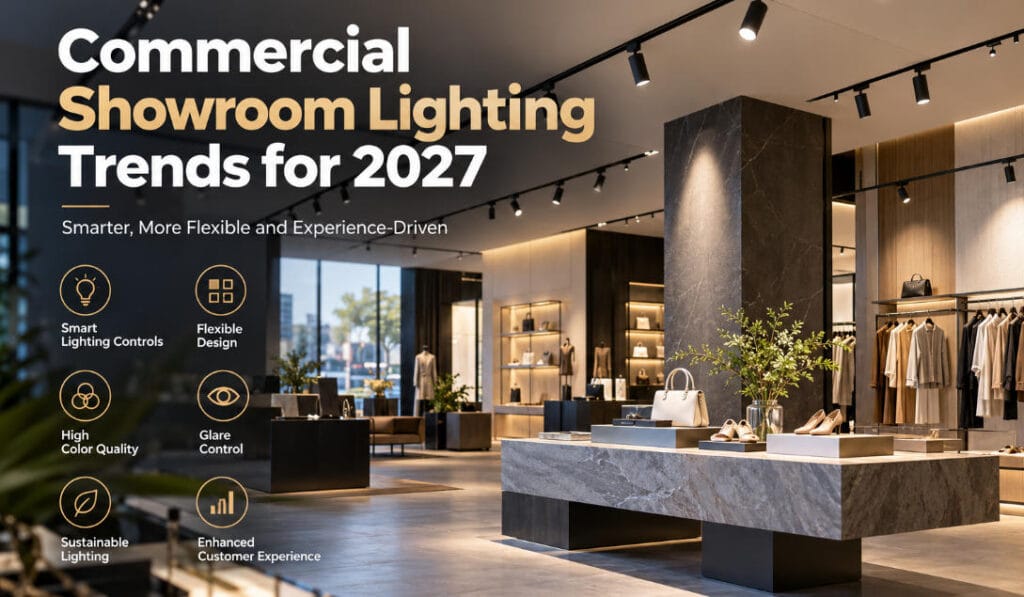
1. Die Beleuchtung von Ausstellungsräumen wird sich von der Allgemeinbeleuchtung zur geschichteten Beleuchtung entwickeln
Eine der deutlichsten Veränderungen im modernen Ausstellungsraumdesign ist der Rückgang der gleichmäßigen Beleuchtung.
Traditionelle Gewerbeflächen waren häufig stark von gleichmäßig verteilter Deckenbeleuchtung abhängig. Dieser Ansatz bietet ausreichende Beleuchtung, kann jedoch Produkte, architektonische Details und Ausstellungsbereiche visuell flach erscheinen lassen.
Im Jahr 2027 wird die Beleuchtungsplanung für Ausstellungsräume zunehmend mehrere Beleuchtungsebenen nutzen.
Ein typisches Beleuchtungskonzept kann Folgendes kombinieren:
- Umgebungsbeleuchtung für die allgemeine Sichtbarkeit;
- Akzentbeleuchtung für Waren und Displays;
- Wandflutung für vertikale Flächen;
- Engstrahlbeleuchtung für hochwertige Produkte;
- dekorative Beleuchtung für die Markenatmosphäre;
- architektonische Beleuchtung für Verkehrswege und räumliche Definition.
Das Ziel ist nicht einfach, mehr Licht zu erzeugen. Es besteht darin, visuelle Hierarchie.
zu schaffen. Kunden sollten intuitiv verstehen, wohin sie zuerst schauen sollen, welche Produkte wichtig sind und wie sie sich durch den Ausstellungsraum bewegen.
Dies ist besonders wichtig in Modeausstellungsräumen, Möbelgeschäften, Autohäusern, Schmuckdisplays, Galerien und Premium-Produktumgebungen.
Verstellbare Leuchten wie kommerzielle Strahler eignen sich gut für diesen Ansatz, da die Lichtrichtung geändert werden kann, wenn sich Displays, Layouts und Produktkollektionen weiterentwickeln.
2. Flexible Strahlerbeleuchtung wird weiterhin zentral für die Ausstellungsraumgestaltung bleiben
Permanente Beleuchtungslayouts lassen sich in kommerziellen Ausstellungsräumen zunehmend schwerer rechtfertigen.
Einzelhandelskampagnen ändern sich. Displays werden verschoben. Neue Produktkollektionen treffen ein. Ausstellungsbereiche werden neu organisiert.
Die Beleuchtung muss sich daher mit der Ware verändern.
Strahlerbeleuchtung bietet einen wichtigen Vorteil, da Leuchten neu positioniert, neu ausgerichtet oder ausgetauscht werden können, ohne das gesamte Deckenbeleuchtungssystem neu zu planen.
Für kommerzielle Projekte im Jahr 2027 wird Flexibilität zunehmend Teil der Beleuchtungsspezifikation werden und nicht mehr nur ein optionaler Vorteil sein.
Statt nur zu fragen:
“Wie viele Watt verbraucht diese Leuchte?”
werden Designer und Auftragnehmer zunehmend fragen:
“Wie einfach kann sich dieses Beleuchtungssystem in den nächsten fünf Jahren anpassen?”
Zum Beispiel können verstellbare zylinderförmige Leuchten wie die SP-GD5068B2 Zylinder-Strahler in displayorientierte Layouts integriert werden, bei denen gerichtetes Licht und visuelle Konsistenz wichtig sind.
Bei größeren oder häufig wechselnden kommerrischen Umgebungen können Strahlersysteme auch den Bedarf an wiederholten Deckenanpassungen verringern, wenn sich die Warenpräsentationslayouts ändern.
Das Ergebnis ist eine Beleuchtungsinfrastruktur, die auf Veränderung statt Beständigkeit.
ausgelegt ist. 3. Intelligente Lichtsteuerungen werden wichtiger werden als die Effizienz der Leuchten allein
Die erste LED-Transformation konzentrierte sich in erster Linie auf den Ersatz ineffizienter Lichtquellen.
Die nächste Transformation betrifft zunehmend die intelligente Steuerung dieser LEDs.
Die IEA beschrieb diese Entwicklung im Jahr 2026 als den Beginn einer zweiten Welle des Beleuchtungseinsatzes, die auf intelligentere, effizientere und kreislauforientiertere Systeme ausgerichtet ist.
Für Showrooms bedeutet dies, dass zukünftige Beleuchtungssysteme zunehmend Folgendes umfassen können:
- Szenensteuerung;
- zeitgesteuerte Dimmung;
- Anwesenheitserkennung;
- Tageslichtnutzung;
- individuelle Adressierung einzelner Leuchten;
- Energieüberwachung;
- Ferninbetriebnahme;
- Daten zur vorausschauenden Wartung;
- Integration in Gebäudemanagementsysteme.
Die DALI-Technologie veranschaulicht diesen Wandel deutlich. Moderne DALI-Datenspezifikationen ermöglichen es kompatiblen LED-Treibern, standardisierte Informationen über Leuchtenleistung, Energieverbrauch, Diagnose und Wartung zu melden.
Drahtlose vernetzte Beleuchtung entwickelt sich parallel dazu.
Bluetooth Networked Lighting Control beispielsweise ermöglicht individuell adressierbare Leuchten und sensorbasierte Netzwerke, die auf Anwesenheit und Tageslichtbedingungen reagieren und gleichzeitig Betriebsdaten an Gebäudesysteme liefern können.
Für Showroom-Betreiber dürfte der Wert einer Leuchte im Jahr 2027 daher zunehmend nicht nur davon abhängen, wie effizient sie Licht erzeugt, sondern auch davon, wie intelligent dieses Licht verwaltet werden kann..
4. Dynamische Lichtszenen werden unterschiedliche Showroom-Funktionen unterstützen
Ein kommerzieller Showroom dient selten den ganzen Tag über nur einem einzigen Zweck.
Derselbe Raum kann morgens für normales Produktstöbern, nachmittags für Kundenpräsentationen und abends für Werbeveranstaltungen genutzt werden.
Die Verwendung einer einzigen festen Beleuchtungsstärke für jedes Szenario kann sowohl das visuelle Erlebnis als auch die Energieeffizienz einschränken.
Szenenbasierte Beleuchtung bietet einen anderen Ansatz.
Ein Showroom könnte verschiedene Einstellungen verwenden, wie zum Beispiel:
Täglicher Ausstellungsmodus
Ausgewogene Umgebungs- und Akzentbeleuchtung für normalen Kundenverkehr.
Premium-Produktmodus
Reduzierte Umgebungsbeleuchtung kombiniert mit stärkerer Akzentbeleuchtung zur Erhöhung des visuellen Kontrasts.
Präsentationsmodus
Niedrigere Beleuchtungsniveaus um digitale Bildschirme herum, während eine angemessene Beleuchtung von Produkten und Verkehrswegen aufrechterhalten wird.
Veranstaltungsmodus
Dramatischerer Kontrast, ausgewählte Akzentbeleuchtung und angepasste Farbtemperatur.
Reinigungs- oder Wartungsmodus
Hohe Allgemeinbeleuchtung für Personalvorgänge.
Anstatt Beleuchtung als statische Gebäudedienstleistung zu behandeln, können Designer sie daher als programmierbaren Teil des Kundenerlebnisses betrachten.
Produkte, die für intelligente Steuerung ausgelegt sind, wie die SP-GD8308B1AI 30W KI-Strahler, spiegeln auch die breitere Marktrichtung hin zu steuerbarer und anpassungsfähiger kommerzieller Beleuchtung wider.
5. Farbqualität wird über eine einfache CRI-Zahl hinausgehen
Farbwiedergabe war in der Showroom-Beleuchtung schon immer wichtig.
Ein Bekleidungshändler möchte, dass Stoffe glaubwürdig erscheinen. Ein Möbel-Showroom benötigt Holz, Stein und Polsterstoffe, die ihren Charakter behalten. Automobiloberflächen müssen subtile Veränderungen auf metallischen Oberflächen offenbaren. Kunstwerke, Kosmetika und Schmuck stellen noch anspruchsvollere Farbanforderungen.
Historisch gesehen haben sich viele Spezifikationen in erster Linie auf den CRI verlassen.
Allerdings verwenden Beleuchtungsfachleute zunehmend ausgefeiltere Ansätze zur Bewertung der Farbwiedergabe.
Die Illuminating Engineering Society führt derzeit ANSI/IES TM-30-24 unter ihren aktiven farbbezogenen technischen Dokumenten auf. Darüber hinaus bietet ihr Beleuchtungspraxisleitfaden ANSI/IES LP-30-26 aus dem Jahr 2026 Anleitungen zur Einbeziehung von TM-30-Metriken in Beleuchtungsspezifikations- und Designprozesse.
TM-30 ermöglicht es Designern, Eigenschaften wie Farbtreue und Farbumfang zu bewerten, anstatt sich vollständig auf einen traditionellen CRI-Wert zu verlassen.
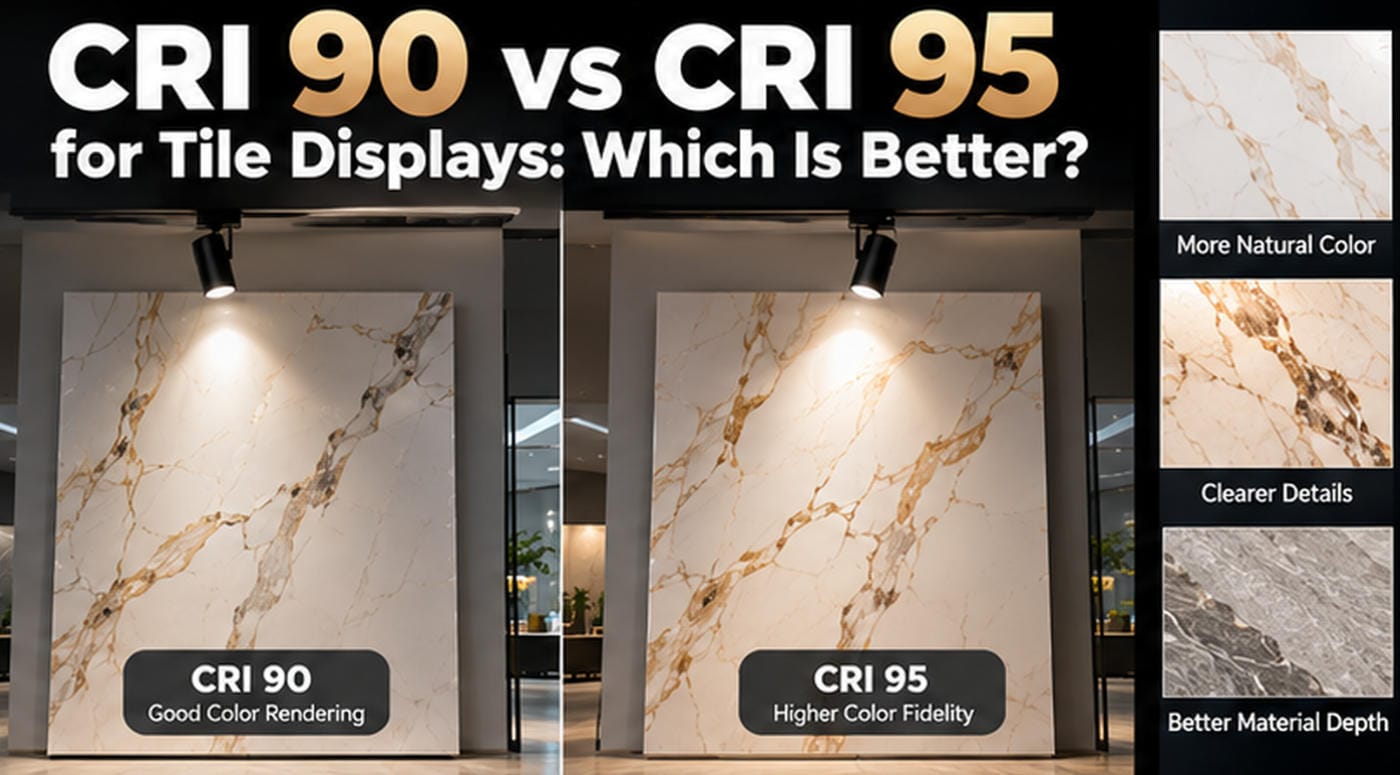
Für Showroom-Projekte ist dies wichtig, da zwei Lichtquellen mit ähnlichen CRI-Kennwerten dennoch deutlich unterschiedliche visuelle Eindrücke erzeugen können.
Bis 2027 werden professionelle Showroom-Spezifikationen daher voraussichtlich zunehmend Wert auf das Gesamtspektral- und Farbwiedergabeverhalten einer Lichtquelle, legen, insbesondere bei Premium-Waren.
6. Bessere Blendungskontrolle wird zu einem Zeichen hochwertigerer Showroom-Beleuchtung werden
Helligkeit allein erzeugt keine gute Einzelhandelsbeleuchtung.
Schlecht kontrollierte Leuchten können unangenehme Blendung verursachen, insbesondere wenn leistungsstarke Strahler auf Augenhöhe der Kunden installiert oder von Glas, poliertem Stein, Metall oder Automobiloberflächen reflektiert werden.
This becomes particularly important as showroom interiors increasingly use reflective materials and minimalist architectural finishes.
The trend toward better visual comfort is also visible in broader building standards. WELL lighting guidance, for example, includes considerations related to brightness management, electric-light glare control and visual comfort.
As a result, commercial lighting specifications are increasingly likely to consider:
- deep anti-glare optics;
- controlled cut-off angles;
- appropriate beam distributions;
- shielding accessories;
- fixture positioning;
- luminance contrast;
- reflected glare from merchandise.
The best showroom lighting in 2027 will not necessarily be the brightest.
It will be the lighting that directs brightness precisely where it adds value.
7. Smaller Fixtures and Cleaner Ceilings Will Gain Importance
Showroom architecture is becoming increasingly minimal.
Designers often want customers to notice merchandise and materials rather than bulky ceiling equipment.
This creates demand for smaller luminaires with more precise optical performance.
Compact track lights, recessed spotlights and cylinder fixtures can help reduce visual clutter while maintaining strong accent illumination.
The lighting fixture effectively becomes part of the architecture rather than an independent visual object.
For projects where designers want the lighting hardware to remain visible but visually restrained, products such as the SP-GD6290B2 Zylinder-Schienenstrahler can fit naturally within contemporary commercial environments.
At the same time, completely hiding fixtures is not always the objective.
Some brands intentionally use visible track systems as part of an industrial or technical aesthetic.
The key trend is therefore not invisibility itself, but greater integration between lighting hardware and interior architecture.
8. Material-Specific Lighting Will Become More Sophisticated
Different materials respond differently to light.
Stone needs texture.
Metal needs highlights.
Wood benefits from controlled warmth.
Textiles depend heavily on accurate color reproduction.
Glass requires careful glare and reflection management.
For this reason, future showroom projects will increasingly move away from choosing one universal beam angle and color temperature for an entire space.
Instead, lighting designers may select different optical strategies according to the displayed material.
A narrow beam can emphasize a small object.
A medium beam can illuminate furniture or mannequins.
Wall washing can improve vertical presentation.
Grazing light can reveal stone textures.
This approach is especially relevant for architectural-material showrooms.
For example, lighting solutions developed for surfaces such as sintered stone can help designers explore the relationship between directional light, texture and material presentation. SUNPOL’s SP-QD6290B1AI Sinterstein-Leuchte is one example of a product positioned around this type of application.
In 2027, specifying fixtures by display material and visual objective rather than simply by room type is likely to become increasingly important.
9. Lighting Will Become Part of Building Data Infrastructure
One of the most important long-term developments in commercial lighting is easy to overlook.
A connected luminaire is no longer only a source of illumination.
It can also become a node within a building network.
DALI-enabled systems can provide standardized energy and diagnostic information, while networked lighting systems can incorporate occupancy, daylight and environmental sensing.
This information can support:
- energy management;
- predictive maintenance;
- occupancy analysis;
- space utilization;
- HVAC optimization;
- fault identification;
- facility management.
The convergence is already becoming visible. In August 2026, the Bluetooth SIG highlighted projects connecting networked lighting control with HVAC systems so that building services can respond dynamically to occupancy and environmental conditions.
For large commercial showrooms, dealerships and brand experience centers, this creates a significant shift.
Lighting infrastructure can become part of the wider smart-building nervous system.
10. Sustainability Will Move From “LED Efficiency” to Lifecycle Efficiency
Choosing LED lighting is no longer enough to establish a strong sustainability strategy.
LED has already become the dominant technology in many lighting applications.
The next stage involves considering the complete lifecycle of the lighting system.
That includes:
- luminaire efficacy;
- intelligent controls;
- replaceable components;
- driver accessibility;
- system interoperability;
- product lifespan;
- maintenance requirements;
- future reconfiguration;
- material use;
- end-of-life considerations.
This transition is particularly important for commercial interiors because refurbishment cycles can be relatively short.
If an entire luminaire system must be removed whenever a showroom layout changes, the environmental benefit of high operating efficiency may be partially offset by material waste.
Open and interoperable control systems may also help extend system life. The DALI Alliance, for example, emphasizes interoperability, upgradeability, energy monitoring and long-term system compatibility as important elements of modern lighting infrastructure.
For showroom owners, sustainability will therefore become increasingly connected to how long a system remains useful, not simply how many lumens per watt it produces.
11. Human-Centric Principles Will Influence Commercial Spaces—But With Greater Scientific Discipline
“Human-centric lighting” has been heavily marketed during the past decade.
In 2027, the concept is likely to become more technically disciplined.
The International Commission on Illumination (CIE) updated its position on integrative lighting in 2024, emphasizing that lighting for human well-being should be considered together with visual, energy, architectural and environmental requirements rather than treated as a standalone formula.
That distinction matters for commercial showrooms.
Instead of assuming that simply changing color temperature automatically creates healthier lighting, designers are likely to consider a broader combination of:
- visuellen Komfort;
- daylight exposure;
- glare;
- vertikale Beleuchtung;
- time of exposure;
- intensity;
- spectral characteristics;
- customer and employee requirements.
In other words, 2027 showroom lighting will increasingly focus on appropriate light at the appropriate place and time, rather than relying on simplified marketing claims.
12. Showroom Lighting Will Be Designed Around Experience, Not Lux Alone
Lux remains essential.
But it cannot describe the entire experience of a commercial space.
Two showrooms can have exactly the same average illuminance while feeling completely different.
One may appear flat and visually tiring.
The other may feel premium, comfortable and carefully curated.
The difference often comes from contrast, vertical illumination, color quality, beam control, material interaction and lighting hierarchy.
This explains why the direction of commercial lighting is moving from quantitative illumination toward qualitative visual experience.
The goal is no longer simply:
Illuminate the showroom.
The goal is:
Use light to guide attention, communicate brand identity and make products easier to understand.
That principle is likely to define many of the strongest showroom lighting projects in 2027.
What Should Showroom Owners Consider for 2027 Projects?
For businesses planning a new showroom or renovation, the specification process should begin with the commercial objective rather than the fixture catalogue.
Consider:
- Which products should receive the highest visual priority?
- How frequently will displays change?
- Which materials require specialized lighting?
- Is high color fidelity important?
- Is glare likely to occur on reflective products?
- Will lighting scenes change during the day?
- Should the lighting system integrate with sensors or building controls?
- Can fixtures and drivers be maintained or replaced easily?
- Will the lighting layout remain useful if the showroom changes?
- Can energy consumption be measured and optimized?
Answering these questions early can produce a lighting system that remains relevant far longer than a system designed only around initial illuminance calculations.
Conclusion
Commercial showroom lighting in 2027 will not be defined by one revolutionary luminaire.
Instead, the industry is moving toward a combination of better optics, flexible track systems, intelligent controls, advanced color evaluation, lower glare, data connectivity and lifecycle-oriented design.
LED efficiency remains important, but it is increasingly becoming the starting point.
The competitive difference will come from what happens after the LED is switched on: how accurately the light is controlled, where it is directed, how it interacts with products and materials, how easily it adapts to changing displays and how effectively it communicates with the wider building.
For retailers, designers, architects and commercial project contractors, this means lighting should increasingly be considered part of the complete showroom experience rather than simply another electrical system.
For companies developing new commercial display environments, SUNPOL Lighting provides commercial lighting solutions for applications ranging from track lighting and accent lighting to specialized product-display illumination.
Data & Industry Sources
1. International Energy Agency (IEA) — “The Next Wave of LED Lighting: Smarter, Circular and More Efficient,” March 6, 2026.
The IEA reports that lighting in buildings and outdoor applications represented approximately 8% of global electricity demand in 2024, or about 2,200 TWh. It also notes that global building floor area increased by more than 20% over the previous decade while lighting electricity use remained comparatively stable.
2. International Energy Agency — Energy Efficiency 2025.
The IEA reports that buildings account for approximately 30% of global energy demand, with commercial and public buildings accounting for roughly 30% of building energy demand.
3. DALI Alliance — DALI Data Specifications.
DALI Parts 251, 252 and 253 standardize luminaire, energy and diagnostic information that can be communicated through compatible lighting-control networks.
4. DALI Alliance — Sustainability and Lighting-Control Materials.
DALI documentation highlights occupancy sensing, daylight harvesting, automated dimming, energy monitoring and system interoperability as tools for improving commercial lighting efficiency and lifecycle management.
5. Bluetooth SIG — Bluetooth Networked Lighting Control.
Bluetooth NLC documentation describes individually addressable, sensor-rich commercial lighting networks capable of occupancy monitoring, daylight-responsive control and integration with wider building systems.
6. Bluetooth SIG — Networked Lighting Control and HVAC Integration, August 27, 2026.
The organization documents the growing integration of occupancy-aware lighting networks with HVAC and wider building-management functions.
7. Illuminating Engineering Society — ANSI/IES TM-30-24 and ANSI/IES LP-30-26.
IES technical materials demonstrate the industry’s continued development of more comprehensive methods for specifying and evaluating light-source color rendition beyond reliance on conventional CRI alone.
8. International Commission on Illumination (CIE) — Position Statement on Integrative Lighting, 2024.
CIE emphasizes balancing human well-being considerations with visual, architectural, environmental and energy requirements when applying integrative lighting principles.