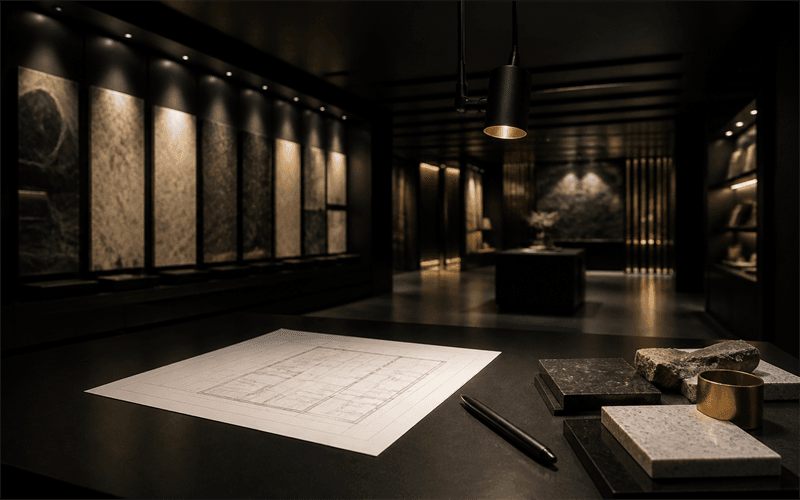

A showroom can be brightly illuminated and still feel uncomfortable.
You may notice it when walking past a wall of polished porcelain tiles. The products are clearly visible, but the ceiling lights create distracting points of brightness. Move a few steps farther, and the display suddenly looks uneven, with bright patches separated by darker areas.
Adding more light rarely solves both problems.
What matters is how that light reaches the display—and how much of the light source remains visible to the customer.
This is where a grille track light offers an interesting alternative to conventional single-aperture spotlights. By arranging multiple optical cells within one fixture, grille lighting can provide controlled directional illumination while reducing direct exposure to bright LED sources.
For retail designers, architects and showroom operators, understanding this optical structure is useful when balancing visual comfort, product visibility and a clean ceiling appearance.
What Is a Grille Track Light?
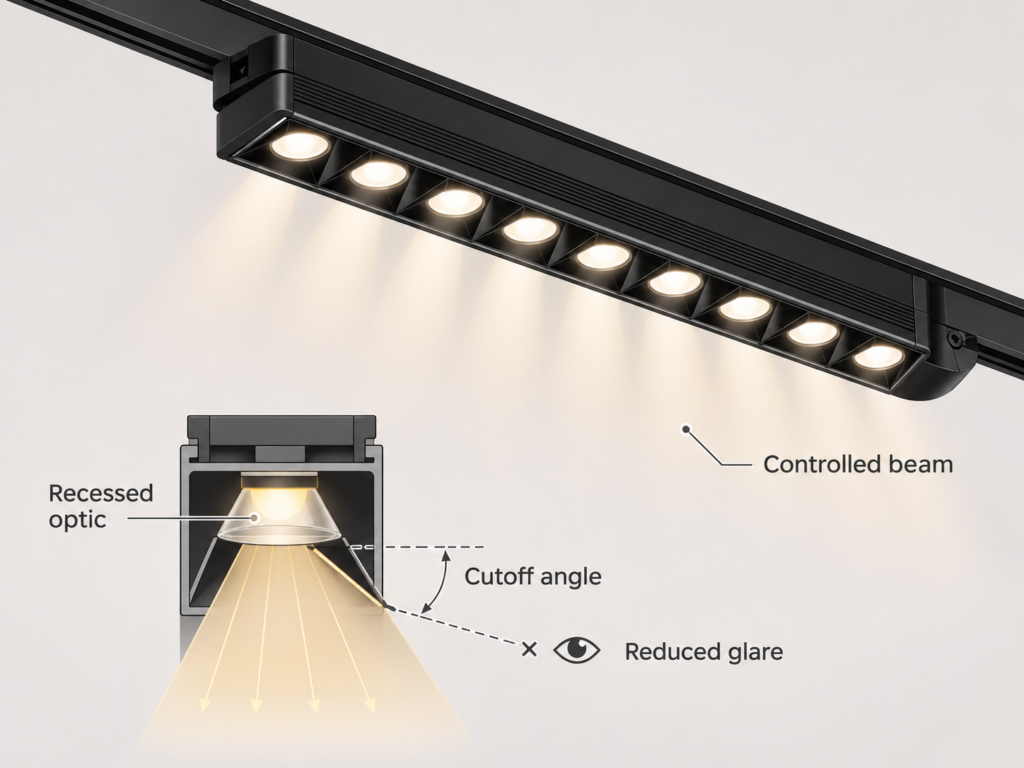
A grille track light is a track-mounted LED luminaire that uses a series of optical cells, typically arranged within a linear housing, to direct light toward a designated area.
Instead of relying on one large luminous opening, the fixture distributes its optical components across multiple smaller apertures.
Each cell may incorporate a lens, reflector or shielding structure, depending on the manufacturer’s design.
The arrangement serves two important purposes: controlling the direction of emitted light and limiting the visibility of bright optical components from certain viewing angles.
Unlike a traditional cylindrical spotlight, a linear grille fixture also presents a different architectural appearance. Its compact row of apertures can fit naturally into contemporary retail spaces, galleries and material showrooms.
However, the presence of multiple cells does not automatically guarantee better glare performance or higher uniformity. Those results depend on the optical geometry, photometric distribution and installation.
How Multi-Cell Optics Control Light
The most distinctive feature of grille track lighting is its multi-cell optical structure.
Imagine replacing one relatively large luminous opening with a row of smaller, individually controlled apertures.
Each aperture becomes part of the overall beam-forming system.
Smaller apertures and controlled source visibility
A large exposed LED lens can appear intensely bright when viewed from across a room.
In a well-designed grille fixture, the optical sources sit behind the front opening, where cell walls provide physical shielding.
This reduces the range of viewing directions from which the luminous elements can be seen directly.
The apparent brightness experienced by an observer still depends on source luminance, aperture dimensions, viewing distance and angle. Dividing an optical opening into smaller sections is therefore not, by itself, proof of lower glare.
The benefit comes from combining the individual apertures with effective shielding and controlled light distribution.
The role of individual reflectors and lenses
Within a multi-cell arrangement, optical elements determine how light leaves each compartment.
A relatively narrow distribution can concentrate illumination on selected products. A wider distribution can provide broader coverage across a merchandise group or display surface.
When individual cell distributions are properly coordinated, they can combine to form the fixture’s intended output pattern.
This is particularly useful for linear displays, where designers may want a consistent visual effect without installing numerous separate cylindrical spotlights.
The critical detail is the combined photometric performance, not simply the number of optical cells.
A fixture with twenty cells is not necessarily more uniform than one with ten. Cell spacing, optical alignment, luminous intensity distribution and mounting geometry all influence the final result.
Cutoff Angle: Why Optical Shielding Matters
One of the most useful concepts in a professional grille track light guide is the cutoff angle.
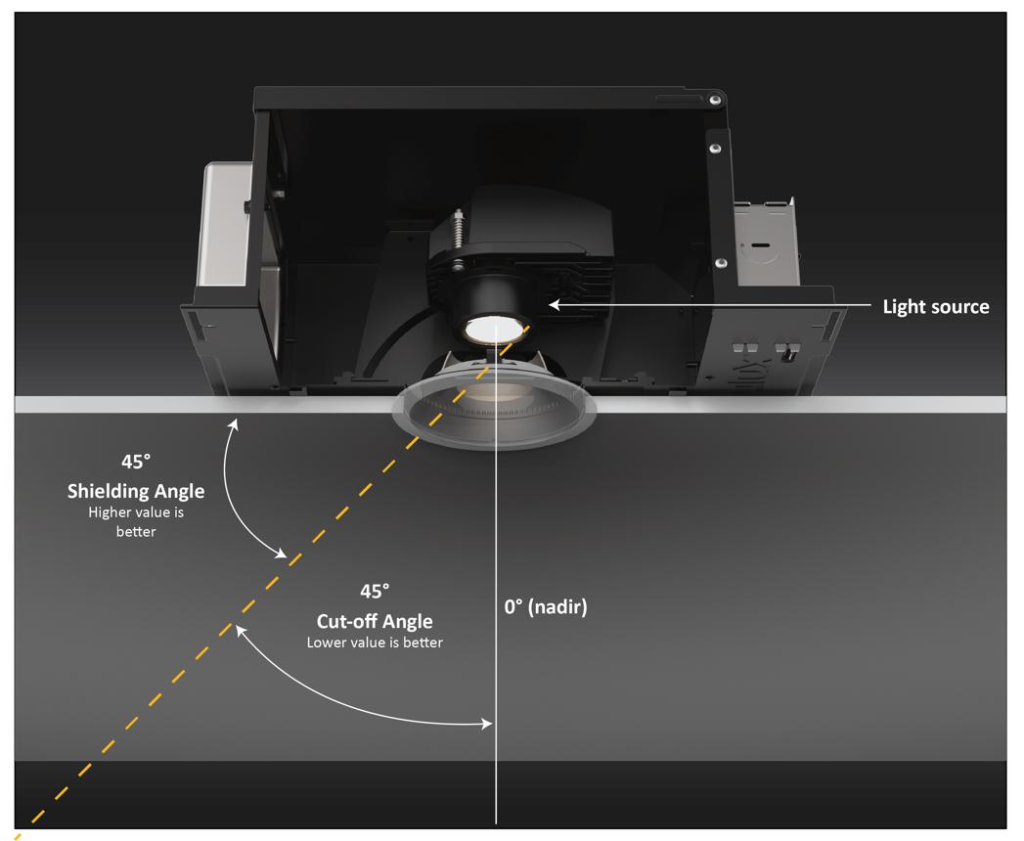
In practical lighting design, cutoff and shielding describe how the fixture geometry limits direct visibility of the light source at particular viewing angles.
A recessed optical cell creates a physical boundary between the LED and the surrounding space.
As the observer moves farther away from the central beam direction, the cell wall may eventually block the direct view of the source.
The geometry depends on three basic elements:
- The depth of the optical cell
- The width of its opening
- The position of the luminous surface within the cell
For a simplified straight-walled cell, if the source is recessed by depth d behind an aperture of width w, a central viewing ray is geometrically blocked beyond an off-axis angle of approximately:
θ = arctan(w / 2d)
This simplified relationship assumes a central source and does not represent the complete shielding behavior of a real lens or LED array. Actual cutoff specifications also depend on the angle convention used by the manufacturer.
A deeper optical cell generally provides stronger geometric shielding, while a wider aperture exposes the source over a larger range of directions.
There is a trade-off, however.
Excessive shielding may obstruct useful light, reduce optical efficiency or constrain the desired beam spread.
A well-engineered grille fixture balances source concealment with practical illumination performance.
Cutoff angle is not beam angle
These two specifications are frequently confused.
Beam angle describes the angular spread of a luminaire’s main light distribution, commonly measured between directions where luminous intensity falls to 50% of its peak value.
Cutoff or shielding angle concerns the visibility of the source and the geometric limits imposed by the luminaire.
A grille track light may offer a 24° beam while using a separate optical structure to control source visibility.
Knowing one angle does not establish the other.
For a more detailed discussion of shielding structures and their role in glare reduction, read SUNPOL’s guide to how anti-glare track lights work.
Uniform Illumination: More Than a Smooth-Looking Beam
Uniformity becomes especially important when lighting large surfaces.
Consider a showroom displaying several porcelain slabs side by side.
If the center of each slab receives noticeably more illumination than its edges, differences in brightness may distract customers from comparing colors and finishes.
Grille track lighting can help designers build a more controlled distribution, but the fixture alone cannot guarantee uniform coverage.
How individual beams combine
Light from separate optical cells contributes to the overall illumination pattern.
When those distributions overlap appropriately, the combined result can reduce visible brightness gaps.
Poorly coordinated distributions may instead create concentrated zones, uneven transitions or excessive spill.
The same principle applies when several grille fixtures illuminate one continuous display wall.
Mounting distance, fixture spacing, beam selection and aiming determine how the individual lighting patterns interact.
Uniformity should therefore be evaluated across the entire illuminated surface.
A common measurement is the ratio of minimum illuminance to average illuminance:
U₀ = E_min / E_avg
For example, if a display surface has an average illuminance of 500 lux and a minimum of 350 lux, its calculated overall uniformity is 0.70.
That number describes the evaluated surface; it is not an inherent uniformity rating of the luminaire.
A higher value generally indicates a more even illuminance distribution. Whether high uniformity is desirable depends on the display concept.
A gallery may intentionally use strong contrast around individual artworks. A continuous tile sample wall may benefit from much more even coverage.
Uniformity should not eliminate visual hierarchy
Perfectly uniform lighting is not always attractive.
Retail environments need contrast to distinguish hero products from surrounding merchandise.
The objective is to avoid unwanted brightness variations while preserving intentional emphasis.
For a large material wall, uniform illumination may support accurate comparison of surfaces. For a premium product feature, a narrower beam can create depth and visual focus.
The most effective grille track light solutions consider both requirements.
Grille Track Light vs. Conventional Spotlight
Both lighting types can provide effective commercial accent lighting, but their optical layouts and installation characteristics differ.
| Design factor | Grille track light | Cylindrical spotlight |
|---|---|---|
| Optical configuration | Multiple apertures in a linear body | Usually one main optical aperture |
| Source shielding | Individual cell geometry can provide shielding | Recessed reflector or baffle can provide shielding |
| Light distribution | Combined distribution from multiple cells | Distribution from one main optical system |
| Display applications | Linear displays, product groups, feature walls | Individual products, focal points, flexible accents |
| Ceiling appearance | Slim, linear optical arrangement | Distinct cylindrical fixture |
| Visual comfort | Depends on cell shielding and installation | Depends on recess, optics and aiming |
Neither design is universally superior.
A cylindrical spotlight with an effective recessed optical system may provide excellent visual comfort. Similarly, a poorly positioned grille fixture can produce direct or reflected glare.
For showrooms with long product displays, grille track lighting offers a useful alternative worth evaluating.
For individual objects that require highly flexible aiming, conventional spotlights may be more practical.
Where Grille Track Lighting Makes the Biggest Difference
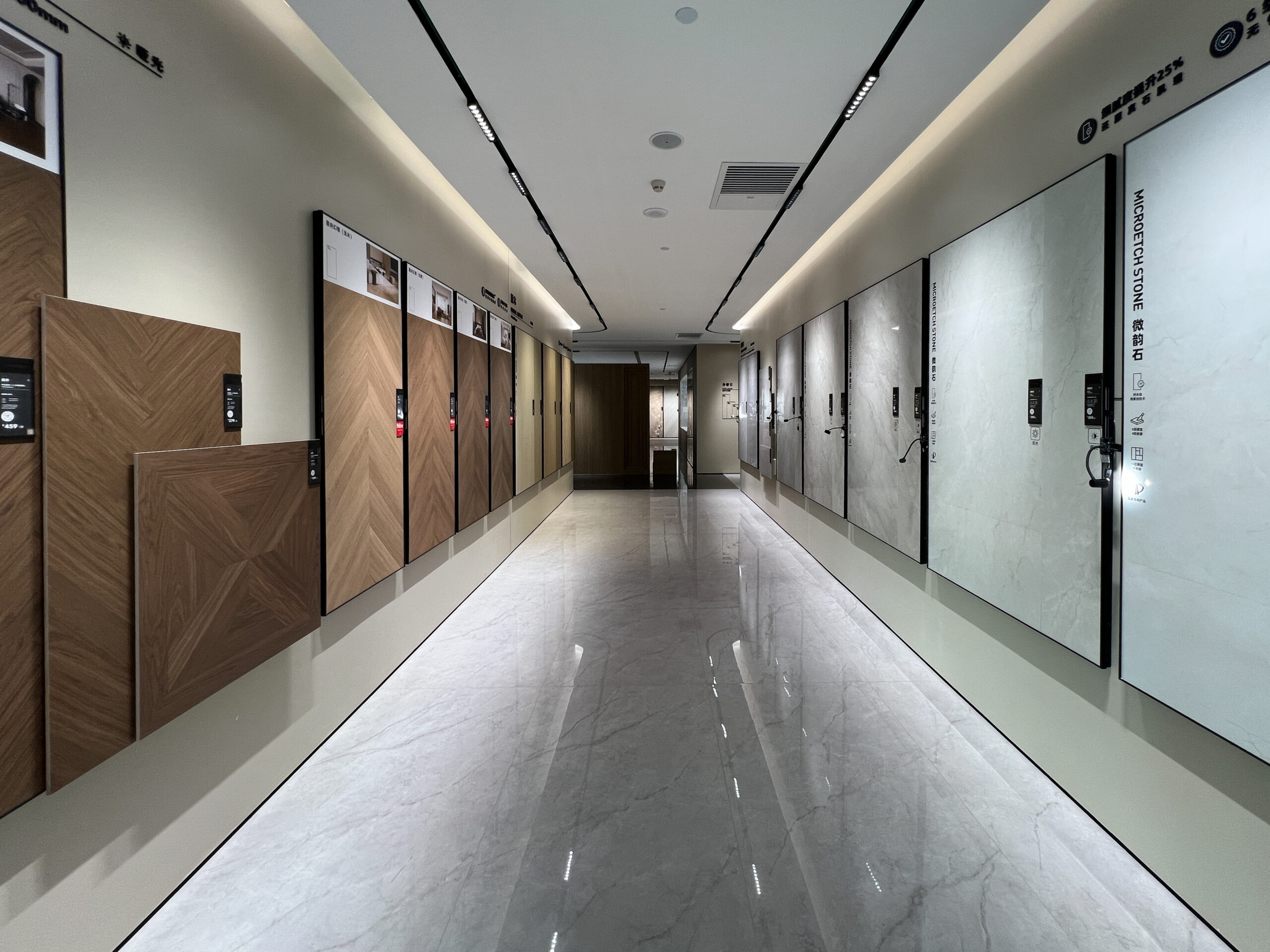
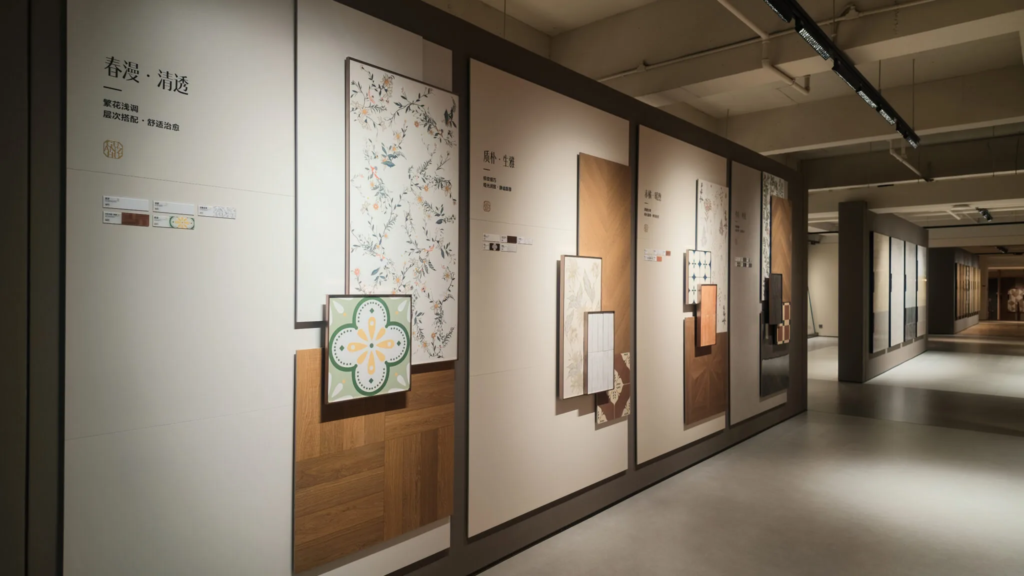
Ceramic tile and natural stone showrooms
Large material displays are among the most demanding commercial lighting applications.
Polished porcelain, marble and sintered stone can reflect bright luminaires into a customer’s normal viewing direction.
Grille fixtures with properly controlled optical apertures can help reduce direct source visibility. Their linear arrangement may also suit repeated display modules and long walls.
Yet optical shielding cannot remove reflections from glossy materials by itself.
The track position and aiming direction must keep strong reflected images away from important viewing locations.
For heavily textured stone, some directional contrast should remain. Lighting that is too diffuse may make the surface appear flatter than it really is.
Retail stores and product displays
In retail environments, lighting must support browsing without distracting customers from the merchandise.
Grille track lights can work well above display tables, along shelving zones and near feature walls.
A carefully chosen distribution can illuminate product groups while maintaining a discreet ceiling appearance.
Designers should check that the fixture delivers enough vertical illumination to the merchandise rather than concentrating attention on horizontal floor brightness.
Bathroom and sanitaryware showrooms
Bathroom displays introduce mirrors, polished metal, glass and glossy ceramic surfaces.
Even a well-shielded luminaire may produce a visible reflection when placed directly within a mirror’s reflected field of view.
Here, grille lighting should be coordinated with fixture position, beam direction and surrounding ambient illumination.
Comfortable bathroom showroom lighting is achieved through the entire installation, not only the fixture’s anti-glare structure.
SUNPOL Grille Track Light Solutions for Commercial Projects
At SUNPOL lighting, grille track lights form part of a wider range of professional showroom and commercial display products.
Two models illustrate how different grille formats can serve different project requirements.
SP-GD58535H61B1 20-Cell Grille Track Light
The SUNPOL SP-GD58535H61B1 20-Cell Grille Track Light uses a linear multi-cell configuration designed for commercial display applications.
Its published specifications include:
- Rated power: 30W
- Luminous flux: 3000 lm
- Beam options: 24° and 36°
- Color rendering: CRI Ra ≥90
- Forward/backward adjustment: 150°
- Dimensions: 585 × 35 × 61 mm
- Housing: Matte black, 6063 aluminum
The 24° option provides a more concentrated distribution, while the 36° option offers broader accent coverage.
Its linear form makes it worth considering for long merchandise walls, tile displays and architectural feature areas.
The twenty-cell structure describes the fixture’s optical arrangement; actual glare control and illumination uniformity should be verified with the relevant photometric data.
SLT2358B2 35W Grille Track Light
Another option is the SUNPOL SLT2358B2 35W Grille Track Light.
This model has a more compact linear body and is designed for commercial accent lighting.
Published specifications include 35W rated power, 2800 lm output, 24° and 36° beam options, CRI Ra ≥90 and 150° forward/backward adjustment.
Its listed dimensions are 403 × 42 × 66 mm, and it supports T3 and S3 track systems.
The shorter body may be useful where fixture size and architectural proportions are important.
Although its wattage is higher than the 20-cell model, its published luminous flux is lower. This is a reminder that electrical power alone does not determine useful light delivery.
Optical performance, efficiency and the distribution required by the installation must all be considered.
Both products can be explored alongside other options in the SUNPOL Grille Track Lighting collection.
How to Choose the Right Grille Track Light
When comparing grille fixtures for a commercial project, start with the display rather than the product’s wattage.
A useful selection process considers the following questions.
How large is the illuminated surface?
A narrow beam may be suitable for a small product arrangement, while a wider distribution or several coordinated fixtures may be required for a continuous wall.
Where will customers stand?
Source visibility changes with viewing position. Evaluate the fixture from circulation routes, display entrances and common product-inspection positions.
Is the material glossy or textured?
Glossy surfaces require particular attention to reflected glare. Textured materials may need directional illumination to reveal their surface structure.
What photometric information is available?
Request IES or LDT files for the specific optical configuration. Use lighting calculations to assess illuminance, uniformity and relevant viewing directions.
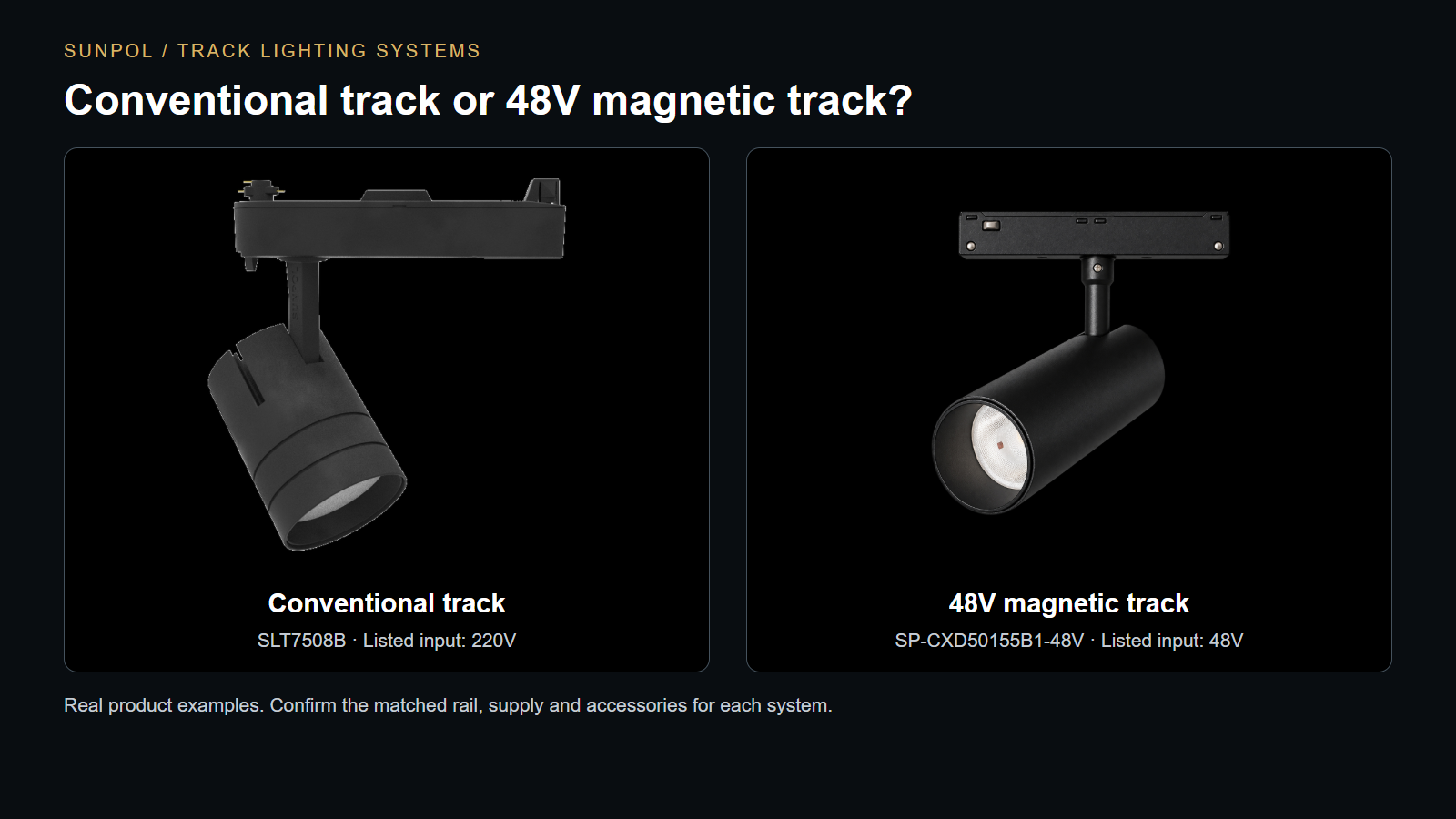
Is the track system compatible?
Check the mounting system, electrical requirements and adjustment range. Mechanical fit and electrical compatibility should not be assumed from appearance alone.
What color quality does the display require?
A comfortable optical system should also reproduce product colors appropriately. CRI, color temperature and color consistency deserve attention, especially in material showrooms.
For larger commercial projects, SUNPOL’s commercial display lighting solutions provide a broader approach to combining different fixtures according to display requirements.
Frequently Asked Questions
Do grille track lights reduce glare?
They can reduce direct source visibility through recessed optical cells and shielding geometry. Actual glare performance depends on the complete optical design, fixture positioning and observer location.
Are more optical cells always better?
No. Cell count alone does not determine glare control or illumination uniformity. Aperture dimensions, shielding depth, optical distribution and installation geometry are more meaningful performance factors.
What is the best beam angle for a grille track light?
There is no universal best angle. A 24° beam can be useful for concentrated accents, while a 36° beam may suit broader coverage. The correct choice depends on mounting height, distance to the display and the required illuminated area.
Can grille track lights provide uniform wall lighting?
Yes, a coordinated installation can provide relatively even wall illumination. However, the result must be assessed using the fixture’s photometric distribution, spacing, aiming and the dimensions of the wall. A grille structure does not automatically produce uniform wall washing.
Are grille track lights suitable for premium showrooms?
They are worth considering for premium showrooms because their linear appearance and controlled optical structure can complement modern interiors. Their suitability depends on the materials being displayed and the overall lighting design.
Visual comfort in a showroom is rarely achieved by reducing brightness alone.
The real challenge is placing useful light on merchandise without exposing customers to unnecessary glare or creating distracting variations across the display.
A grille track light addresses part of that challenge through its multi-cell optical arrangement. Recessed apertures, controlled distributions and appropriate shielding can help produce a more visually discreet lighting system.
Cutoff geometry determines how effectively the source is concealed. Beam distribution influences how the display is illuminated. Fixture spacing and aiming determine whether the final result feels balanced.
All three deserve attention.
For commercial designers and showroom operators, a grille fixture is most valuable when its optical design is matched to the products, the architecture and the people viewing them.
That is the principle behind effective SUNPOL lighting: make the merchandise easy to appreciate, while allowing the lighting itself to remain comfortably in the background.