The global commercial lighting industry is entering a new stage of transformation.
For much of the past decade, the industry’s primary story was the transition from conventional lamps to LED technology. Between 2026 and 2030, however, commercial lighting is expected to move beyond simple LED replacement. Energy efficiency will remain important, but purchasing decisions are increasingly being shaped by smart controls, flexible lighting design, retrofit demand, sustainability requirements, visual comfort, and application-specific performance.
For retailers, offices, hotels, galleries, showrooms, commercial contractors and lighting designers, this means lighting is becoming less of a standalone building component and more of an integrated part of the commercial environment.
Current market research supports this direction. Mordor Intelligence estimates the global commercial lighting market at approximately USD 22.57 billion in 2026, with the market projected to reach USD 51.04 billion by 2031, representing a compound annual growth rate of approximately 17.73% between 2026 and 2031.
At the same time, broader studies covering industrial and commercial LED lighting indicate even larger market opportunities. The Business Research Company estimates the industrial and commercial LED lighting market at USD 93.19 billion in 2026, potentially reaching USD 193.38 billion by 2030. Because this figure includes both industrial and commercial applications, it should not be directly compared with commercial-only market estimates.
The variation between these figures illustrates an important point: commercial lighting is not a single standardized market category. Different studies may include or exclude lamps, luminaires, controls, industrial facilities, outdoor applications and connected lighting systems. Nevertheless, almost every major industry indicator points toward continued growth in LED-based, intelligent and application-oriented lighting solutions through the end of the decade.
Commercial Lighting Is Moving Beyond the First LED Replacement Cycle
The first LED revolution was primarily about efficiency.
Commercial building owners replaced fluorescent, halogen and other conventional lighting technologies because LEDs offered lower electricity consumption, longer operating life and reduced maintenance requirements.
That transition is already well advanced.
According to the International Energy Agency, lighting in buildings and outdoor applications still accounted for approximately 8% of global electricity demand in 2024, equivalent to around 2,200 TWh of electricity consumption. The IEA argues that the next stage of lighting efficiency will increasingly depend not only on LED adoption, but also on smarter controls, higher system efficiency and more circular product design.
For the commercial lighting market between 2026 and 2030, this creates a fundamentally different competitive environment.
The question is no longer simply:
“Should a commercial project switch to LED?”
Instead, specifiers and buyers increasingly ask:
- How efficiently does the complete luminaire operate?
- Can lighting output be adapted to different commercial environments?
- Can beam angles and distributions be changed after installation?
- Does the system support dimming or intelligent controls?
- How well does the lighting render products, materials and architectural finishes?
- Can individual fixtures be maintained or replaced easily?
- How flexible is the system when a retail layout changes?
- Does the solution meet current energy and sustainability requirements?
These questions are particularly relevant in premium retail, showrooms, hospitality, galleries and other environments where lighting affects not only energy consumption but also customer experience and visual presentation.
1. LED Will Remain the Core Technology, but Differentiation Is Changing
LED lighting will remain the dominant technology behind commercial lighting growth through 2030.
Mordor Intelligence reported that LED products represented approximately 66.59% of the commercial lighting market in 2025, while LED-related demand was expected to continue expanding strongly over the following years.
At the same time, the LED market itself is becoming increasingly mature.
That creates price pressure in standardized products and shifts competition toward areas where manufacturers can create additional value.
Instead of competing only through watts, lumens and price, commercial lighting suppliers increasingly differentiate products through:
Optical performance: precise beam control, improved uniformity, reduced glare and different beam-angle options.
Color quality: higher color-rendering performance and application-specific color temperatures.
Fixture flexibility: adjustable, modular and interchangeable lighting systems.
Controls compatibility: dimming, sensors and intelligent lighting integration.
Application specialization: luminaires optimized for retail stores, offices, museums, hospitality spaces and architectural environments.
Product design: smaller dimensions, cleaner architectural integration and improved visual comfort.
This change is especially significant for display-oriented applications.
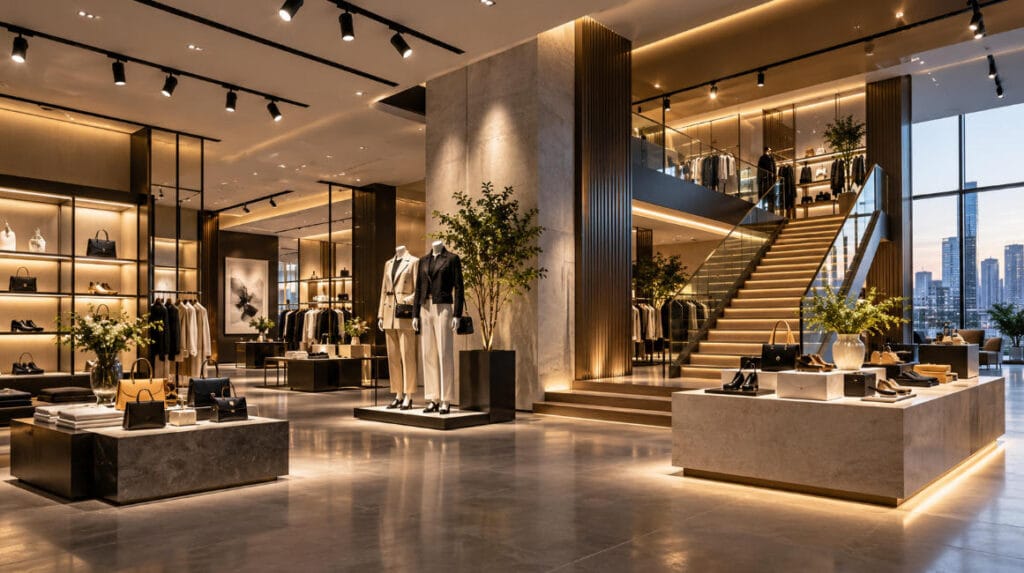
In retail and showroom projects, for example, the purpose of lighting is not simply to illuminate a room. The lighting system must direct customer attention, define visual hierarchy and present merchandise accurately.
For projects requiring adjustable accent lighting, buyers can explore SUNPOL’s commercial lighting product range for different track lighting, spotlight and architectural lighting configurations.
2. Retrofit and Renovation Will Be One of the Largest Sources of Demand
New commercial construction will continue to generate lighting demand, but the installed base of older buildings represents another major opportunity between 2026 and 2030.
According to Mordor Intelligence, retrofit and renovation projects represented approximately 62.21% of commercial lighting demand in 2025.
Several factors are driving this trend.
First, many commercial buildings still operate older fluorescent or early-generation LED systems that can be upgraded to more efficient solutions.
Second, retailers and commercial property operators regularly redesign interiors without replacing the entire building infrastructure.
Third, sustainability targets are encouraging building owners to improve existing assets rather than relying exclusively on new construction.
For lighting manufacturers, this means retrofit compatibility and installation flexibility will become increasingly important.
Track lighting is particularly relevant in this environment because fixture positions and lighting directions can often be modified without rebuilding the ceiling infrastructure.
For retail stores, galleries and showrooms that frequently change layouts or merchandise displays, adjustable systems can reduce the cost and complexity associated with future lighting modifications.
SUNPOL’s SP-GD5068B2 Cylinder Track Light, for example, represents the type of directional lighting architecture commonly used where flexible accent illumination is required.
Rather than treating lighting as a permanent fixed configuration, commercial spaces are increasingly adopting systems that can evolve together with changing layouts.
3. Smart and Connected Lighting Will Become More Important
One of the clearest trends for the 2026–2030 period is the continued development of connected commercial lighting.
Mordor Intelligence estimates that smart systems represented approximately 41.53% of commercial lighting shipments in 2025, with connected lighting expected to grow faster than conventional non-connected systems.
This transition is important because lighting fixtures are distributed throughout almost every commercial building.
Once connected, they can become part of a broader building-control infrastructure.
Depending on the project, smart commercial lighting may incorporate:
- Occupancy detection
- Daylight sensing
- Automated dimming
- Scheduled operation
- Zone-based lighting control
- Energy monitoring
- Centralized system management
- Integration with building-management systems
The economic logic is straightforward.
LED technology reduces the energy required to generate light. Intelligent controls can reduce unnecessary operating hours or excessive lighting levels.
The combination of efficient fixtures and intelligent control therefore creates additional energy-saving potential compared with fixture replacement alone.
Connected lighting is also becoming strategically important to major lighting manufacturers. Signify, for example, continues to emphasize connected systems and services as part of its professional lighting portfolio. The company reported EUR 5.8 billion in total sales in 2025 and operations across more than 70 markets, illustrating the scale at which global lighting companies are investing in integrated lighting technologies.
By 2030, smart functionality is likely to become increasingly expected in mid-to-large commercial projects rather than being treated solely as a premium feature.
4. Retail Lighting Will Become More Experience-Oriented
Retail represents one of the most demanding commercial lighting applications.
The growth of e-commerce has forced physical stores to provide something a website cannot fully replicate: a spatial and sensory brand experience.
Lighting plays a central role in creating that experience.
A successful retail lighting system must balance several layers of illumination:
Ambient lighting provides comfortable general visibility.
Accent lighting directs attention toward merchandise and important displays.
Vertical lighting improves visibility of shelves, walls and product displays.
Decorative lighting contributes to the brand environment.
Task lighting supports checkout counters, fitting rooms and working areas.
This has increased demand for flexible directional products such as track lights, recessed spotlights and adjustable downlights.
Beam control is particularly important.
A narrow beam can create dramatic product highlights, while wider distributions can illuminate shelving or larger displays. Adjustable luminaires allow lighting designers to modify these effects when merchandise layouts change.
Products such as the SP-GD6290B2 Cylinder Track Light reflect this broader movement toward compact, directional commercial display lighting.
For manufacturers serving the retail lighting market, optical performance and flexibility may therefore become more important competitive factors than raw lumen output alone.
5. Energy Regulations Will Continue to Reshape Product Requirements
Government efficiency policies remain another important driver of commercial lighting development.
LED technology has already dramatically improved luminaire efficacy compared with traditional lighting technologies. However, energy standards are continuing to become more demanding in several major markets.
This means commercial lighting manufacturers increasingly need to consider the efficiency of the complete lighting system rather than the LED chip alone.
Driver efficiency, thermal management, optical losses, dimming behavior and control compatibility all influence real-world performance.
The trend also favors suppliers capable of providing reliable technical documentation.
Commercial lighting buyers increasingly expect information such as:
- Luminaire wattage
- Luminous flux
- Luminous efficacy
- Color rendering index
- Color temperature
- Beam angle
- Driver specification
- Dimming compatibility
- Photometric data
- Product lifetime
- Certification information
For professional lighting manufacturers, transparent technical documentation is becoming an important part of building trust with architects, contractors and project buyers.
6. Sustainability Will Extend Beyond Energy Consumption
Energy efficiency remains a major sustainability metric, but the definition of sustainable lighting is expanding.
The IEA has highlighted circularity as one of the important elements of the next generation of lighting development.
Between 2026 and 2030, commercial lighting projects may increasingly evaluate products according to factors such as:
- Service life
- Replaceable components
- Driver accessibility
- Material selection
- Repairability
- Packaging
- Product efficiency
- Recyclability
This shift could gradually influence luminaire design.
A highly integrated fixture may look visually clean, but if an individual component cannot be serviced, the entire luminaire may need replacement when one component fails.
Modular architectures can potentially provide better long-term serviceability.
For project buyers, this changes the meaning of product cost.
The lowest purchase price does not always represent the lowest lifecycle cost.
Installation, electricity consumption, maintenance, component replacement and future layout changes must also be considered.
7. Asia-Pacific Will Remain a Critical Commercial Lighting Market
Regional growth will not be evenly distributed.
Different market studies identify Asia-Pacific as one of the most important regions for future commercial and industrial LED lighting growth.
Mordor Intelligence’s commercial and industrial LED lighting analysis identifies Asia-Pacific as the fastest-growing market during its 2025–2030 forecast period.
Growth in the region is supported by several structural factors, including:
- Continued urbanization
- Expansion of modern retail
- Hospitality development
- Commercial real-estate construction
- Infrastructure investment
- LED replacement cycles
- Manufacturing capacity
- Growing demand for energy-efficient buildings
Asia is also central to the lighting supply chain.
China in particular remains an important manufacturing base for LED components, drivers, optics and finished luminaires.
This gives established Chinese commercial lighting manufacturers an opportunity to move beyond OEM manufacturing and compete through product engineering, optical design, customization and project support.
For professional buyers evaluating lighting suppliers, manufacturing capability alone is therefore no longer enough.
Successful suppliers increasingly need to combine production capacity with application knowledge.
8. Commercial Lighting Will Become More Application-Specific
One of the strongest changes expected through 2030 is the transition from generic illumination toward application-specific lighting.
A supermarket, luxury fashion store, museum, hotel and corporate office may all technically require LED lighting, but their lighting objectives are completely different.
A supermarket may prioritize uniformity and operational efficiency.
A fashion retailer may prioritize color rendering and merchandise contrast.
A museum may require accurate beam control and protection of sensitive exhibits.
A hotel may emphasize visual comfort and atmosphere.
An office may focus on glare control, workplace comfort and daylight integration.
As a result, the future commercial lighting market will increasingly reward manufacturers capable of understanding the environment in which the luminaire is used.
SUNPOL’s approach to professional commercial lighting focuses on lighting solutions for commercial spaces where optical control, fixture flexibility and visual performance are important considerations.
For B2B buyers, the specification process should therefore start with the application rather than with the fixture.
What Commercial Lighting Buyers Should Consider Between 2026 and 2030
As commercial lighting technology continues to evolve, purchasing decisions should increasingly evaluate the complete lighting system.
Important questions include:
What is the lighting objective?
General illumination, product highlighting and architectural accent lighting require different optical strategies.
How flexible must the system be?
Retail and showroom layouts often change, making adjustable systems particularly valuable.
How important is color quality?
Projects involving fashion, food, artwork or premium materials may require higher color-rendering performance.
Will controls be required?
Even if intelligent controls are not installed immediately, future compatibility can reduce upgrade costs.
What is the lifecycle cost?
Energy use, maintenance, component replacement and installation should be considered together with purchase price.
Can the manufacturer provide project support?
Photometric information, product customization and technical consultation can significantly reduce specification risk for professional projects.
Outlook: What Will Define the Commercial Lighting Market by 2030?
The global commercial lighting market is unlikely to be defined by one breakthrough technology between 2026 and 2030.
Instead, several trends will develop simultaneously.
LED will continue replacing conventional lighting.
Retrofit demand will remain significant.
Connected lighting will become increasingly common.
Energy regulations will continue improving system efficiency.
Retail and hospitality lighting will become more experience-oriented.
Sustainability requirements will expand from energy savings toward lifecycle performance and circular product design.
And commercial buyers will increasingly expect lighting manufacturers to provide solutions rather than individual fixtures.
This transformation creates opportunities across the value chain.
For manufacturers, the challenge will be moving away from commodity competition toward optical engineering, application expertise, product reliability and flexible project solutions.
For lighting designers and contractors, the opportunity lies in using new technology to create commercial environments that consume less energy while providing better visual experiences.
For building owners and retailers, the most important shift may be recognizing that lighting is no longer simply an operational expense.
Well-designed commercial lighting can simultaneously influence energy performance, visual comfort, merchandise presentation and the overall character of a space.
As the market moves toward 2030, these combined functions are likely to become the real measure of commercial lighting value.
Data Sources & References
1. Mordor Intelligence — Commercial Lighting Market, 2026–2031
Reported global commercial lighting market size: USD 22.57 billion in 2026; forecast USD 51.04 billion by 2031; forecast CAGR approximately 17.73%.
2. The Business Research Company — Industrial and Commercial LED Lighting Global Market Report 2026
Reported market size: USD 93.19 billion in 2026; projected USD 193.38 billion by 2030; forecast CAGR approximately 20%. This dataset includes both industrial and commercial LED lighting and therefore has a broader scope than commercial-only studies.
3. International Energy Agency — “The Next Wave of LED Lighting: Smarter, Circular and More Efficient,” March 2026
The IEA estimates lighting in buildings and outdoor applications consumed approximately 2,200 TWh in 2024, representing around 8% of global electricity demand.
4. Mordor Intelligence — Global Commercial and Industrial LED Lighting Market, 2025–2030
Forecast CAGR approximately 16.4%, with Asia-Pacific identified as the fastest-growing region during the forecast period.
5. Signify Annual Report 2025 / 2026 Publication
Signify reported approximately EUR 5.8 billion in 2025 sales and operations in more than 70 markets while continuing its focus on LED, connected lighting systems and services.
Data note: Market research organizations use different definitions and segmentation methodologies. Commercial lighting, commercial LED lighting, and industrial & commercial LED lighting should not be treated as identical market categories. All market figures above retain the scope used by their original publishers.