Мировая индустрия коммерческого освещения вступает в новый этап трансформации.
На протяжении большей части последнего десятилетия главной темой отрасли был переход от традиционных ламп к светодиодным технологиям. Однако в период с 2026 по 2030 год коммерческое освещение, как ожидается, выйдет за рамки простой замены на светодиоды. Энергоэффективность останется важной, но решения о закупках всё в большей степени формируются под влиянием интеллектуальных систем управления, гибкого дизайна освещения, спроса на модернизацию, требований устойчивого развития, зрительного комфорта и производительности для конкретных применений.
Для розничных сетей, офисов, отелей, галерей, шоурумов, коммерческих подрядчиков и дизайнеров освещения это означает, что освещение становится не столько отдельным строительным компонентом, сколько интегрированной частью коммерческой среды.
Текущие рыночные исследования подтверждают это направление. Mordor Intelligence оценивает мировой рынок коммерческого освещения примерно в 22,57 млрд долларов США в 2026 году, при этом прогнозируется, что рынок достигнет 51,04 млрд долларов США к 2031 году, что представляет собой совокупный среднегодовой темп роста примерно 17,73% в период с 2026 по 2031 год.
В то же время более широкие исследования, охватывающие промышленное и коммерческое светодиодное освещение, указывают на ещё более масштабные рыночные возможности. The Business Research Company оценивает рынок промышленного и коммерческого светодиодного освещения в 93,19 млрд долларов США в 2026 году, который потенциально может достичь 193,38 млрд долларов США к 2030 году. Поскольку этот показатель включает как промышленные, так и коммерческие применения, его не следует напрямую сравнивать с оценками рынка только коммерческого освещения.
Различия между этими цифрами иллюстрируют важный момент: коммерческое освещение не является единой стандартизированной рыночной категорией. Различные исследования могут включать или исключать лампы, светильники, системы управления, промышленные объекты, наружные применения и подключённые системы освещения. Тем не менее практически все основные отраслевые индикаторы указывают на продолжение роста светодиодных, интеллектуальных и ориентированных на конкретные применения решений в области освещения до конца десятилетия.
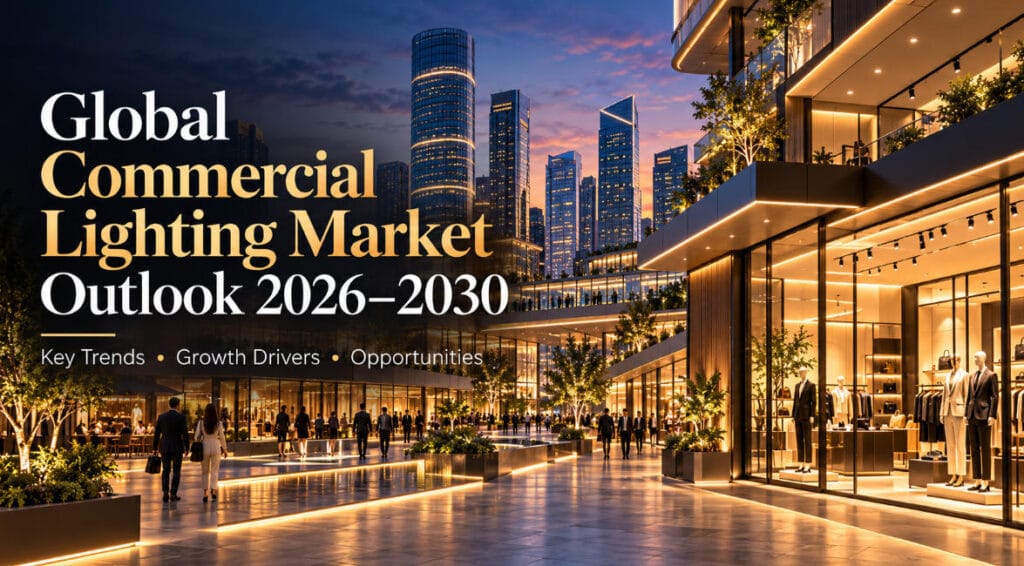
Коммерческое освещение выходит за рамки первого цикла замены на светодиоды
Первая светодиодная революция была прежде всего связана с эффективностью.
Владельцы коммерческих зданий заменяли люминесцентные, галогенные и другие традиционные технологии освещения, поскольку светодиоды обеспечивали более низкое потребление электроэнергии, более длительный срок службы и снижение требований к обслуживанию.
Этот переход уже далеко продвинулся.
Согласно Международному энергетическому агентству, освещение в зданиях и наружных применениях по-прежнему составляло примерно 8% мирового спроса на электроэнергию в 2024 году, что эквивалентно примерно 2 200 ТВт·ч потребления электроэнергии. МЭА утверждает, что следующий этап повышения эффективности освещения будет всё в большей степени зависеть не только от внедрения светодиодов, но и от более интеллектуальных систем управления, более высокой эффективности систем и более циркулярного дизайна продукции.
Для рынка коммерческого освещения в период с 2026 по 2030 год это создаёт принципиально иную конкурентную среду.
Вопрос больше не сводится просто к:
“Следует ли коммерческому проекту переходить на светодиоды?”
Вместо этого проектировщики и покупатели всё чаще задают вопросы:
- Насколько эффективно работает светильник в целом?
- Можно ли адаптировать световой поток к различным коммерческим средам?
- Можно ли изменить углы и распределение светового пучка после установки?
- Поддерживает ли система диммирование или интеллектуальное управление?
- Насколько хорошо освещение передаёт цвета товаров, материалов и архитектурной отделки?
- Можно ли легко обслуживать или заменять отдельные светильники?
- Насколько гибкой является система при изменении планировки торгового зала?
- Соответствует ли решение текущим требованиям в области энергетики и устойчивого развития?
Эти вопросы особенно актуальны в премиальной розничной торговле, шоурумах, гостиничном бизнесе, галереях и других средах, где освещение влияет не только на энергопотребление, но и на впечатления клиентов и визуальную презентацию.
1. Светодиоды останутся ключевой технологией, но дифференциация меняется
Светодиодное освещение останется доминирующей технологией, обеспечивающей рост коммерческого освещения до 2030 года.
Mordor Intelligence сообщила, что светодиодная продукция составляла примерно 66,59% рынка коммерческого освещения в 2025 году, при этом спрос на светодиодную продукцию, как ожидалось, продолжит активно расти в последующие годы.
В то же время сам рынок светодиодов становится всё более зрелым.
Это создаёт ценовое давление на стандартизированную продукцию и смещает конкуренцию в те области, где производители могут создавать дополнительную ценность.
Вместо конкуренции исключительно по ваттам, люменам и цене, поставщики коммерческого освещения всё чаще дифференцируют продукцию за счёт:
Оптических характеристик: точного управления световым пучком, улучшенной равномерности, снижения бликов и различных вариантов углов светового пучка.
Качество цвета: более высокая цветопередача и цветовые температуры, ориентированные на конкретные применения.
Гибкость светильников: регулируемые, модульные и взаимозаменяемые системы освещения.
Совместимость с системами управления: диммирование, датчики и интеграция интеллектуального освещения.
Специализация по применениям: светильники, оптимизированные для розничных магазинов, офисов, музеев, объектов гостиничного бизнеса и архитектурных сред.
Дизайн продукта: меньшие габариты, более чистая архитектурная интеграция и повышенный визуальный комфорт.
Это изменение особенно значимо для применений, ориентированных на демонстрацию.
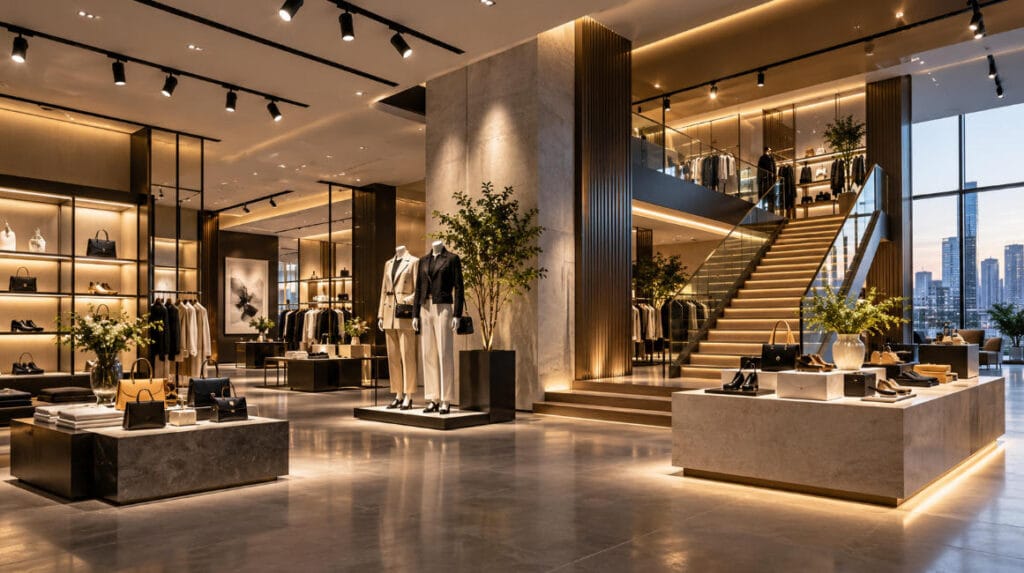
В розничных проектах и проектах выставочных залов, например, цель освещения состоит не просто в освещении помещения. Система освещения должна направлять внимание покупателя, определять визуальную иерархию и точно представлять товары.
Для проектов, требующих регулируемого акцентного освещения, покупатели могут ознакомиться с решениями SUNPOL ассортимент коммерческого освещения Sunpol для различных конфигураций трекового освещения, прожекторов и архитектурного освещения.
2. Модернизация и реконструкция станут одним из крупнейших источников спроса
Новое коммерческое строительство будет продолжать формировать спрос на освещение, но существующий фонд старых зданий представляет собой ещё одну крупную возможность в период с 2026 по 2030 год.
Согласно Mordor Intelligence, проекты модернизации и реконструкции составили примерно 62,21% спроса на коммерческое освещение в 2025 году.
Несколько факторов驱动 эту тенденцию.
Во-первых, многие коммерческие здания всё ещё эксплуатируют старые люминесцентные или ранние поколения светодиодных систем, которые могут быть модернизированы до более эффективных решений.
Во-вторых, розничные операторы и операторы коммерческой недвижимости регулярно перепроектируют интерьеры без замены всей инфраструктуры здания.
В-третьих, цели в области устойчивого развития побуждают владельцев зданий улучшать существующие активы, а не полагаться исключительно на новое строительство.
Для производителей освещения это означает, что совместимость с модернизацией и гибкость установки станут всё более важными.
Трековое освещение особенно актуально в этом контексте, поскольку положение светильников и направление освещения часто можно изменить без перестройки потолочной инфраструктуры.
Для розничных магазинов, галерей и выставочных залов, которые часто меняют планировку или экспозиции товаров, регулируемые системы могут снизить стоимость и сложность, связанные с будущими изменениями освещения.
Решения SUNPOL SP-GD5068B2 Цилиндрический трековый светильник, например, представляют собой тип архитектуры направленного освещения, обычно используемый там, где требуется гибкое акцентное освещение.
Вместо того чтобы рассматривать освещение как постоянную фиксированную конфигурацию, коммерческие пространства всё чаще внедряют системы, которые могут развиваться вместе с изменяющимися планировками.
3. Интеллектуальное и подключённое освещение станет более важным
Одной из наиболее очевидных тенденций периода 2026–2030 годов является дальнейшее развитие подключённого коммерческого освещения.
Mordor Intelligence оценивает, что интеллектуальные системы составили примерно 41,53% поставок коммерческого освещения в 2025 году, при этом ожидается, что подключённое освещение будет расти быстрее, чем традиционные неподключённые системы.
Этот переход важен, поскольку осветительные приборы распределены практически по каждому коммерческому зданию.
После подключения они могут стать частью более широкой инфраструктуры управления зданием.
В зависимости от проекта интеллектуальное коммерческое освещение может включать:
- Обнаружение присутствия
- Датчики дневного света
- Автоматическое диммирование
- Работа по расписанию
- Зональное управление освещением
- Мониторинг энергопотребления
- Централизованное управление системой
- Интеграция с системами управления зданием
Экономическая логика очевидна.
Светодиодная технология снижает энергию, необходимую для генерации света. Интеллектуальные системы управления могут сократить ненужные часы работы или чрезмерные уровни освещённости.
Сочетание эффективных светильников и интеллектуального управления, таким образом, создаёт дополнительный потенциал энергосбережения по сравнению с одной лишь заменой светильников.
Подключённое освещение также становится стратегически важным для крупных производителей освещения. Signify, например, продолжает уделять особое внимание подключённым системам и услугам как части своего портфеля профессионального освещения. Компания сообщила о 5,8 млрд евро общих продаж в 2025 году and operations across more than 70 markets, illustrating the scale at which global lighting companies are investing in integrated lighting technologies.
By 2030, smart functionality is likely to become increasingly expected in mid-to-large commercial projects rather than being treated solely as a premium feature.
4. Retail Lighting Will Become More Experience-Oriented
Retail represents one of the most demanding commercial lighting applications.
The growth of e-commerce has forced physical stores to provide something a website cannot fully replicate: a spatial and sensory brand experience.
Lighting plays a central role in creating that experience.
A successful retail lighting system must balance several layers of illumination:
Ambient lighting provides comfortable general visibility.
Accent lighting directs attention toward merchandise and important displays.
Vertical lighting improves visibility of shelves, walls and product displays.
Decorative lighting contributes to the brand environment.
Task lighting supports checkout counters, fitting rooms and working areas.
This has increased demand for flexible directional products such as track lights, recessed spotlights and adjustable downlights.
Beam control is particularly important.
A narrow beam can create dramatic product highlights, while wider distributions can illuminate shelving or larger displays. Adjustable luminaires allow lighting designers to modify these effects when merchandise layouts change.
Products such as the SP-GD6290B2 Цилиндрический трековый светильник reflect this broader movement toward compact, directional commercial display lighting.
For manufacturers serving the retail lighting market, optical performance and flexibility may therefore become more important competitive factors than raw lumen output alone.
5. Energy Regulations Will Continue to Reshape Product Requirements
Government efficiency policies remain another important driver of commercial lighting development.
LED technology has already dramatically improved luminaire efficacy compared with traditional lighting technologies. However, energy standards are continuing to become more demanding in several major markets.
This means commercial lighting manufacturers increasingly need to consider the efficiency of the complete lighting system rather than the LED chip alone.
Driver efficiency, thermal management, optical losses, dimming behavior and control compatibility all influence real-world performance.
The trend also favors suppliers capable of providing reliable technical documentation.
Commercial lighting buyers increasingly expect information such as:
- Luminaire wattage
- Luminous flux
- Luminous efficacy
- Color rendering index
- Color temperature
- Beam angle
- Driver specification
- Dimming compatibility
- Photometric data
- Product lifetime
- Certification information
For professional lighting manufacturers, transparent technical documentation is becoming an important part of building trust with architects, contractors and project buyers.
6. Sustainability Will Extend Beyond Energy Consumption
Energy efficiency remains a major sustainability metric, but the definition of sustainable lighting is expanding.
The IEA has highlighted circularity as one of the important elements of the next generation of lighting development.
Between 2026 and 2030, commercial lighting projects may increasingly evaluate products according to factors such as:
- Service life
- Replaceable components
- Driver accessibility
- Material selection
- Repairability
- Packaging
- Product efficiency
- Recyclability
This shift could gradually influence luminaire design.
A highly integrated fixture may look visually clean, but if an individual component cannot be serviced, the entire luminaire may need replacement when one component fails.
Modular architectures can potentially provide better long-term serviceability.
For project buyers, this changes the meaning of product cost.
The lowest purchase price does not always represent the lowest lifecycle cost.
Installation, electricity consumption, maintenance, component replacement and future layout changes must also be considered.
7. Asia-Pacific Will Remain a Critical Commercial Lighting Market
Regional growth will not be evenly distributed.
Different market studies identify Asia-Pacific as one of the most important regions for future commercial and industrial LED lighting growth.
Mordor Intelligence’s commercial and industrial LED lighting analysis identifies Asia-Pacific as the fastest-growing market during its 2025–2030 forecast period.
Growth in the region is supported by several structural factors, including:
- Continued urbanization
- Expansion of modern retail
- Hospitality development
- Commercial real-estate construction
- Infrastructure investment
- LED replacement cycles
- Manufacturing capacity
- Growing demand for energy-efficient buildings
Asia is also central to the lighting supply chain.
China in particular remains an important manufacturing base for LED components, drivers, optics and finished luminaires.
This gives established Chinese commercial lighting manufacturers an opportunity to move beyond OEM manufacturing and compete through product engineering, optical design, customization and project support.
For professional buyers evaluating lighting suppliers, manufacturing capability alone is therefore no longer enough.
Successful suppliers increasingly need to combine production capacity with application knowledge.
8. Commercial Lighting Will Become More Application-Specific
One of the strongest changes expected through 2030 is the transition from generic illumination toward application-specific lighting.
A supermarket, luxury fashion store, museum, hotel and corporate office may all technically require LED lighting, but their lighting objectives are completely different.
A supermarket may prioritize uniformity and operational efficiency.
A fashion retailer may prioritize color rendering and merchandise contrast.
A museum may require accurate beam control and protection of sensitive exhibits.
A hotel may emphasize visual comfort and atmosphere.
An office may focus on glare control, workplace comfort and daylight integration.
As a result, the future commercial lighting market will increasingly reward manufacturers capable of understanding the environment in which the luminaire is used.
SUNPOL’s approach to professional commercial lighting focuses on lighting solutions for commercial spaces where optical control, fixture flexibility and visual performance are important considerations.
For B2B buyers, the specification process should therefore start with the application rather than with the fixture.
What Commercial Lighting Buyers Should Consider Between 2026 and 2030
As commercial lighting technology continues to evolve, purchasing decisions should increasingly evaluate the complete lighting system.
Important questions include:
What is the lighting objective?
General illumination, product highlighting and architectural accent lighting require different optical strategies.
How flexible must the system be?
Retail and showroom layouts often change, making adjustable systems particularly valuable.
How important is color quality?
Projects involving fashion, food, artwork or premium materials may require higher color-rendering performance.
Will controls be required?
Even if intelligent controls are not installed immediately, future compatibility can reduce upgrade costs.
What is the lifecycle cost?
Energy use, maintenance, component replacement and installation should be considered together with purchase price.
Can the manufacturer provide project support?
Photometric information, product customization and technical consultation can significantly reduce specification risk for professional projects.
Outlook: What Will Define the Commercial Lighting Market by 2030?
The global commercial lighting market is unlikely to be defined by one breakthrough technology between 2026 and 2030.
Instead, several trends will develop simultaneously.
LED will continue replacing conventional lighting.
Retrofit demand will remain significant.
Connected lighting will become increasingly common.
Energy regulations will continue improving system efficiency.
Retail and hospitality lighting will become more experience-oriented.
Sustainability requirements will expand from energy savings toward lifecycle performance and circular product design.
And commercial buyers will increasingly expect lighting manufacturers to provide solutions rather than individual fixtures.
This transformation creates opportunities across the value chain.
For manufacturers, the challenge will be moving away from commodity competition toward optical engineering, application expertise, product reliability and flexible project solutions.
For lighting designers and contractors, the opportunity lies in using new technology to create commercial environments that consume less energy while providing better visual experiences.
For building owners and retailers, the most important shift may be recognizing that lighting is no longer simply an operational expense.
Well-designed commercial lighting can simultaneously influence energy performance, visual comfort, merchandise presentation and the overall character of a space.
As the market moves toward 2030, these combined functions are likely to become the real measure of commercial lighting value.
Data Sources & References
1. Mordor Intelligence — Commercial Lighting Market, 2026–2031
Reported global commercial lighting market size: USD 22.57 billion in 2026; forecast USD 51.04 billion by 2031; forecast CAGR approximately 17.73%.
2. The Business Research Company — Industrial and Commercial LED Lighting Global Market Report 2026
Reported market size: USD 93.19 billion in 2026; projected USD 193.38 billion by 2030; forecast CAGR approximately 20%. This dataset includes both industrial and commercial LED lighting and therefore has a broader scope than commercial-only studies.
3. International Energy Agency — “The Next Wave of LED Lighting: Smarter, Circular and More Efficient,” March 2026
The IEA estimates lighting in buildings and outdoor applications consumed approximately 2,200 TWh in 2024, representing around 8% of global electricity demand.
4. Mordor Intelligence — Global Commercial and Industrial LED Lighting Market, 2025–2030
Forecast CAGR approximately 16.4%, with Asia-Pacific identified as the fastest-growing region during the forecast period.
5. Signify Annual Report 2025 / 2026 Publication
Signify reported approximately EUR 5.8 billion in 2025 sales and operations in more than 70 markets while continuing its focus on LED, connected lighting systems and services.
Data note: Market research organizations use different definitions and segmentation methodologies. Commercial lighting, commercial LED lighting, and industrial & commercial LED lighting should not be treated as identical market categories. All market figures above retain the scope used by their original publishers.