
Choosing the right lighting for a commercial showroom involves more than selecting attractive fixtures or achieving sufficient brightness. One of the most important decisions is determining the appropriate color temperature for the products being displayed.
When comparing 3000K vs 4000K showroom lighting, designers, retailers, and project contractors often face a practical question: should a showroom use warm white lighting to create an inviting atmosphere, or neutral white lighting to present materials with a cleaner, more contemporary appearance?
The answer depends on the type of products, surface finishes, brand positioning, architectural environment, and visual experience the showroom aims to create.
For ceramic tile, natural stone, bathroom fixtures, furniture, and premium retail displays, even a relatively small difference in color temperature can significantly change how customers perceive surfaces and surrounding spaces.
This 3000K vs 4000K showroom lighting guide explains the technical differences between these two popular options, evaluates their advantages in different commercial applications, and provides a practical framework for selecting professional LED lighting systems.

Understanding Color Temperature in Showroom Lighting
Correlated color temperature (CCT) describes the perceived color appearance of a white light source. It is expressed in Kelvin (K).
Lower color temperatures produce a warmer visual appearance, while higher color temperatures generally create a more neutral or cooler impression.
In commercial interiors, color temperature influences the relationship between merchandise, architectural finishes, and surrounding light.
What Does 3000K Lighting Look Like?
3000K lighting produces a warm white appearance with a subtle yellowish character.
It is often associated with comfortable residential interiors, hospitality environments, luxury boutiques, and premium lifestyle displays.
When applied appropriately, 3000K lighting can create a welcoming atmosphere while complementing warm-colored materials such as beige marble, timber, brass, cream ceramics, and natural stone.
However, its warmer appearance may not be ideal for every merchandise category.
Cool gray tiles, certain white ceramics, and blue-toned materials can appear perceptually warmer under 3000K illumination than under a more neutral source.
What Does 4000K Lighting Look Like?
4000K lighting produces a more neutral white appearance with less visible warmth than 3000K.
It is frequently used in contemporary commercial interiors where clean presentation, visual clarity, and balanced illumination are priorities.
In tile and stone showrooms, 4000K can be particularly effective for displaying white, gray, silver, and cool-toned materials.
It can also support a technical or architectural presentation style.
Importantly, 4000K is not automatically brighter, more accurate, or more energy-efficient than 3000K. Actual illumination depends on the luminaire’s output, distribution, efficiency, and installation conditions.

3000K vs 4000K Showroom Lighting: Key Differences
The following comparison summarizes how the two color temperatures typically influence showroom design.
| Feature | 3000K Lighting | 4000K Lighting |
|---|---|---|
| Color appearance | Warm white | Neutral white |
| Visual atmosphere | Welcoming and intimate | Clean and contemporary |
| Typical design style | Luxury, residential, hospitality | Modern, architectural, technical |
| Warm-toned stone | Often complementary | More neutral appearance |
| White and gray tile | May introduce perceptual warmth | Often appears more neutral |
| Wood and furniture | Emphasizes warmth | Creates a balanced appearance |
| Bathroom displays | Spa-inspired environments | Contemporary sanitaryware displays |
| Color accuracy | Depends on spectrum and CRI | Depends on spectrum and CRI |
| Best selection method | Material mockup | Material mockup |
Neither option is universally superior.
The most suitable color temperature is the one that supports the product’s intended appearance without compromising customer comfort or material evaluation.
A showroom designed primarily for emotional engagement may benefit from a different lighting strategy than a technical material-selection center.
Which Color Temperature Is Better for Ceramic Tile and Stone Showrooms?
Ceramic tile and natural stone showrooms are among the most demanding commercial lighting applications.
Customers frequently compare subtle differences in surface color, marble veining, gloss, texture, and material consistency.
A lighting system that creates a beautiful interior atmosphere but distorts these characteristics may make product evaluation more difficult.
3000K for Warm Stone and Premium Residential Collections
3000K lighting can work particularly well for collections featuring:
- Beige and cream porcelain tiles
- Travertine-inspired finishes
- Warm marble patterns
- Earth-toned natural stone
- Wood-look ceramic tiles
- Luxury residential bathroom concepts
For example, a showroom presenting cream-colored marble alongside warm timber cabinetry may benefit from a 3000K lighting scheme.
The warm white appearance supports the overall residential design concept and can create visual continuity between the display products and surrounding materials.
Nevertheless, designers should verify that the warm lighting does not conceal important color differences between adjacent samples.
4000K for Modern Tiles and Cool-Toned Stone
4000K is often a practical starting point for showrooms displaying:
- White porcelain tiles
- Gray marble
- Concrete-effect surfaces
- Cool-toned ceramic collections
- Contemporary sintered stone
- Minimalist architectural materials
Its more neutral appearance can make it easier to evaluate products without the pronounced warm atmosphere associated with 3000K.
However, color temperature alone cannot guarantee faithful material presentation.
Surface reflectance, color rendering, installation geometry, and environmental contrast must also be considered.
For large-format materials, lighting designers should pay particular attention to beam distribution and reflection control.
SUNPOL explores these considerations in greater detail in its guide to lighting large-format porcelain slabs and sintered stone.
Why Real Showroom Conditions Matter
Tile showrooms frequently combine vertical display panels, horizontal product samples, decorative installations, and consultation areas.
These different functions can require different lighting approaches within the same space.
For example, a long display wall may benefit from consistent vertical illumination, while a residential bathroom demonstration area may require softer, warmer lighting.
SUNPOL’s Guanzhu Tile Showroom Lighting Project illustrates the importance of balancing individual material displays with an integrated bathroom environment.
The project provides useful application context, although its published overview should not be treated as a controlled 3000K-versus-4000K comparison.
3000K vs 4000K for Bathroom and Sanitaryware Showrooms
Bathroom showrooms present a different challenge from conventional product display spaces.
They combine material evaluation with lifestyle presentation.
Customers want to inspect the appearance of toilets, basins, bathtubs, faucets, mirrors, and ceramic surfaces. At the same time, they want to imagine how those products will look in a completed bathroom.
When 3000K Works Better
3000K is suitable for bathroom displays designed around relaxation, comfort, and luxury.
Examples include spa-inspired bathrooms, freestanding bathtub installations, warm stone walls, and hotel-style vanity displays.
Warm white illumination can complement brushed brass fixtures, wood accents, and creamy surfaces.
The overall effect can help communicate a comfortable residential environment.
When 4000K Works Better
4000K may be more suitable for modern sanitaryware displays featuring white ceramic fixtures, chrome finishes, and minimalist architecture.
Its neutral appearance can support product inspection and a cleaner visual presentation.
However, specular reflections from chrome fittings, mirrors, and glazed ceramics require careful control.
A higher color temperature does not solve glare problems.
Fixture positioning, optical design, beam direction, and reflected brightness are often more important.
A Combined Lighting Strategy
For large bathroom showrooms, using separate lighting zones can be particularly effective.
A project might use 4000K for technical product displays and 3000K for residential lifestyle installations.
The transition between zones should be carefully designed so that customers do not experience abrupt visual inconsistency.
Where accurate color comparison is essential, samples should also be evaluated under a consistent reference lighting condition.
How Color Temperature Affects Furniture and Retail Showrooms
Furniture showrooms frequently use lighting to communicate comfort, craftsmanship, and material quality.
A warm 3000K scheme may complement wooden furniture, upholstered sofas, leather chairs, and decorative accessories.
Conversely, 4000K may suit contemporary furniture collections featuring metal, glass, white laminates, and minimalist finishes.
For commercial retail environments, the correct choice depends heavily on brand identity and merchandise.
A premium boutique might prioritize atmosphere and visual hierarchy, while a construction-material showroom may prioritize consistent color evaluation.
The fundamental principle is that color temperature should serve the displayed product, not simply follow a general commercial lighting trend.
Why CRI Matters More Than Choosing 3000K or 4000K Alone
One of the most common mistakes in showroom lighting design is assuming that color temperature determines color-rendering accuracy.
It does not.
Correlated color temperature describes the color appearance of the light itself.
Color Rendering Index (CRI), by contrast, describes aspects of how faithfully a light source renders object colors compared with a defined reference illuminant.
A 3000K LED with poor color rendering may distort merchandise colors.
A 4000K LED with poor color rendering may create similar problems.
Both color temperatures can be suitable for professional showroom applications when the lighting system provides appropriate spectral quality.
Recommended Color-Rendering Considerations
For many premium commercial displays, CRI Ra ≥90 is a reasonable specification starting point.
For more demanding material comparisons, designers may also examine:
- CRI Ra: General color-rendering performance.
- R9: Rendering of saturated red, which is not included in the traditional CRI Ra average.
- TM-30 Rf: Average color fidelity relative to a reference illuminant.
- TM-30 Rg: Average color gamut relative to the reference.
- Chromaticity consistency: How closely fixtures match one another in apparent white color.
The Illuminating Engineering Society’s ANSI/IES TM-30-24 method provides a broader framework for evaluating color rendition than relying on traditional CRI alone. The IES Webstore+1
For a showroom comparing high-value tile or stone collections, these characteristics can be more useful than choosing a color temperature based only on its Kelvin rating.
Lighting Distribution, Beam Angle, and Glare Control
Selecting the correct color temperature is only one part of achieving professional showroom lighting.
Even high-quality 3000K or 4000K LED luminaires can produce unsatisfactory results when installed incorrectly.
Beam Angle Selection
Narrow beams are useful for emphasizing individual products, creating contrast, or highlighting decorative details.
Wider beams are generally more suitable for illuminating larger displays and providing greater coverage.
The correct beam angle depends on mounting height, fixture distance, product dimensions, and the required illumination pattern.
For large tile and stone surfaces, overlapping beams must be evaluated carefully to prevent unwanted bright spots or visible variations.
Glare and Reflected Brightness
Polished ceramic, mirrors, natural stone, and metallic bathroom fixtures can create strong reflections.
Simply increasing luminous output may make these reflections more noticeable.
Lighting designers should instead control the relationship between the luminaire, surface, and typical customer viewing position.
Suitable optical distributions and careful aiming can improve visual comfort without sacrificing product visibility.
Fixture Flexibility
Showrooms often change their product arrangements.
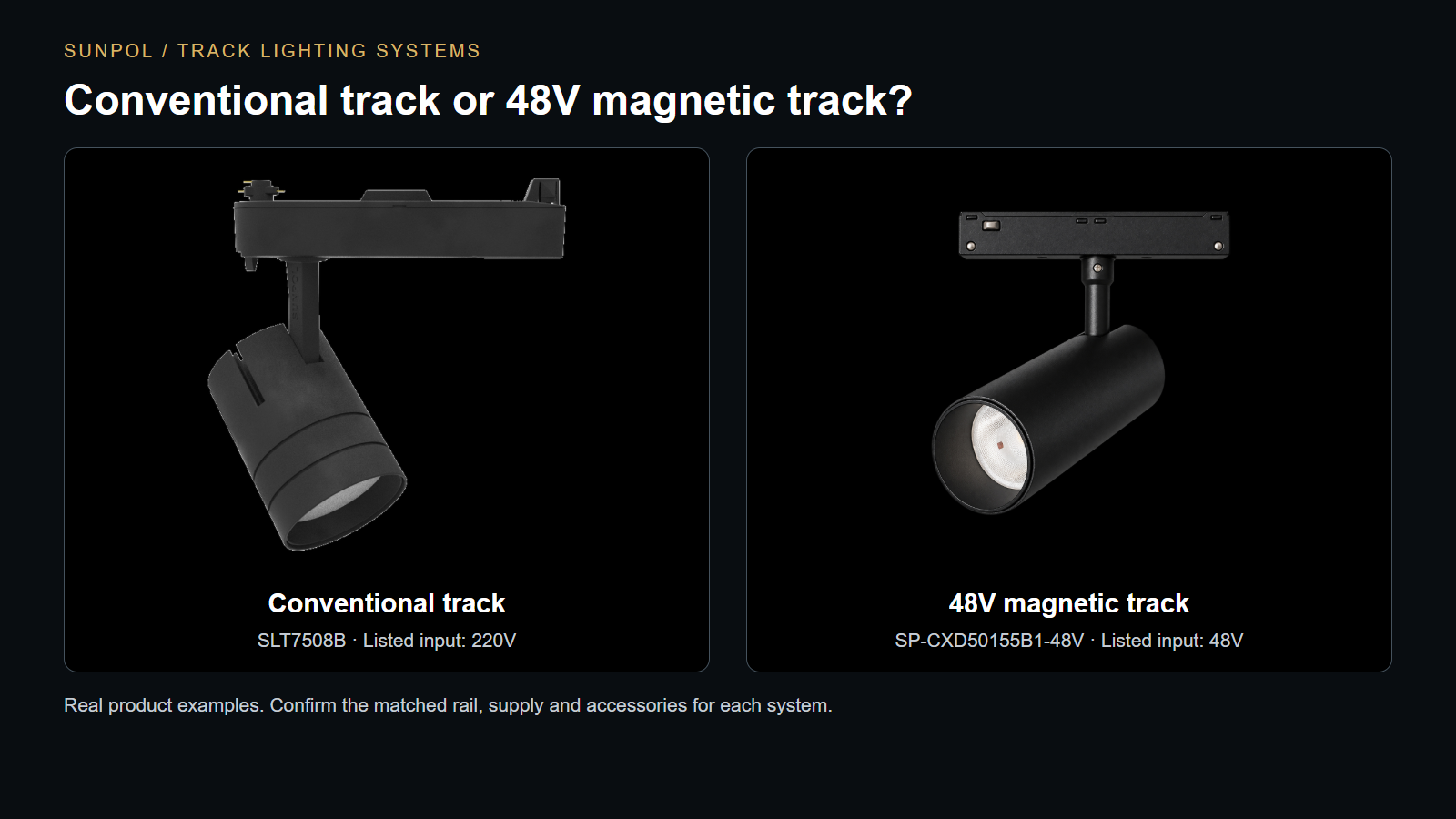
Track lighting can be useful because fixture positions and aiming directions may be adjusted as merchandising layouts evolve.
For example, the SUNPOL SP-GD6290B2 Cylinder Track Light offers multiple power configurations, 15°, 24°, and 36° beam-angle options, and a published nominal color-temperature range of 2700K–6500K.
Its listed CRI Ra ≥90 makes it a relevant candidate for color-sensitive commercial display applications. The exact available 3000K or 4000K configuration should be confirmed when specifying a project.
Practical 3000K vs 4000K Showroom Lighting Solutions
The most effective 3000K vs 4000K showroom lighting solutions begin with the visual objectives of each display area.
Rather than choosing one color temperature for an entire building, designers can divide the showroom into functional lighting zones.
The following values and approaches are preliminary design guidance, not fixed requirements or project-specific calculations.
| Showroom area | Suggested starting CCT | Lighting strategy |
|---|---|---|
| Warm marble display | 3000K | Controlled accent lighting |
| White porcelain display | 4000K | Consistent vertical illumination |
| Large gray stone wall | 4000K | Uniform coverage with controlled reflections |
| Luxury bathroom scene | 3000K | Layered ambient and accent lighting |
| Contemporary sanitaryware | 4000K | Neutral illumination with glare control |
| Furniture lifestyle display | 3000K | Soft background and directional accents |
| Mixed-material showroom | 3500K or zoned CCT | Material testing and scene-based design |
| Consultation and sampling area | Project-dependent | Consistent light for accurate comparison |
Step 1: Evaluate the Product Collection
Identify the dominant material colors and finishes.
Warm-colored merchandise may benefit from warmer illumination, while cool-toned products may be presented more neutrally at 4000K.
Avoid making the decision solely on the overall interior design style.
Step 2: Evaluate the Viewing Environment
Consider ceiling height, daylight penetration, wall color, display geometry, and customer viewing distance.
A 3000K luminaire surrounded by cool daylight may look warmer than it would in an enclosed showroom.
Similarly, a 4000K fixture may appear relatively cool when placed next to a warmer illuminated display.
Step 3: Select Appropriate Color Quality
Confirm the CRI and, where available, TM-30 data for the proposed light source.
For critical product comparisons, check the actual spectrum and appearance of representative samples rather than relying solely on nominal specifications.
Step 4: Create an On-Site Lighting Mockup
Install representative 3000K and 4000K luminaires under realistic conditions.
Evaluate the same materials at comparable illuminance, viewing positions, and beam distributions.
Assess surface colors, reflections, texture visibility, customer comfort, and relationships between adjacent displays.
Where daylight changes significantly, repeat the evaluation under relevant daytime and evening conditions.
Step 5: Finalize the Lighting Specification
After selecting the preferred lighting approach, document the required CCT, color-rendering characteristics, optical distribution, dimming configuration, and acceptable color variation.
For projects involving multiple fixture types, consistent specifications can help reduce visible differences between luminaires.
Common Mistakes When Choosing Showroom Color Temperature
Several recurring mistakes can undermine an otherwise well-designed commercial lighting project.
Mistake 1: Assuming 4000K always delivers more brightness.
Kelvin measures color appearance, not luminous output. Brightness must be evaluated through actual photometric performance.
Mistake 2: Using 3000K for every luxury showroom.
Warm lighting may complement certain materials but can be inappropriate when customers need to compare cool-toned or color-sensitive finishes.
Mistake 3: Ignoring color-rendering performance.
A visually attractive color temperature cannot compensate for poor spectral quality.
Mistake 4: Mixing color temperatures without a defined zoning strategy.
Unplanned combinations of 3000K and 4000K can create inconsistent product appearances and distracting visual transitions.
Mistake 5: Selecting fixtures before evaluating display materials.
The luminaire should be specified around the displayed products and project requirements.
Mistake 6: Overlooking long-term maintenance and color consistency.
Replacement luminaires with different color characteristics may create noticeable mismatches, particularly along continuous display walls.
For professional buyers, these considerations should form part of supplier selection. SUNPOL’s commercial track light supplier guide explains additional criteria such as optical engineering, technical documentation, product quality, and project support.
How SUNPOL Approaches Professional Showroom Lighting
Different showrooms require different lighting strategies.
At SUNPOL, the focus is on considering the displayed materials, architectural conditions, fixture performance, and practical installation requirements together.
For tile and stone showrooms, relevant priorities include material appearance, beam control, color quality, and vertical illumination.
For bathroom displays, designers must also consider polished surfaces, mirrors, lifestyle atmosphere, and visual comfort.
For retail and furniture showrooms, flexible accent lighting can help establish product hierarchy while supporting changes in merchandising layouts.
SUNPOL’s commercial lighting portfolio includes directional track lights, adjustable spotlights, and other architectural lighting products designed for different display requirements.
Its published product and project information provides a starting point for evaluating suitable lighting configurations.
However, a professional lighting recommendation should ultimately depend on the actual showroom layout, samples, project conditions, and confirmed luminaire specifications.
Businesses exploring a tailored approach can learn more about SUNPOL lighting and its professional showroom lighting solutions.
Frequently Asked Questions
Is 3000K or 4000K better for showroom lighting?
Neither is universally better. 3000K often works well for warm materials and lifestyle-oriented displays, while 4000K is commonly suitable for modern interiors, white ceramic products, and cool-toned surfaces. Testing with actual products is the most reliable selection method.
Is 4000K too cool for a luxury showroom?
Not necessarily. A well-designed 4000K lighting system can create a sophisticated contemporary environment, particularly when combined with suitable materials, controlled brightness, and effective architectural lighting.
Is 3000K suitable for ceramic tile displays?
Yes. It can be especially effective for beige, cream, travertine-inspired, and warm-toned tile collections. However, color-sensitive product comparison may require a different or additional reference lighting condition.
Which color temperature shows the true color of marble?
Neither 3000K nor 4000K automatically guarantees true color reproduction. The perceived appearance depends on the spectral characteristics of the light, its CCT, the material, and the surrounding viewing conditions. High-fidelity lighting and actual material testing are essential.
Can 3000K and 4000K be used in the same showroom?
Yes. They can be used in separate functional zones where different visual experiences are intended. However, the transitions should be carefully planned, and customer comparison areas should maintain consistent lighting conditions.
Does 4000K LED lighting consume more electricity than 3000K?
Not inherently. Electricity consumption depends on electrical input power and system performance. Luminaires at different color temperatures may have different efficacy, but the CCT rating alone does not determine energy consumption.
What CRI should commercial showroom lighting have?
CRI Ra ≥90 is often a useful starting point for premium color-sensitive displays. Additional metrics such as TM-30 Rf, Rg, and appropriate hue-specific measures can support more detailed lighting evaluation.
Choosing the Right Color Temperature for Your Showroom
The decision between 3000K vs 4000K showroom lighting should be based on more than visual preference.
3000K can create a warm and inviting atmosphere, making it particularly suitable for luxury residential displays, warm stone collections, furniture, and spa-inspired bathroom environments.
4000K provides a more neutral appearance that often complements white ceramics, cool-toned stone, contemporary sanitaryware, and modern architectural displays.
For showrooms presenting a wide range of materials, a carefully planned combination of different lighting zones may provide greater flexibility than applying a single color temperature throughout the entire space.
Ultimately, the best lighting solution brings together appropriate color temperature, high-quality color rendering, controlled optics, visual comfort, and accurate product presentation.
By evaluating these factors together, commercial showroom operators can create environments that help customers understand materials, compare products confidently, and experience the intended character of each collection.
Planning a new showroom or upgrading an existing lighting system?
Explore SUNPOL’s professional lighting solutions and discuss your display materials, showroom layout, and lighting objectives with the SUNPOL team.
References and Technical Resources
The following industry references support the technical discussion in this article:
- Illuminating Engineering Society (IES). ANSI/IES TM-30-24: IES Method for Evaluating Light Source Color Rendition. Official IES standard
- Illuminating Engineering Society (IES). Color: Specify and Conquer. IES technical article
- Illuminating Engineering Society (IES). Using TM-30 to Improve Your Lighting Design. IES application guidance
- SUNPOL Lighting. SP-GD6290B2 Cylinder Track Light — Product Specifications. Official product specifications
Technical note: The application recommendations are design starting points rather than mandatory lighting standards. The article does not claim independent comparative testing or measured customer-sales outcomes.