Choosing the right commercial track light supplier is an important decision for lighting distributors, retail brands, architects, contractors, and commercial project developers.
Commercial track lighting is widely used in retail stores, shopping malls, tile showrooms, art galleries, furniture displays, and other professional environments. Its flexibility allows lighting fixtures to be repositioned, redirected, or replaced as interior layouts and display requirements change.
However, not all commercial track lights deliver the same level of performance.
Two fixtures may look similar and have identical wattage ratings, yet produce significantly different results in beam uniformity, color reproduction, glare control, operating temperature, and long-term reliability.
For professional buyers, the challenge is not simply finding a manufacturer that can offer competitive prices. It is identifying a supplier capable of delivering consistent product quality, reliable technical documentation, suitable customization options, and dependable project support.
This commercial track light supplier guide explains the essential factors to evaluate before choosing a long-term lighting partner.
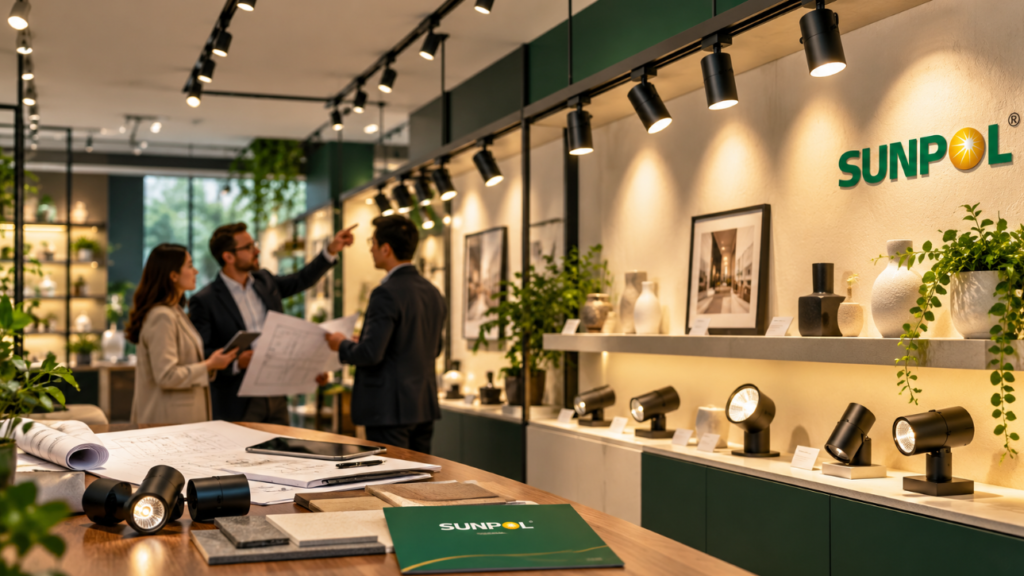
Understand Your Commercial Lighting Requirements First
Before comparing suppliers, clearly define the intended lighting application.
Different commercial spaces have different visual and operational requirements. A track light designed for a fashion retail store may not produce the best results in a ceramic tile showroom or an art gallery.
Retail Stores and Fashion Boutiques
Retail lighting must attract attention, establish visual hierarchy, and present merchandise in an appealing way.
Important requirements include:
- Accurate color rendering for clothing and merchandise.
- Adjustable beam angles for different display sizes.
- Controlled glare for customer comfort.
- Flexible positioning for seasonal merchandising changes.
- Consistent color temperature across multiple fixtures.
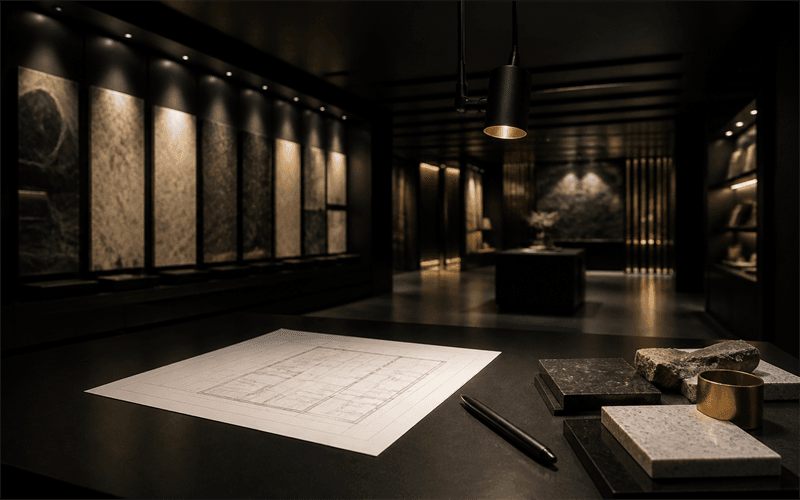
Tile and Stone Showrooms
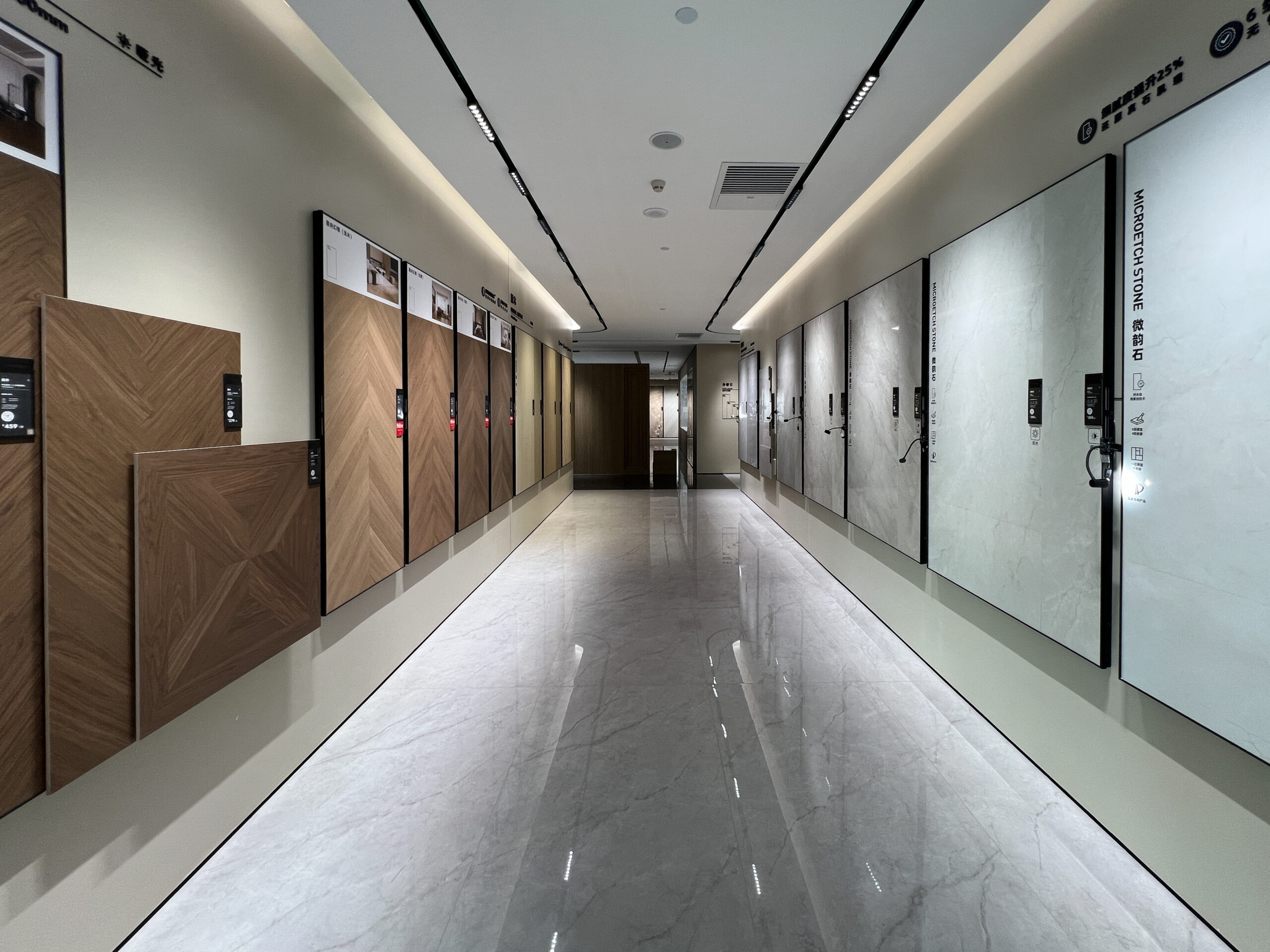
Tile, porcelain, and natural stone displays require particular attention to surface appearance.
Poor lighting can flatten surface textures, exaggerate reflections, or distort the appearance of material colors.
For these environments, buyers should prioritize high color rendering, suitable beam distribution, precise aiming, and controlled reflections.
Art Galleries and Exhibition Spaces
Museums and galleries often require carefully controlled illumination to highlight artwork without creating excessive glare or unwanted brightness differences.
Depending on the objects being displayed, additional considerations may include conservation requirements, dimming performance, and controlled light exposure.
Commercial Offices and Hospitality Spaces
In offices, hotels, and multipurpose commercial interiors, track lighting may provide accent illumination alongside general lighting systems.
Visual comfort, fixture appearance, dimming compatibility, energy efficiency, and maintainability become particularly important.
Key takeaway: A reliable supplier should ask about the application, mounting height, display materials, lighting objectives, and project conditions before recommending a specific product.
Buyers can begin by reviewing the available commercial LED track lighting products from SUNPOL to understand different track-mounted lighting configurations.
Evaluate the Supplier’s Technical and Optical Capabilities
One of the most important steps in selecting a commercial track light supplier is evaluating the technical performance of its products.
Wattage alone is not sufficient to determine lighting quality.
Professional buyers should compare measurable specifications and, when possible, request independent testing or sample evaluation.
Luminous Output and Efficiency
Luminous flux, expressed in lumens, indicates the total visible light output of a luminaire.
Luminous efficacy, expressed in lumens per watt (lm/W), describes how efficiently electrical power is converted into visible light.
Higher efficacy can help reduce operating costs, but the most efficient product is not automatically the most suitable for every application.
A luminaire with high total light output may still perform poorly if its beam distribution does not match the intended display.
For example, a wide-beam fixture may illuminate an entire merchandise wall, while a narrow-beam fixture may deliver more concentrated light to a single product.
The final selection should consider both efficiency and the required light distribution.
Color Rendering Index (CRI)
Color rendering is especially important in professional display environments.
For many commercial applications, CRI Ra ≥80 may provide an acceptable starting point, depending on project requirements. However, premium retail stores, tile showrooms, furniture displays, and other color-sensitive environments often benefit from CRI Ra ≥90.
High color rendering helps customers evaluate product colors and materials more accurately.
Still, CRI should not be treated as the only indicator of color quality.
Professional buyers may also request TM-30 information, including color fidelity and gamut characteristics, when detailed color evaluation is important.
The Illuminating Engineering Society describes TM-30 as a method for evaluating multiple aspects of color rendition beyond a single average CRI value.
Beam Angle and Optical Distribution
Beam angle determines how light spreads from the luminaire.
Common commercial applications may use different beam distributions:
| Beam angle | Typical application |
|---|---|
| 10°–15° | Small objects and concentrated accent lighting |
| 20°–24° | Individual displays, sculptures, featured merchandise |
| 30°–36° | General retail accent lighting and medium-sized display zones |
| 40°–60° | Larger product areas and broader illumination |
These ranges are indicative rather than universal specifications. The correct angle depends on mounting height, aiming direction, target dimensions, and the required illuminance.
A professional supplier should be able to explain the difference between nominal beam angle and the resulting illumination on a real surface.
Glare Control
Excessive glare is one of the most common problems in commercial lighting.
Poor glare control can make customers uncomfortable, create unwanted reflections on glass or polished surfaces, and reduce the visual quality of merchandise.
When evaluating suppliers, examine the optical design, light source position, accessory options, fixture aiming, and proposed installation layout.
A well-designed commercial track lighting system should provide focused illumination without causing unnecessary visual discomfort.
Thermal Management
LED temperature influences performance and long-term reliability.
A supplier should therefore be able to explain:
- Heat sink construction and materials.
- Thermal performance at rated operating conditions.
- Driver temperature limits.
- LED module temperature management.
- Relevant reliability and lifetime test evidence.
Products with insufficient thermal management may experience accelerated lumen depreciation, color shifts, or electronic component failures.
Check Manufacturing Experience and Quality Control
A commercial lighting supplier should demonstrate the ability to produce consistent results across multiple orders.
This is particularly important for distributors, lighting wholesalers, and contractors managing repeat projects.
Manufacturing Capability
When evaluating a manufacturer, ask whether it has the resources and processes needed for the relevant work.
These may include precision machining, optical assembly, fixture finishing, electrical assembly, photometric testing, and final product inspection.
Not every manufacturer must produce every component internally. What matters is whether the supplier maintains effective control over critical components, production processes, and product verification.
Quality Control Procedures
A dependable quality management process should cover several stages of production.
Incoming material inspection: Checks whether important purchased components meet specified requirements.
In-process inspection: Identifies potential problems before products reach final assembly.
Photometric verification: Confirms light output, distribution, and color characteristics against approved specifications.
Electrical and thermal testing: Helps verify safe and reliable operation under defined conditions.
Final inspection: Checks appearance, operation, labeling, packaging, and order conformity.
Buyers should request appropriate test records or inspection procedures rather than relying exclusively on general quality claims.
Batch-to-Batch Consistency
A supplier may produce an excellent initial sample but struggle to maintain the same quality in later production.
For commercial projects, inconsistent color temperature, beam appearance, or luminaire dimensions can create substantial installation and maintenance problems.
Ask prospective suppliers how they manage component substitutions, production tolerances, approved samples, and batch traceability.
Manufacturing transparency is therefore a valuable part of the selection process.
SUNPOL provides information about its production processes, including material preparation, precision machining, assembly, and inspection, on its LED lighting factory and manufacturing capabilities page.
4. Verify Product Certifications and Market Compliance
Certifications and regulatory compliance are essential considerations when importing commercial lighting products.
Requirements vary by country, product configuration, electrical characteristics, and installation environment.
A supplier should understand which documentation is relevant to the intended destination market.
European Markets
Buyers supplying the European Economic Area should review applicable EU requirements, including relevant safety, electromagnetic compatibility, environmental, and documentation obligations.
Depending on the product, these may involve the Low Voltage Directive, EMC Directive, RoHS requirements, and other applicable legislation.
CE marking is a manufacturer’s declaration of conformity with applicable EU requirements; it is not itself a universal third-party certification.
North American Markets
For the United States and Canada, buyers may need to verify compliance with applicable electrical safety standards and local installation requirements.
Relevant product listings or certifications can be important depending on the market, authority having jurisdiction, and project specifications.
Never assume that a certification accepted in one region automatically satisfies the requirements of another.
International Luminaire Safety Standards
IEC 60598-1 is an important international reference for general luminaire safety requirements.
The applicable standards and certification requirements should be confirmed for the exact product type and target market.
Documents to Request
Before placing a commercial order, request the documents relevant to the specific model and destination market, such as applicable test reports, declarations of conformity, product labels, installation instructions, and supporting technical files.
Where third-party certificates are involved, verify their scope, issuing organization, validity, and model coverage.
Important: A supplier’s general certification claims do not automatically demonstrate that every product model or configuration is certified.
Examine Product Customization and Project Support
Commercial lighting projects often require more than standard catalog products.
Architects, lighting designers, engineering contractors, and international distributors may need different technical configurations depending on their projects.
A capable supplier should be able to discuss suitable customization options and their practical limitations.
Common Customization Requirements
Commercial track lighting customization may involve:
- Different power ratings and fixture sizes.
- Beam angle and optical configuration options.
- Color temperature and color-rendering requirements.
- White, black, or project-specific finishes.
- Track adapter and electrical system compatibility.
- Driver and dimming options.
- Branding, labeling, and packaging requirements.
Not every option is available for every fixture. Customized configurations may also require additional engineering validation and compliance review.
OEM and ODM Cooperation
For distributors developing private-label product ranges, OEM or ODM cooperation may be important.
OEM arrangements typically involve supplying products under a customer’s branding or agreed specifications.
ODM cooperation may involve broader product development and design modifications.
Buyers should clarify tooling ownership, intellectual property, development costs, minimum order quantities, testing responsibilities, and production approval procedures before proceeding.
Lighting Design Support
Technical support is particularly valuable for complex showroom projects.
A professional lighting supplier may help customers select beam distributions, suitable fixture positions, mounting configurations, and color characteristics based on the project layout.
For commercial retail applications, SUNPOL’s retail display lighting solutions illustrate how accent lighting, high-CRI illumination, ambient lighting, and adaptable fixture positioning can be considered together.
This application-focused approach can help buyers move beyond purchasing individual fixtures toward planning a coordinated lighting system.
Assess Track System Compatibility and Installation Requirements
Track system compatibility is often overlooked during the supplier selection process.
Commercial track lights are not universally interchangeable.
Different systems may vary in track dimensions, electrical configuration, adapter construction, mounting methods, and control arrangements.
A fixture that appears mechanically compatible with a track may still be electrically unsuitable.
Important Compatibility Questions
Before purchasing, confirm:
- What type of track does the fixture support?
- What input voltage and electrical configuration are required?
- Is the fixture compatible with the intended track manufacturer and model?
- Does the system support the required dimming or control method?
- Can the fixture be securely positioned and adjusted after installation?
- Are compatible replacement adapters and accessories available?
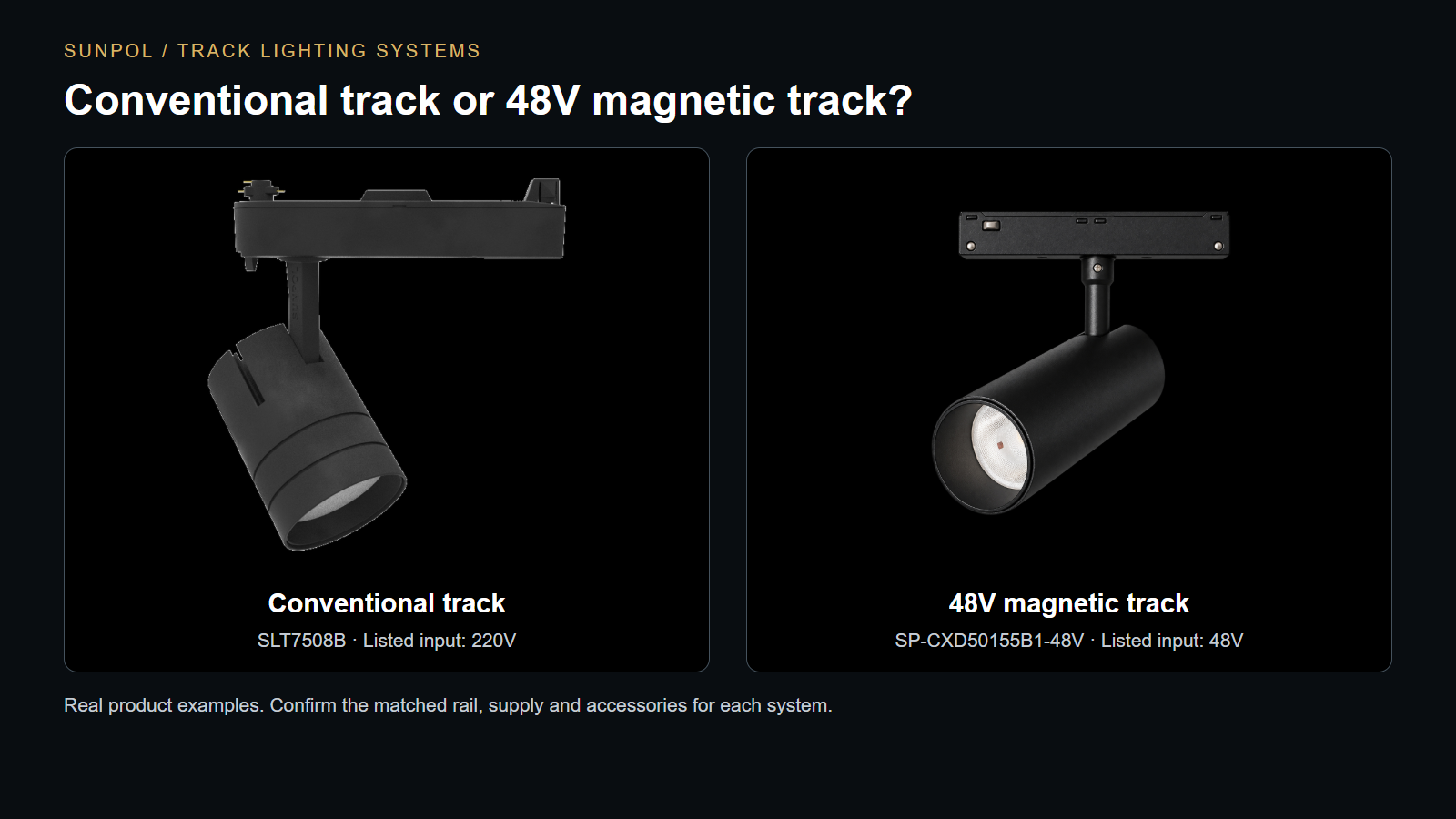
For example, some commercial projects use conventional mains-powered track systems, while others require low-voltage magnetic tracks or specialized control systems.
These products should not be considered interchangeable without technical verification.
Where a project uses existing track infrastructure, suppliers should request detailed track information before recommending replacement luminaires.
A dependable commercial track light supplier should provide clear compatibility guidance and appropriate installation documentation.
Compare Commercial Track Light Products Using Real Specifications
One of the most effective ways to evaluate suppliers is to compare actual product specifications rather than marketing descriptions.
A supplier’s technical credibility becomes clearer when product pages contain measurable information about light output, beam distribution, electrical characteristics, materials, and installation requirements.
Example: SUNPOL SP-GD8308B1AI 30W AI Track Light
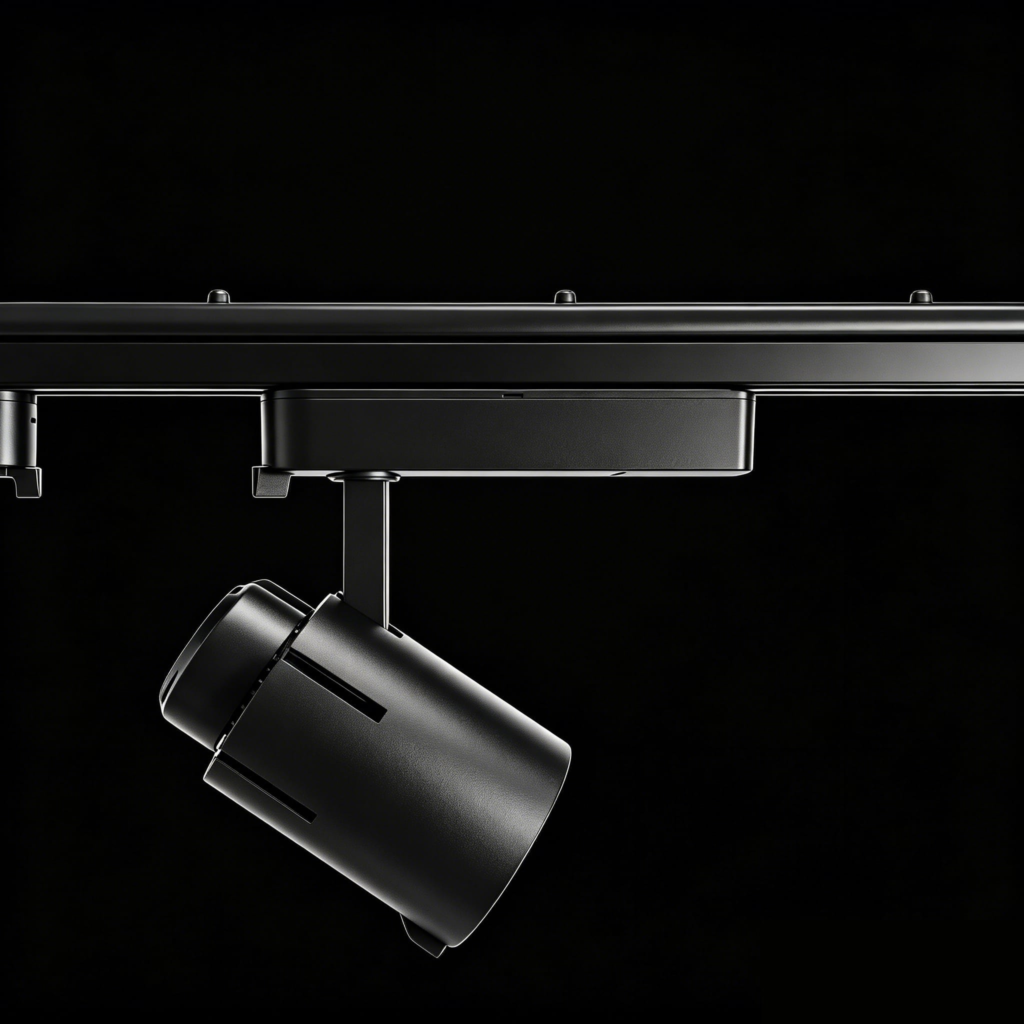
This track-mounted fixture is positioned for commercial product displays and showroom applications, combining adjustable directional lighting with an AI intelligent lighting function.Illustrative product reference; verify final specifications on the linked official product page.
The following published specifications offer an example of the technical information buyers should examine when comparing professional track lighting products.
| Parameter | Published specification |
|---|---|
| Model | SP-GD8308B1AI |
| Rated power | 30W |
| Input voltage | AC 220V, 50/60Hz |
| Luminous flux | 2,250 lm |
| Luminous efficacy | ≥75 lm/W |
| Beam angle | 36° |
| Color rendering | CRI Ra ≥90 |
| Horizontal rotation | 350° |
| Vertical tilt | 90° |
| Material | 1070 aluminum |
| Protection rating | IP20 |
| Track compatibility | T3, S3, ultra-narrow track |
These values are published in SUNPOL’s product specifications.
The 36° beam distribution and adjustable aiming make the fixture relevant to accent lighting applications such as merchandise displays, feature walls, and showroom product collections.
Its high-CRI specification is also particularly relevant for environments where accurate material and product presentation matters.
However, before specifying any luminaire for a project, buyers should still confirm electrical compatibility, detailed photometric performance, required control features, and installation conditions.
Explore the SUNPOL SP-GD8308B1AI 30W AI Track Light for additional technical information.
Evaluate Reliability, Warranty, and After-Sales Support
Product quality matters, but the supplier’s response after delivery is equally important.
Commercial lighting projects may require years of operation, replacement parts, maintenance support, and consistent product availability.
An attractive warranty statement has limited value if the supplier cannot provide a clear claims procedure or suitable replacement components.
Warranty Terms
Ask prospective suppliers to provide written warranty conditions.
Important details include the warranty period, covered components, excluded conditions, permitted operating environments, and remedies available if defects occur.
A warranty should also explain whether the supplier provides replacement fixtures, replacement components, repair services, or other remedies.
Long-Term Product Availability
For retail chains and multi-location commercial projects, product continuity can be critical.
A buyer may need to purchase additional fixtures several years after the initial installation.
Changes in LED packages, optics, drivers, or fixture dimensions can make future replacement more difficult.
Ask suppliers about product lifecycle management, replacement compatibility, and notifications concerning major component changes.
Reliability Testing
Reliable suppliers should be able to discuss the testing methods relevant to the product.
These may include:
- Electrical safety and functional testing.
- Thermal performance evaluation.
- LED lumen-maintenance assessment.
- Driver performance and reliability.
- Product aging and production inspection.
- Mechanical durability where applicable.
Claims about exceptionally long operating lifetimes should be supported by appropriate evidence and clearly stated assumptions. SUNPOL describes its incoming material inspection, in-process checks, photometric testing, and final verification procedures on its lighting quality assurance page.
Buyers can use this information as a starting point for discussing the specific inspection records and acceptance criteria needed for their projects.
Compare Total Procurement Cost, Not Just Unit Price
Price is an important purchasing factor, particularly for large commercial installations.
However, choosing the lowest-priced fixture does not always result in the lowest overall project cost.
The total cost of procurement and ownership can include multiple expenses beyond the initial purchase.
Initial Procurement Costs
These may include the luminaire price, track system, adapters, accessories, project customization, packaging, inspection, freight, insurance, duties, and other applicable import charges.
Installation Costs
Poorly documented or incompatible lighting products may increase installation time and create additional labor expenses.
A technically suitable product with clear installation instructions can reduce the risk of rework.
Operating Costs
Electrical power consumption influences the ongoing cost of a commercial lighting installation.
Consider an illustrative project using 100 track lights rated at 30W, operating 10 hours per day for 300 days per year.
The annual energy consumption would be:
100 × 30W × 10 hours × 300 days ÷ 1,000 = 9,000 kWh per year.
At an assumed electricity price of US$0.15 per kWh, annual electricity cost would be US$1,350.
This example considers luminaire power consumption only. Actual consumption may vary with controls, operating schedules, and system characteristics.
Maintenance and Replacement Costs
Fixture failures can involve more than the replacement product.
Maintenance may also require labor, access equipment, store disruption, shipping, and inventory management.
For retailers operating across multiple locations, these costs can become significant.
Therefore, commercial buyers should compare suppliers using a realistic total-cost model rather than relying exclusively on the lowest quotation.
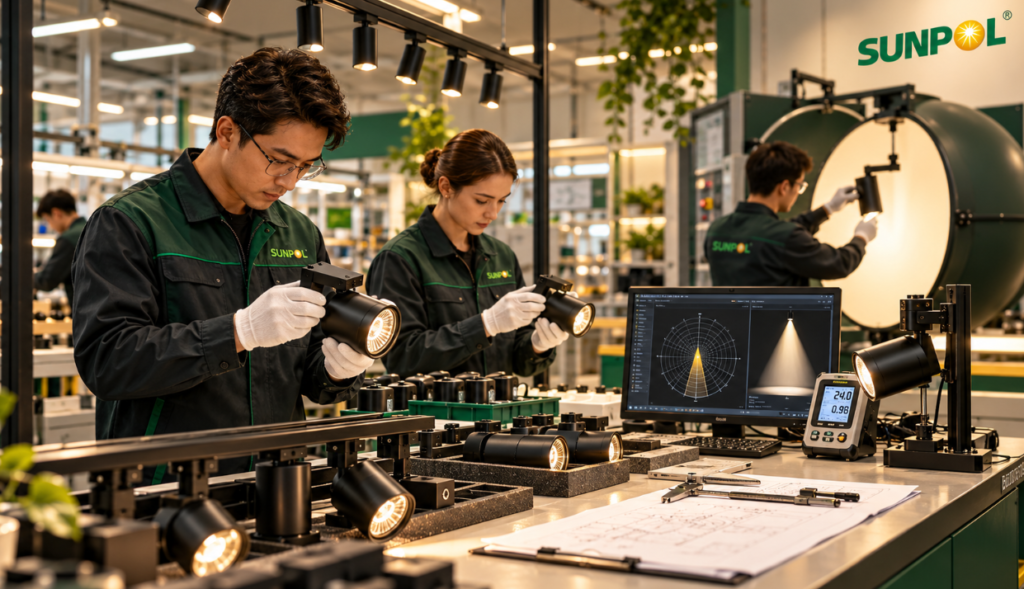
Review Delivery Capacity and International Cooperation
Reliable delivery is essential for commercial construction and retail rollout projects.
Delays in lighting procurement can affect installation schedules, store openings, and project completion.
A supplier’s delivery capability should be assessed before an order is confirmed.
Production Lead Time
Ask for separate estimated lead times for samples, standard products, customized configurations, and repeat orders.
Do not assume that lead times published for standard catalog products apply to all project requirements.
Minimum Order Quantity
Minimum order quantities may differ according to fixture configuration, finish, packaging requirements, and component availability.
For international distributors, flexible purchasing arrangements may be useful during product introduction and market testing.
Export Documentation
International buyers should confirm that suppliers can provide the documentation necessary for the shipment and destination market.
This may include commercial invoices, packing lists, shipping documents, certificates of origin where applicable, and relevant product compliance records.
Communication and Engineering Responsiveness
Supplier communication can be especially important when technical modifications or installation questions arise.
A capable partner should respond accurately to engineering inquiries, identify limitations, and communicate changes before production.
For larger projects, buyers should also agree on technical drawing approval, pre-production samples, order inspections, and delivery milestones.
Common Mistakes When Selecting a Commercial Track Light Supplier
Many procurement problems can be avoided by identifying common mistakes early.
Choosing Only by Wattage
Two 30W track lights may deliver different illumination results because of differences in optical distribution, efficiency, and construction.
Compare photometric data and application suitability rather than treating wattage as the primary performance measure.
Ignoring Track Compatibility
Ordering fixtures without verifying their electrical and mechanical compatibility with the intended track can cause costly delays.
Compatibility should be confirmed before bulk procurement.
Focusing Only on Purchase Price
A lower unit price may be offset by higher installation, maintenance, or replacement costs.
Compare total costs alongside technical performance.
Accepting Unverified Certification Claims
Certification statements should be supported by documentation relevant to the exact model, configuration, and market.
Skipping Sample Evaluation
Physical samples can reveal issues that are difficult to identify from catalog photographs.
Whenever practical, evaluate beam appearance, fixture quality, dimming behavior, heat management, and track installation before approving bulk production.
Overlooking Future Replacement Requirements
Commercial lighting installations often remain in service for years.
Confirm how future replacement products and spare components will be managed.
Why Consider SUNPOL as a Commercial Track Lighting Partner?
SUNPOL lighting focuses on professional commercial and showroom illumination, including track lighting, adjustable spotlights, and other architectural lighting products.
Its product positioning emphasizes the presentation of materials, merchandise, and commercial interior environments.
Rather than treating every lighting project as a simple fixture purchase, SUNPOL approaches commercial lighting through the relationship between light distribution, surface characteristics, fixture positioning, and visual experience.
Specialized Commercial Lighting Applications
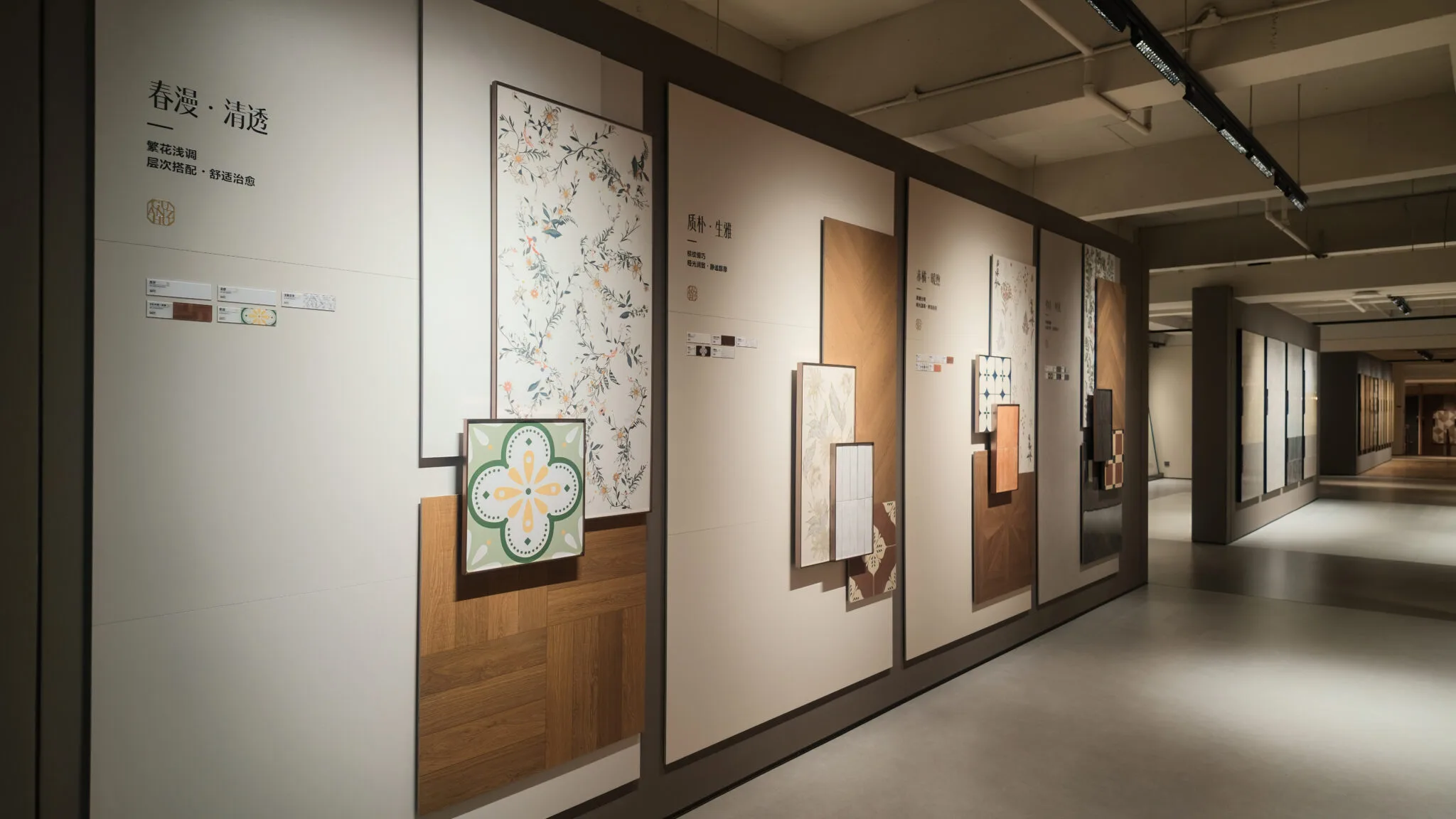
SUNPOL’s product portfolio is relevant to several display-oriented environments, including retail stores, ceramic tile and stone showrooms, bathroom showrooms, furniture displays, and commercial exhibition spaces.
These applications often demand more precise lighting than basic general-purpose illumination.
Product and Optical Engineering
SUNPOL publishes technical information for selected track lighting products, including beam angles, color rendering, power ratings, adjustment ranges, and track compatibility.
This information helps professional buyers begin a structured product evaluation.
Manufacturing and Quality Processes
SUNPOL also describes its manufacturing activities and inspection procedures through its official factory and quality assurance pages.
For procurement teams, these resources provide a foundation for further supplier qualification, sample testing, and technical discussions.
Project-Oriented Cooperation
For showroom and commercial display projects, the company places emphasis on understanding the intended visual effect and recommending lighting approaches that match the displayed materials.
However, as with any supplier, buyers should confirm the exact product specifications, requested customization, project documentation, and commercial terms before proceeding.
SUNPOL may be particularly worth evaluating for projects where directional lighting, color rendering, visual comfort, and display presentation are central purchasing considerations.
Commercial Track Light Supplier Evaluation Checklist
Before finalizing a supplier, procurement teams can use a weighted evaluation model.
The following framework is an illustrative purchasing tool, not an independent rating of any manufacturer.
| Evaluation criteria | Suggested weighting |
|---|---|
| Optical and technical performance | 25% |
| Manufacturing quality and consistency | 20% |
| Compliance and documentation | 15% |
| Customization and project support | 15% |
| Commercial terms and total cost | 10% |
| Delivery and supply reliability | 10% |
| Warranty and after-sales support | 5% |
| Total | 100% |
Score each supplier from 1 to 5 against the same evidence-based criteria, then calculate the weighted result.
For example, a supplier offering excellent prices but insufficient compliance documentation should not automatically be preferred over a slightly more expensive manufacturer with verified technical performance and reliable quality controls.
For safety-critical or mandatory market-entry requirements, buyers should use pass/fail qualification rules rather than allowing strong scores in other categories to compensate for noncompliance.
This structured evaluation process can help procurement teams make more consistent and defensible supplier decisions.
Questions to Ask Before Placing Your First Order
A professional buyer should request clear answers to the following questions before selecting a long-term commercial track light supplier:
- Can you provide complete technical specifications and photometric data for the proposed models?
- What CRI, color temperature, and beam angle options are available?
- Which track systems and electrical configurations are supported?
- What quality control procedures are used during production?
- Can you provide relevant compliance documentation for the destination market?
- What customization options are available, and how are they validated?
- What are the sample and bulk-order lead times?
- How do you maintain consistency between production batches?
- What warranty conditions and after-sales procedures apply?
- Can you provide suitable technical assistance for our lighting project?
The quality of a supplier’s answers can reveal as much about its professionalism as its product catalog.
Choose a Lighting Partner, Not Just a Product Vendor
Selecting the right commercial track light supplier requires more than comparing product photographs, wattages, and unit prices.
A successful purchasing decision begins with a clear understanding of the lighting application and continues through technical evaluation, supplier qualification, sample testing, compliance verification, and commercial negotiation.
The most reliable suppliers are those that can demonstrate consistent manufacturing quality, appropriate optical performance, clear technical documentation, and dependable support throughout the project lifecycle.
For distributors, contractors, retail brands, and commercial showroom developers, these capabilities can help reduce procurement risk while improving long-term lighting performance.
SUNPOL combines a focus on professional display lighting with a portfolio of track-mounted luminaires and application-oriented lighting solutions.
Whether you are planning a new retail store, upgrading a tile showroom, or developing a commercial lighting product range, the right supplier should be able to translate your requirements into a technically suitable and commercially practical solution.