Commercial lighting is entering a new stage of transformation.
For much of the past decade, the lighting industry focused on replacing conventional lamps with LEDs. That transition delivered substantial improvements in energy efficiency, lifetime and maintenance costs. By 2027, however, simply specifying LED fixtures will no longer be enough to define an advanced commercial lighting project.
The next phase will increasingly focus on how efficiently light is delivered, how intelligently it is controlled, how easily a lighting system can adapt to changing spaces, and how effectively lighting supports the visual experience of people and products.
Recent industry data already points in this direction. According to the International Energy Agency (IEA), lighting in buildings and outdoor applications accounted for approximately 8% of global electricity demand in 2024, equivalent to around 2,200 TWh. At the same time, worldwide building floor area increased by more than 20% over the previous decade while electricity consumption for lighting in buildings remained relatively stable, largely because of improvements in lighting efficiency.
This suggests that the commercial lighting market is moving beyond the first LED efficiency revolution and toward a second phase centered on connected controls, application-specific optics, flexible lighting architecture, circular design and better quality of light.
Here are the major commercial lighting trends expected to shape projects in 2027.
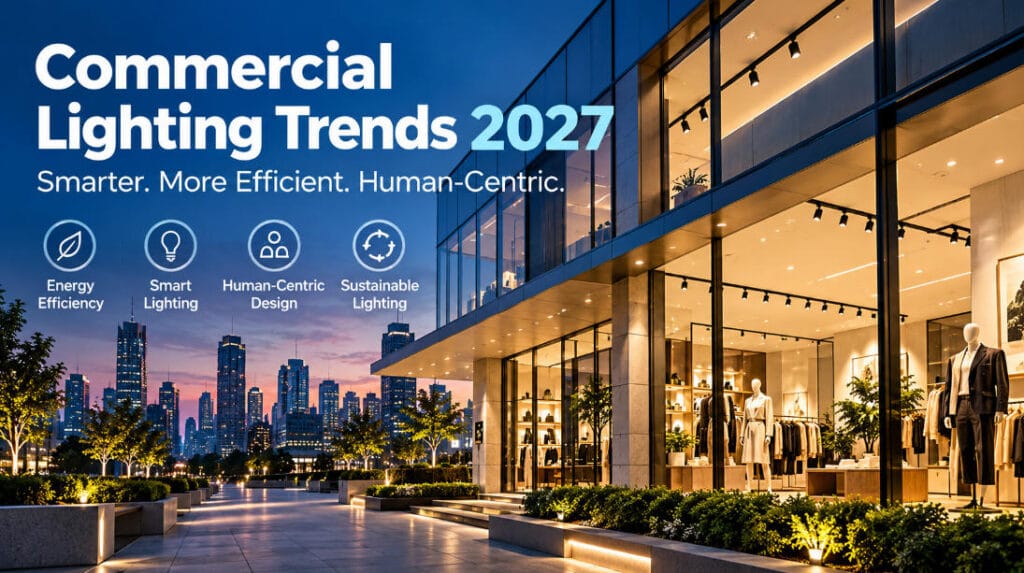
1. Energy Efficiency Moves Beyond LED Conversion
LED technology is already established across much of the commercial lighting market. As a result, the question for designers and building owners is changing.
Instead of asking:
“Should we replace conventional lighting with LED?”
The more relevant question is becoming:
“How can we extract more efficiency from an already LED-based lighting system?”
The IEA describes this transition as the beginning of a “second wave” of LED deployment. While LED adoption has already reduced lighting electricity demand substantially, additional efficiency opportunities remain through higher-efficacy products, better controls, optimized lighting layouts and accelerated renovation of older installations.
This is especially important in commercial environments where lighting can operate for long periods every day.
Retail stores, supermarkets, offices, hotels, galleries and showrooms can therefore achieve additional savings not simply by reducing luminaire wattage, but by improving the complete lighting system.
For manufacturers and project designers, this means metrics such as lumens per watt, optical efficiency, beam utilization, driver efficiency and system-level power consumption will become increasingly important.
The most efficient luminaire is not necessarily the fixture with the lowest wattage. It is the luminaire that delivers the required illumination to the target area with the least unnecessary light and energy.
2. Smart Lighting Evolves into Connected Building Infrastructure
One of the most significant commercial lighting trends for 2027 will be the continued development of connected lighting.
The U.S. Department of Energy has identified connected LED lighting as an important source of future lighting energy savings. Its long-term solid-state lighting analysis estimates that connected lighting could contribute significantly to lighting-control energy savings as adoption increases.
The commercial market is already demonstrating this transition.
Signify reported that its installed base of connected light points reached 167 million by the end of 2025, illustrating the growing scale of connected lighting infrastructure.
By 2027, more commercial projects are likely to treat lighting as part of the building’s digital infrastructure rather than as an isolated electrical system.
Lighting networks can potentially connect:
- occupancy sensors;
- daylight sensors;
- dimming systems;
- scheduling controls;
- building management systems;
- energy monitoring platforms;
- HVAC systems;
- wireless building networks.
Standards are evolving accordingly.
The DALI Alliance, for example, is extending digital lighting control beyond traditional wired DALI networks through DALI+ and wireless-to-DALI gateways, including technologies designed to work with Thread, Bluetooth Mesh and Zigbee ecosystems.
Bluetooth Networked Lighting Control is similarly targeting offices, retail spaces, healthcare facilities, factories and other commercial environments.
The result is an important change in lighting specification:
A luminaire is increasingly becoming a controllable node rather than simply a source of illumination.
3. Flexible Lighting Becomes Essential for Changing Commercial Spaces
Commercial spaces are changing faster than their lighting systems traditionally have.
Retail stores frequently change displays. Showrooms introduce new products. Galleries rotate exhibitions. Offices reorganize workspaces. Hospitality environments change layouts for different functions.
Fixed lighting installations can make these changes difficult.
For this reason, flexible lighting architecture is likely to become increasingly valuable in 2027.
Track lighting is particularly suited to these environments because luminaires can be repositioned and redirected as displays change.
For retail and showroom applications, designers can explore Sunpol’s commercial lighting product range to evaluate different fixture formats for adaptable lighting layouts.
Directional luminaires such as the SP-GD5068B2 Cylinder Track Light can support commercial applications where adjustable accent lighting is required.
This flexibility also has a sustainability advantage.
Instead of rebuilding an entire lighting installation when the interior layout changes, adaptable systems can allow existing luminaires to be repositioned or reconfigured.
For retailers, galleries and showrooms with frequently changing displays, this can reduce both renovation complexity and material waste.
4. Optical Precision Becomes More Important Than Raw Lumen Output
For many years, commercial lighting specifications focused heavily on wattage and lumen output.
Those numbers remain important, but they do not tell the complete story.
In a retail environment, for example, a high-lumen fixture with poor beam control may illuminate circulation areas, ceilings or adjacent displays unnecessarily.
A carefully engineered optical system can deliver light exactly where it is needed.
By 2027, professional commercial lighting specification is therefore likely to place greater emphasis on:
beam angle + optical efficiency + glare control + target illuminance + visual hierarchy.
Different beam distributions perform different functions.
Narrow beams can emphasize products, sculptures or architectural features. Medium beams can provide flexible merchandise lighting. Wider distributions can support general illumination.
This is particularly relevant for commercial display lighting, where contrast between ambient and accent lighting can help establish visual hierarchy.
Rather than asking only how much light a fixture produces, designers increasingly need to ask:
Where does that light actually go?
5. Human-Centric Lighting Becomes More Practical and Application-Specific
Human-centric lighting has been discussed for years, but the concept is gradually becoming more practical.
For commercial projects, this does not necessarily mean installing complex tunable-white systems everywhere.
Instead, it means designing lighting around how people actually use a space.
Important considerations include:
- visual comfort;
- glare control;
- appropriate illuminance;
- color rendering;
- correlated color temperature;
- vertical illumination;
- contrast;
- time spent in the environment.
An office, luxury boutique, supermarket and hotel lobby should not use the same lighting strategy simply because they have similar floor areas.
In retail spaces, lighting must support merchandise presentation while maintaining customer comfort.
In offices, prolonged visual tasks make glare management particularly important.
In hospitality environments, atmosphere and visual comfort may matter as much as illuminance.
This application-based approach is likely to become a stronger differentiator between basic LED products and professional commercial lighting solutions.
6. High-Quality Color Rendering Becomes a Commercial Requirement
Energy efficiency once dominated LED product development.
Today, visual quality is becoming equally important in many commercial applications.
This is particularly true in:
- fashion retail;
- cosmetics;
- jewelry;
- supermarkets;
- furniture showrooms;
- museums;
- hospitality environments.
In these applications, lighting affects how customers perceive materials, textures and colors.
A technically efficient fixture that produces poor color reproduction may reduce the visual quality of an entire environment.
As a result, designers increasingly evaluate not only general CRI but also characteristics such as R9 performance, color consistency and spectral quality.
The European Union’s EPREL database demonstrates how detailed lighting product information is becoming. Registered light-source data can include luminous flux, energy consumption, correlated color temperature, color rendering parameters and other performance characteristics.
For manufacturers, this means commercial lighting competition will increasingly involve quality of light, rather than efficiency alone.
7. Glare Control Moves Higher on the Specification List
As LED luminaires become smaller and more powerful, luminance at the light source can increase substantially.
Without proper optical design, this can create uncomfortable glare.
The issue is especially important in environments where people remain for long periods or where luminaires are positioned within normal viewing angles.
Commercial lighting design for 2027 is therefore likely to place greater attention on:
- recessed light sources;
- anti-glare reflectors;
- optical cut-off angles;
- shielding accessories;
- appropriate beam selection;
- careful luminaire positioning.
This represents an important change in product design.
The goal is no longer simply to create smaller and brighter luminaires.
The goal is to create compact fixtures that provide powerful illumination without unnecessary visual discomfort.
8. Miniaturization Continues — Without Sacrificing Performance
Architects and interior designers increasingly prefer lighting hardware that integrates quietly into the space.
This trend is encouraging smaller track heads, compact recessed spotlights and more discreet lighting systems.
However, miniaturization creates engineering challenges.
Smaller luminaires must still manage:
- LED junction temperatures;
- driver performance;
- optical efficiency;
- glare;
- long-term lumen maintenance.
Consequently, successful miniaturization requires improvements in thermal management, LED packages, drivers and optical systems.
For commercial projects, the objective is increasingly less visible hardware with better-controlled light.
This trend is particularly relevant to premium retail, museums, galleries and hospitality interiors where lighting equipment should support the architecture rather than dominate it.
9. Circular Lighting and Serviceability Gain Importance
Sustainability is also changing how commercial lighting products are evaluated.
Historically, sustainability discussions focused mainly on energy consumption during operation.
That remains important, but manufacturers and specifiers are increasingly considering the complete product lifecycle.
Questions now include:
Can components be replaced?
Can the driver be serviced?
Can the luminaire be upgraded?
Can materials be separated for recycling?
Can the product remain useful when the interior changes?
This transition is already visible among major lighting companies. Signify reported that circular revenues represented 37% of its sales in 2025, exceeding its stated 2025 target of 32%.
Its newer sustainability strategy also emphasizes durable, upgradeable, repairable and recyclable products.
For commercial projects, this can change purchasing decisions.
A luminaire designed for a longer service life may create more value than a cheaper fixture that requires complete replacement after a component failure.
By 2027, lifecycle thinking is therefore likely to become an increasingly important part of commercial lighting procurement.
10. Retrofit-Friendly Lighting Remains a Major Opportunity
Although LED technology is common in new construction, a large installed base of older lighting systems remains.
The IEA notes that LED retrofits can be delayed because commercial renovations often involve practical challenges such as ceiling access, rewiring and fixture replacement.
Consequently, many lighting upgrades occur during broader refurbishment projects.
This creates an important opportunity for products that reduce installation complexity.
Track systems, adaptable drivers, wireless controls and retrofit-compatible luminaires can help building owners modernize lighting without completely redesigning electrical infrastructure.
Wireless lighting controls may be particularly relevant here.
The DALI Alliance has highlighted wireless solutions as useful for retrofit projects and environments where installing new control wiring would be difficult.
Therefore, one of the strongest commercial lighting opportunities approaching 2027 may not be new construction at all.
It may be modernizing the enormous installed base of existing commercial buildings.
11. Retail Lighting Becomes More Experience-Driven
Physical retail continues to compete with digital commerce, which increases the importance of the in-store experience.
Lighting plays a major role in that experience.
A modern retail lighting system must do more than meet minimum illumination requirements.
It can help create:
- visual hierarchy;
- product emphasis;
- navigation;
- brand atmosphere;
- material definition;
- changing promotional zones.
This is why accent lighting remains important for fashion stores, automotive showrooms, furniture stores, galleries and premium retail environments.
Instead of uniformly illuminating the entire space, designers can combine ambient illumination with carefully positioned accent lighting.
Businesses planning these environments can refer to Sunpol’s commercial display lighting solutions and professional lighting products to develop application-specific lighting strategies.
The objective is simple:
Illuminate the merchandise intentionally rather than illuminate the entire room equally.
12. Commercial Lighting Becomes More Application-Specific
Perhaps the broadest trend shaping 2027 is specialization.
There is no universal “best commercial light.”
A supermarket needs different optics from a museum.
A fashion boutique requires different color rendering from a warehouse.
A hotel lobby requires different visual comfort from a car showroom.
A gallery may require precise accent lighting and excellent glare control, while an office may prioritize uniformity, efficiency and controls.
The commercial lighting market is therefore moving from a product-centered approach toward an application-centered approach.
Manufacturers capable of combining luminaires, optics, drivers, controls and project-specific configurations will be better positioned to serve professional lighting projects.
For Sunpol, this means commercial lighting solutions can be structured around the real needs of retail stores, showrooms, hospitality environments, galleries and other architectural spaces rather than simply presenting isolated fixture specifications.
What Commercial Lighting Buyers Should Look for in 2027
When evaluating a commercial lighting system for a future project, wattage and purchase price should be only part of the decision.
Professional buyers, lighting designers and contractors should also consider:
Optical performance — Does the beam distribution match the application?
Energy efficiency — How much useful light reaches the target for the energy consumed?
Color quality — Are CRI, R9 and color consistency appropriate for the objects being illuminated?
Glare control — Will occupants see the lighted environment or be distracted by the light source?
Flexibility — Can luminaires be repositioned when the space changes?
Controls compatibility — Can the system support dimming, sensors or digital control where required?
Serviceability — Can important components be maintained or replaced?
Lifetime performance — How will the luminaire perform after thousands of operating hours?
System compatibility — Can fixtures, drivers, controls and accessories work together reliably?
These factors increasingly determine the real lifecycle value of commercial lighting.
Looking Ahead: Commercial Lighting in 2027
The commercial lighting industry is not moving toward a single revolutionary technology.
Instead, several developments are converging.
LED efficacy continues to improve.
Connected controls are becoming more sophisticated.
Wireless and IP-based lighting networks are expanding.
Optical systems are becoming more precise.
Luminaires are becoming smaller and more adaptable.
Sustainability is moving from energy efficiency toward lifecycle performance and circularity.
And commercial customers increasingly expect lighting to improve not only visibility, but also flexibility, atmosphere and operational efficiency.
For lighting manufacturers, designers, contractors and building owners, the key lesson for 2027 is therefore straightforward:
The future of commercial lighting is not simply about producing more light with fewer watts. It is about delivering the right light, in the right place, at the right time, with less energy and greater flexibility.
That shift will define the next generation of commercial lighting.
Data Sources & Industry References
1. International Energy Agency (IEA) — “The next wave of LED lighting: Smarter, circular and more efficient,” March 2026.
The IEA reports that lighting in buildings and outdoor applications accounted for approximately 8% of global electricity demand in 2024, or around 2,200 TWh. It also notes that global built floor area increased by more than 20% over the previous decade while electricity use for lighting in buildings remained relatively stable, largely because of efficiency improvements.
2. U.S. Department of Energy — Solid-State Lighting Energy Savings Forecast.
DOE projections indicate that LED lamps and luminaires could represent 84% of U.S. lighting installations by 2035. Under DOE’s technology-development scenario, LED lighting could generate more than 569 TWh of annual energy savings by 2035, with commercial, industrial and outdoor applications contributing substantially to the opportunity.
3. Signify — Full-Year 2025 Results and 2025 Annual Report.
Signify reported an installed base of 167 million connected light points at the end of 2025. The company also reported that circular revenues reached 37% of sales in 2025, illustrating growing commercial emphasis on connected and circular lighting.
4. European Commission — Ecodesign and Energy Labelling for Light Sources.
EU Ecodesign requirements for light sources and separate control gear are governed by Regulation (EU) 2019/2020, while the rescaled A-to-G energy label for light sources has applied since September 2021. EPREL provides product-level information including energy consumption, luminous flux and correlated color temperature.
5. DALI Alliance — DALI+, DALI-2 and Wireless Lighting Controls.
The DALI Alliance is developing wired, wireless and IP-based approaches to interoperable lighting control. DALI+ extends DALI commands across IP-based and wireless carriers, while gateway specifications support integration with technologies including Bluetooth Mesh and Zigbee.
6. Bluetooth SIG — Bluetooth Networked Lighting Control.
Bluetooth SIG identifies offices, retail, healthcare, factories and other commercial facilities as applications for Bluetooth Mesh-based Networked Lighting Control, with energy savings, occupant experience and building operations among the targeted benefits.