SUNPOL / Beam angle selection
Start with the display size and the distance from the light—not a narrow-or-wide label alone.
Choosing a beam angle for retail and showroom lighting means deciding where the useful light should fall, how adjacent beams should meet, and what customers will see as they move through the space. A spotlight aimed at a small product island has a different task from one illuminating a full-height material panel.
What does a beam angle actually describe?
For a conventional symmetrical beam, the nominal beam angle commonly describes the angular spread between directions where luminous intensity falls to half its peak value. It is a photometric description, not a hard-edged circle beyond which all light disappears. Check the manufacturer’s definition and distribution curve for the exact optic.
Two luminaires with the same nominal angle can differ in peak intensity, spill light, beam shape and transition. A rectangular or asymmetric wall-lighting distribution also cannot be reduced to a single circular footprint. The angle should therefore be read alongside the actual photometric data.
A narrow beam is not automatically brighter on every target, and a wide beam is not automatically more comfortable. Output, aiming, distance and the observer’s view all contribute to the result.
Estimate the footprint at the actual throw distance
For a symmetrical cone aimed perpendicular to a flat target, an approximate geometric width is 2 × distance × tan(beam angle ÷ 2). Distance here runs from the light’s optical position to the target plane along the aiming direction. It is not automatically the floor-to-ceiling height.

| Throw distance | 15° estimated width | 24° estimated width | 36° estimated width |
|---|---|---|---|
| 1m | 0.26m | 0.43m | 0.65m |
| 2m | 0.53m | 0.85m | 1.30m |
| 3m | 0.79m | 1.28m | 1.95m |
At a two-metre perpendicular throw, a 24° cone gives an approximate width of 0.85m. That is a useful first comparison against the display dimensions, but it does not establish illuminance, uniformity or the required number of fittings. An angled beam produces a different footprint, and real light extends beyond a nominal boundary.
Choose the starting optic around the merchandise
Small objects and selected details
A narrower option can help isolate an object or feature. Check the whole product from the normal viewing position: an intense patch on one small area may leave the surrounding product underlit.
Retail shelves and product groups
Compare the illuminated width against the shelf depth and the group of products. Watch for shelf edges, signs and nearby fixtures that block the beam. A wider optic may require a different output to achieve the intended emphasis.
Large tile and stone panels
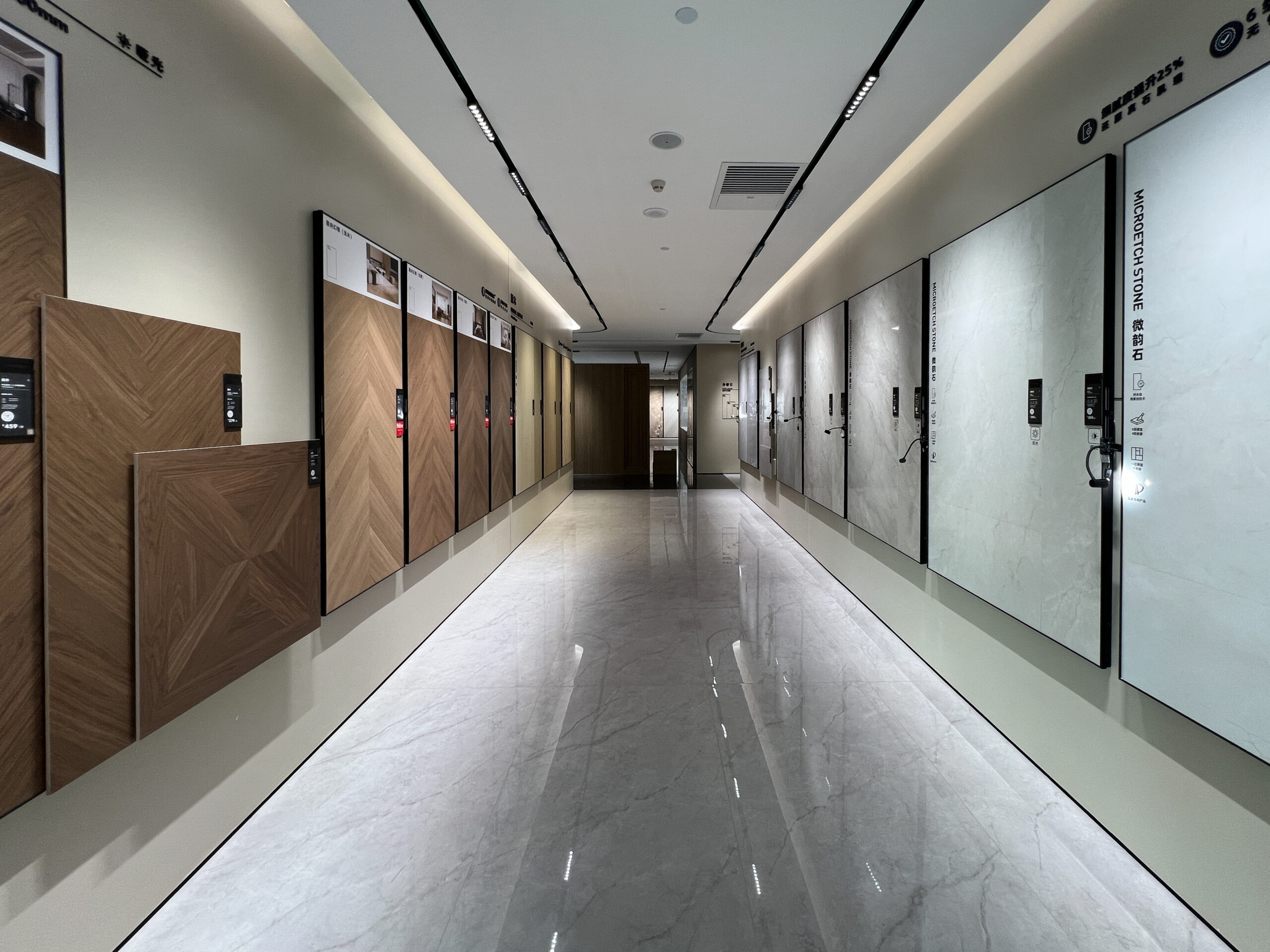
Consider the complete panel, including its upper and lower regions. Multiple spots can create visible hot spots; a dedicated wall-lighting distribution may be worth reviewing when uniform vertical coverage is the goal.
Furniture and bathroom settings
Assess the complete room setting and customer route. Test reflective taps, glass, mirrors and glossy ceramics at realistic viewing positions rather than selecting from a plan alone.
Check overlap, aiming and visual comfort together
Arrange a trial with the proposed spacing and aiming. Look for bright stripes, dark gaps, repeated hot spots and unwanted spill onto neighboring displays. A neat geometric overlap on a drawing does not guarantee an even lighting result.
Adjust one variable at a time: position, aiming, optic or output. Keep a record of the successful configuration so it can be repeated consistently. Where available, use the selected luminaire’s IES or LDT data and an appropriate lighting calculation to support the layout.
On polished materials, move through the visitor’s viewing positions and check reflections as well as direct visibility of the light source. For a fuller discussion, read cómo funcionan las luces de carril antideslumbrantes. More wattage is rarely a useful first response to an uncomfortable reflected highlight.
Use a documented product configuration for the trial
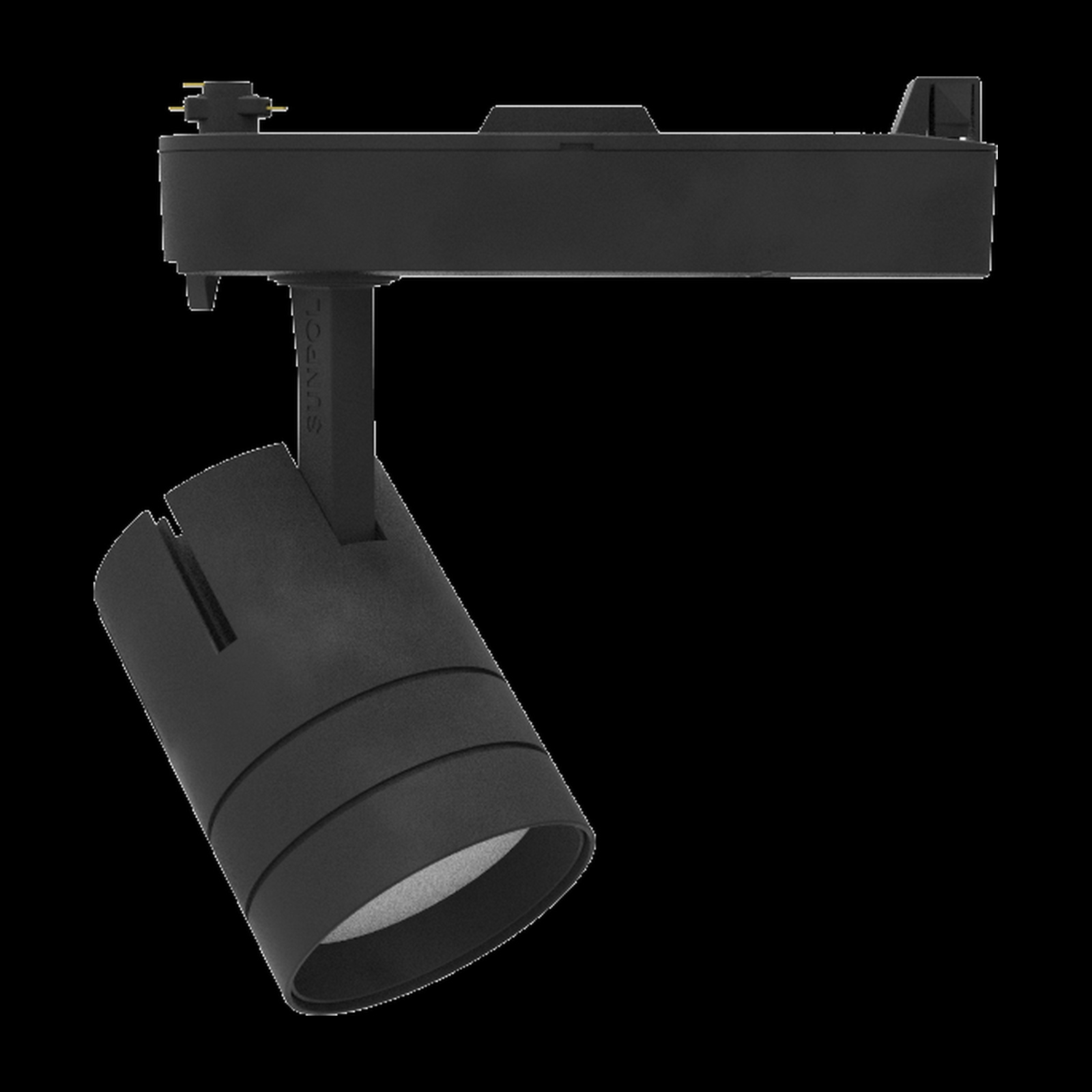
The SUNPOL SLT7508B parameter sheet lists 15°, 24° and 36° options. This makes it a useful model to discuss when comparing optics within a conventional track-mounted family.
Request the intended wattage, optic and color-temperature configuration, and confirm the rail interface separately. The listed options do not mean that the beam is continuously adjustable, or that the optic can be swapped on site without an approved procedure.
View the SLT7508B specification. For the wider selection process, use our guía de selección de iluminación de riel comercial.
A short mock-up checklist before ordering
- Record geometry: the aiming distance, target width and height, track position and normal viewing routes.
- Specify the sample: model, power, optic, color temperature and control setting.
- Check merchandise: use actual material samples and the intended display arrangement.
- Review the complete scene: assess overlap, surrounding brightness, reflections and glare.
- Document the result: save the selected settings and agree any changes before ordering the full quantity.
If existing infrastructure will be retained, complete the existing-track compatibility checks before committing to replacement fittings.
Frequently asked questions
Which beam angle is best for a retail store?
There is no single angle for every store. Start with target size, throw distance, aiming and the intended emphasis, then compare the exact luminaire distributions on the merchandise.
Can I choose a beam angle from ceiling height alone?
No. The fixture-to-display distance and direction are more useful than ceiling height alone. Wall displays, raised shelves and tilted aiming all change the geometry.
Does a 36° beam always cover more useful area than a 24° beam?
Its nominal angular spread is wider, but usable coverage also depends on output, intensity distribution, target orientation and the illumination required. Check photometric data and a mock-up.
Do overlapping beam circles guarantee uniform light?
No. Geometric circles are a planning aid. Real intensity distributions and aiming determine how adjacent beams combine on the surface.
Plan the beam around your display
Send SUNPOL your layout, display photographs and installation information so the relevant configuration can be reviewed for your project.
Technical reference: ERCO lighting knowledge: emission angle. Geometry in this article is illustrative; selected SUNPOL options are referenced to the current product parameter sheet.