
SUNPOL / Existing-track upgrade guide
A new spotlight should be specified against the existing system—not selected because its adapter looks familiar.
Can new track lights fit an existing track? Sometimes they can, but compatibility must be established for the exact rail, adapter, supply and control arrangement. A matching shape, a similar product name or a shared voltage label is not sufficient evidence.
Identify what is already installed
Start with the track manufacturer and exact rail designation. Collect any installation instructions, invoices, fixture labels and accessory part numbers. A shop refurbishment may contain more than one track family, so record each rail run rather than assuming the whole ceiling is identical.
Useful photographs show the overall installation, rail labels, feed and connector labels, and any adapter information visible without opening or altering equipment. If the interface cannot be inspected safely, ask qualified electrical personnel to document it with the system isolated as required. Do not remove live fittings to obtain a photograph.
Photographs help a supplier identify questions; they do not replace the original specification or an electrical and mechanical assessment.
Five checks that determine replacement compatibility
| Check | What needs to match | Useful evidence |
|---|---|---|
| Rail and adapter | Approved mechanical connection and contact arrangement | Rail designation, adapter model and manufacturer compatibility documentation |
| Supply | Required voltage and other specified supply characteristics | Equipment labels and approved system documentation |
| Controles | Fixture/driver operation with the installed control system | Dimmer or controller model, driver specification and supported protocol |
| Connected load | Limits for the complete rail run and supply arrangement | Installed schedule and assessment against the specified ratings |
| Condition and mounting | Serviceable rail, connections, supports and permitted loading | Inspection by qualified personnel and installation records |
The checks work together. A fixture can appear to latch onto a rail and still have an unsuitable electrical contact arrangement or control configuration. Equally, an electrical rating alone says nothing about a secure mechanical connection.
Separate conventional and 48V magnetic systems
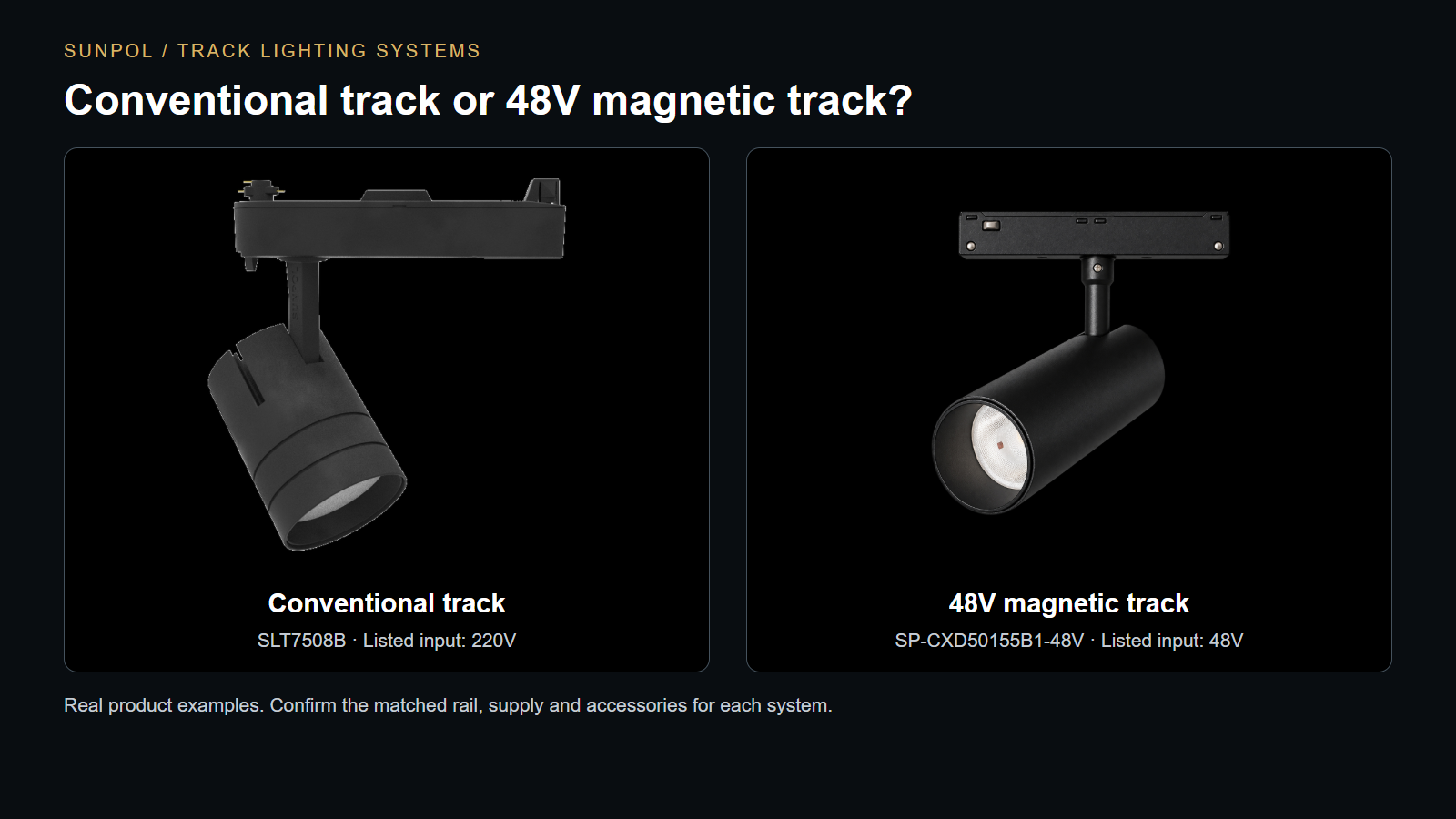
Do not treat “track lighting” as one universal connector standard. Conventional mains-voltage track families can use different adapters, contacts and control arrangements. A circuit-count label or informal H/J/L description alone should not be treated as proof of cross-brand compatibility.
48V magnetic products also need a matched rail, supply arrangement and approved accessories. Sharing a 48V label does not establish matching profile dimensions, polarity, contacts, controls or retention. Do not connect a 48V fixture directly to a mains supply or improvise an adapter to combine unapproved parts.
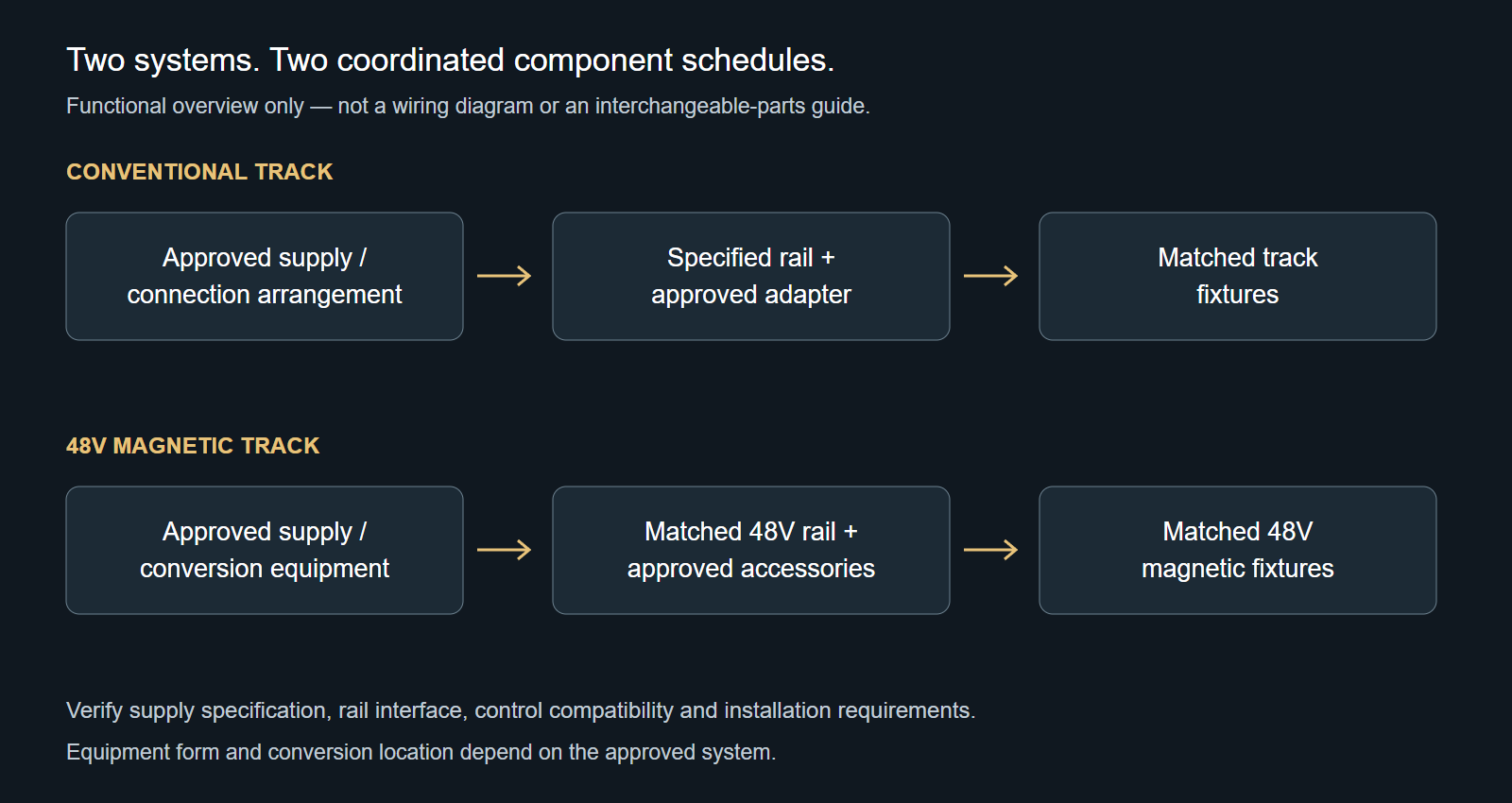
If you are considering replacing the whole infrastructure, compare conventional and 48V magnetic track systems before specifying individual fittings.
Check dimming, drivers and maintenance access
Retaining a track does not necessarily mean that its existing control equipment can operate a new LED fixture correctly. Identify the dimmer or controller, the proposed driver and the supported control method. Confirm the exact configuration with the supplier instead of treating “dimmable” as a universal feature.
For systems with supply equipment serving a rail, confirm its approved specification, available load, installation conditions and maintenance access. Ask what happens when a fixture or supply component needs replacing later. Obtain the required documents and replacement part references for handover.
A lower fixture wattage does not by itself complete the assessment: other characteristics, control behavior and system limits still need review. The electrical contractor should assess the installation against the approved equipment documentation and local requirements.
Choose a practical upgrade route
Keep the documented, serviceable rail
Where compatibility and condition are confirmed, compare approved replacement fittings. Include sample testing, controls and any accessory changes in the proposal.
Replace the uncertain infrastructure
Where the system is unidentified, damaged or unsuitable for the new design, compare a complete replacement schedule. Include ceiling work, supports, supplies and downtime rather than comparing lamp prices alone.
For a phased refurbishment, mark which areas retain the existing system and which receive new infrastructure. Keep the two equipment schedules distinct. Agree who is responsible for the compatibility assessment, installation and final acceptance.
What to send when asking about replacement lights
- Track manufacturer, model and any original documentation.
- Safe photographs of rail, feed and adapter labels.
- Existing fixture schedule and control-equipment information.
- Proposed replacement quantity and desired lighting changes.
- Ceiling layout, display photographs and refurbishment timing.
Ask the supplier for written confirmation naming the rail and proposed fixture/adapter combination, together with any conditions or required accessories. If the rail cannot be confirmed, request a replacement-system proposal rather than a compatibility guess.

Confirm one approved configuration before a full order
After the compatibility review, have an appropriate sample installed and checked by qualified personnel. Confirm secure mounting, correct operation, control behavior and aiming range under the documented procedure. A sample lighting successfully does not by itself prove that the complete installation is compliant or that every rail run is identical.
Por ejemplo, el SUNPOL SLT7508B track spotlight can be considered as a product candidate; its listing is not a promise that it fits your existing rail. Ask for the exact adapter and configuration suitable for the identified system.
Once the infrastructure is resolved, use the beam-angle guide for retail stores and showrooms to plan how the replacement fittings should illuminate the merchandise.
Frequently asked questions
Are all LED track lights compatible with existing tracks?
No. Compatibility depends on the exact rail, adapter, supply and control configuration. Obtain manufacturer confirmation for the proposed combination.
Can I check compatibility by pushing the adapter into the rail?
No. Do not force an unknown fitting or use trial contact as a compatibility test. Mechanical appearance and successful illumination do not establish a correct approved connection.
Can a conventional rail take a 48V magnetic fitting?
Do not assume this is possible. A 48V magnetic fitting requires its approved rail and supply arrangement. Review a complete system change if the infrastructure differs.
What if the original rail manufacturer is unknown?
Collect available records and safe photographs for identification. If the system still cannot be confirmed, have it assessed and compare a documented replacement system before ordering fittings.
Review your existing track before ordering
Send SUNPOL your layout, display photographs and installation information so the relevant configuration can be reviewed for your project.