
China remains one of the world’s largest manufacturing and export bases for lighting products, but the structure of its lighting exports is changing rapidly in 2026. Instead of relying mainly on volume growth, Chinese lighting manufacturers are facing a new competitive environment shaped by weaker demand in some traditional markets, declining unit prices, higher compliance costs, supply-chain adjustments and growing demand for higher-value lighting solutions.
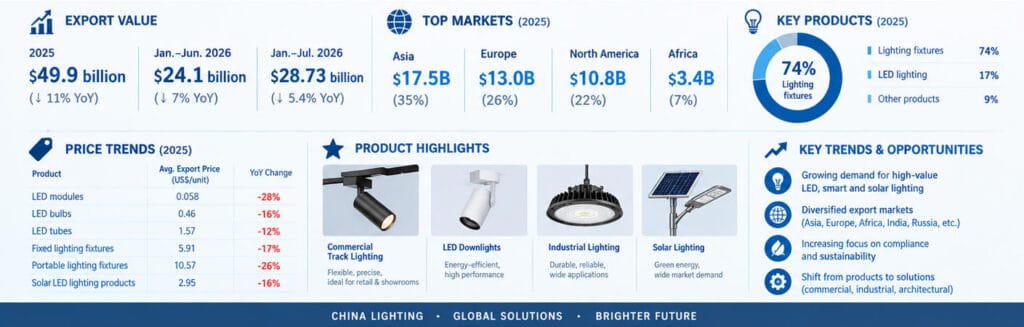
According to data released by the China Association of Lighting Industry based on customs statistics, China’s lighting product exports reached approximately US$49.9 billion in 2025, down about 11% year over year. During the first half of 2026, exports totaled approximately US$24.1 billion, down about 7% year over year. By July 2026, cumulative exports had reached approximately US$28.73 billion, with the year-on-year decline narrowing to 5.4%.
These figures suggest that the Chinese lighting export market is not simply shrinking. Instead, it is undergoing a structural adjustment, with traditional commodity lighting under greater price pressure while LED, solar, smart and application-specific products continue to create new opportunities.

1. China Lighting Export Market Overview in 2026
The 2026 China lighting export market can be understood through three stages: a weak first quarter, gradual stabilization in the second quarter, and early signs of recovery in July.
During January–June 2026, China’s lighting exports declined approximately 7% year over year to US$24.1 billion. However, the monthly trend improved during the second quarter. June exports reached approximately US$4.2 billion, only 2% lower than the same month of the previous year, indicating that the pace of decline had narrowed considerably.
The latest July data provides another important signal. According to industry data reported by ALD Lighting Research Institute, China’s lighting exports reached approximately US$4.61 billion in July 2026, an increase of 2.4% year over year. Cumulative exports for January–July reached US$28.73 billion, down 5.4% year over year.
The July improvement should nevertheless be interpreted carefully. A single month of positive growth does not necessarily indicate a complete market recovery. Exporters are still dealing with international logistics uncertainty, currency fluctuations, trade barriers, raw-material costs and uneven overseas demand.
For international buyers, this means that China’s lighting supply chain remains highly competitive, but supplier selection is becoming increasingly important. Cost alone is no longer sufficient; buyers are paying greater attention to product consistency, certifications, customization capabilities, delivery reliability and after-sales support.
2. Lighting Fixtures Remain the Largest Export Category
Lighting fixtures continue to represent the core of China’s lighting exports.
In 2025, Chinese lighting fixture exports were approximately US$37.2 billion, accounting for about 74% of total lighting product exports. However, the category declined approximately 12% year over year. Fixed lighting fixtures fell about 21%, while portable lighting fixtures declined about 25%.
The trend continued into the first half of 2026. Lighting fixture exports reached approximately US$17.7 billion, down about 9% year over year, according to the China Association of Lighting Industry.
This does not mean that every lighting fixture category is experiencing the same pressure. Product performance is increasingly differentiated by application.
General-purpose and highly standardized lighting products are more exposed to price competition. In contrast, products designed for commercial, architectural, retail, hospitality, industrial and outdoor applications can compete through optical performance, installation flexibility, energy efficiency and project-specific customization.
For example, buyers looking for commercial applications can explore Sunpol’s range of commercial LED lighting products, where application-oriented lighting can be positioned around project requirements rather than purely around unit price.
3. LED Lighting Continues to Dominate the Product Mix
LED remains the dominant technology within China’s lighting export industry.
In the first half of 2026, China’s electric light source exports totaled approximately 14.2 billion units, an increase of 13% year over year, while export value declined approximately 5% to around US$2.6–2.7 billion. LED light-source exports reached approximately 9.4 billion units, up around 27%, accounting for approximately 66% of electric light-source export volume.
LED modules were particularly notable. Their export volume increased about 46% in the first half of 2026, but their average export price fell to approximately US$0.03 per unit, down about 52%. This is a clear example of the industry’s “volume up, price down” pattern.
The situation was already visible in 2025. China’s LED module export volume reached approximately 9.8 billion units, up 66%, while the average export price fell 28% to about US$0.058 per unit. LED bulbs averaged approximately US$0.46 per unit, down 16%, while LED tubes averaged approximately US$1.57 per unit, down 12%.
For buyers, the implication is important: a lower average export price does not necessarily mean that every manufacturer is offering a better-value product. Price reductions can result from component cost reductions, product simplification, intense supplier competition or changes in the product mix.
When comparing Chinese lighting suppliers, buyers should therefore evaluate price together with efficacy, CRI, lifetime, driver quality, thermal management, optical performance, certification and warranty terms.
4. Track Lighting and Commercial Lighting Are Moving Toward Application-Based Competition
Commercial lighting is one of the areas where product differentiation can become more important than simple price competition.
Retail stores, showrooms, galleries, hotels, offices and mixed-use developments increasingly require lighting that can deliver directional control, visual comfort, flexible installation and accurate color rendering.
Track lighting is particularly relevant because it allows luminaires to be repositioned as merchandise layouts or interior configurations change.
For buyers evaluating this segment, products such as Sunpol’s cylinder track light illustrate how Chinese manufacturers are moving beyond basic commodity lamps toward more application-specific commercial lighting products.
At the same time, intelligent lighting is becoming more relevant to commercial projects. AI-assisted and sensor-enabled lighting can potentially improve lighting control, energy management and user experience.
Sunpol’s AI track light product is an example of how the commercial lighting supply chain is moving toward more intelligent product configurations.
For exporters, this shift creates an opportunity to compete through design, optical engineering, controls and project support rather than simply lowering factory prices.
5. Export Markets Are Becoming More Diversified
One of the most important changes in China’s lighting export market is the redistribution of demand across regions.
In 2025, Asia was China’s largest regional destination for lighting products, with exports of approximately US$17.5 billion, accounting for about 35% of total lighting exports. Europe followed at approximately US$13 billion, while North America accounted for approximately US$10.8 billion.
However, the growth rates differed considerably.
North America
North America remained a major market but experienced significant pressure.
China’s lighting exports to North America were approximately US$10.8 billion in 2025, down about 22%. Exports to the United States were approximately US$9.7 billion, down about 23%.
The pressure continued in 2026. During January–June, China’s lighting exports to the United States were approximately US$4.5 billion, down 13% year over year.
By January–July, industry data indicated that exports to the United States had reached approximately US$5.33 billion, down 17% year over year, representing about 18.5% of China’s total lighting exports.
For Chinese manufacturers, the U.S. market therefore remains important, but dependence on a single destination is becoming a more significant commercial risk.
Europe
Europe has shown greater stability.
In 2025, China’s lighting exports to Europe were approximately US$13 billion, down only around 3%. The European Union accounted for approximately US$9.9 billion, with EU exports down about 1%.
During the first half of 2026, exports to Europe reached approximately US$6.4 billion, down only about 1%. The Netherlands, Spain, France and Sweden recorded growth in China’s lighting imports during the period.
The European market is increasingly influenced by energy efficiency, environmental requirements and product compliance. This creates additional costs for exporters, but it can also favor suppliers capable of providing documented performance, certifications and higher-efficiency products.
Africa
Africa has emerged as one of the more resilient regions.
China’s lighting exports to Africa reached approximately US$3.4 billion in 2025, up about 4.6%. During the first half of 2026, exports reached approximately US$1.8 billion, increasing 6% year over year. Nigeria, South Africa and Morocco were among the markets showing growth.
Demand in Africa is supported by urbanization, infrastructure development, commercial construction, outdoor lighting and the need for affordable energy-efficient solutions.
Solar lighting can be particularly relevant in markets where grid reliability remains uneven. The China Association of Lighting Industry reported that solar LED lighting products were among the categories achieving both export-value and average-price growth in the first half of 2026.
India and Russia
India and Russia are also becoming increasingly relevant within China’s diversified export strategy.
During the first half of 2026, lighting exports to Russia increased approximately 12%, while exports to India increased approximately 13%, according to the China Association of Lighting Industry.
These markets also demonstrate why Chinese exporters need to adapt products to local requirements rather than simply exporting standardized products.
6. China Lighting Price Trends: Volume Growth Does Not Equal Value Growth
Price is one of the most important themes in the 2026 China lighting export market.
The 2025 data showed broad-based price deflation. The China Association of Lighting Industry reported that the export prices of 45 lighting product tariff lines decreased year over year.
Selected 2025 average export prices included:
| Product | 2025 Average Export Price | YoY Change |
|---|---|---|
| LED modules | US$0.058/unit | -28% |
| LED bulbs | US$0.46/unit | -16% |
| LED tubes | US$1.57/unit | -12% |
| Fixed lighting fixtures | US$5.91/unit | -17% |
| Portable lighting fixtures | US$10.57/unit | -26% |
| Solar LED lighting products | US$2.95/unit | -16% |
The first half of 2026 shows that this price pressure has not disappeared.
LED modules provide the clearest example: export volume increased 46%, but the average export price declined to approximately US$0.03 per unit, a 52% year-on-year decrease.
At the same time, some higher-value categories are moving in the opposite direction. Solar LED lighting products recorded approximately 5% growth in export value and 12% growth in average export price during the first half of 2026. Automotive lighting exports increased approximately 6%, while average export prices increased about 8%.
This divergence indicates a broader transformation: commodity lighting is increasingly competing on cost, while specialized and integrated lighting solutions are competing on value.
7. What Is Driving the Change in China’s Lighting Exports?
Several structural factors are shaping the 2026 market.
1. Global demand remains uneven
Traditional mature markets are experiencing weaker demand in several lighting segments, while emerging markets are generating new opportunities.
2. Trade barriers are changing sourcing strategies
Tariffs and trade-policy uncertainty are encouraging some international buyers to diversify sourcing locations and production bases.
3. Supply-chain costs remain important
Copper, electronic components, plastics, logistics and other manufacturing inputs can significantly affect the final export price. The China Association of Lighting Industry noted that manufacturing costs increased during the first half of 2026 while end-market price competition remained intense.
4. Compliance is becoming part of product competitiveness
For European and other developed markets, certifications, energy efficiency, environmental documentation and product traceability increasingly influence supplier selection.
5. Buyers are moving from products to solutions
Instead of purchasing only a lamp or fixture, commercial buyers increasingly require complete solutions involving optics, controls, installation, customization and technical support.
This trend is especially relevant to commercial applications such as retail, hospitality, offices, showrooms and architectural projects.
8. What Should International Lighting Buyers Watch in 2026?
For importers and distributors sourcing from China, five factors deserve particular attention.
First, do not evaluate suppliers only by FOB price. A low initial price may not translate into the lowest total cost if the product has higher failure rates, poor driver performance or insufficient certification.
Second, examine product-level export trends. The overall lighting market may decline while specific categories continue to grow. Solar lighting, smart lighting, professional commercial lighting and specialized LED solutions are examples of segments showing stronger structural characteristics.
Third, diversify geographic sourcing and sales markets. China’s lighting exports are becoming less concentrated in a single traditional market. European, African, Asian, Middle Eastern and Latin American opportunities should be evaluated according to product fit and regulatory requirements.
Fourth, prioritize suppliers with engineering capabilities. In a market where standardized LED products face intense price competition, customization, optical design, thermal management, controls and project support can provide greater differentiation.
Fifth, verify compliance before placing large orders. Certification and documentation requirements can vary significantly by destination market and application. Early compliance verification can reduce delays and unexpected costs.
9. Outlook for China’s Lighting Export Market
The latest data suggests that China’s lighting export industry entered 2026 under pressure but has shown signs of gradual stabilization.
The first half of the year recorded a 7% decline in lighting exports, but the monthly decline narrowed through the second quarter. July then recorded 2.4% year-on-year growth, bringing the January–July decline to 5.4%.
At the same time, the industry’s internal structure is changing.
Traditional standardized lighting products remain highly price-sensitive, while solar lighting, automotive lighting, intelligent lighting and application-specific commercial lighting demonstrate stronger value characteristics. The difference between export volume and export value is becoming increasingly important when evaluating market health.
For Chinese manufacturers, the long-term competitive advantage will therefore depend less on simply producing more units and more on product differentiation, efficiency, certification, customization, intelligent controls, supply-chain reliability and international market diversification.
For international buyers, China will continue to be an important sourcing base because of its mature manufacturing ecosystem, broad product range and integrated supply chain. However, the sourcing strategy is evolving from “finding the lowest price” toward “finding the right product, supplier and total-cost structure.”
Conclusion
The China Lighting Export Report 2026 presents a market in transition rather than a simple story of decline.
China’s lighting exports reached approximately US$49.9 billion in 2025, while exports during January–July 2026 reached approximately US$28.73 billion. Although the overall market remained below the previous year’s level, the rate of decline narrowed during the second quarter and July returned to positive year-on-year growth.
The most important change is structural. Traditional commodity lighting is experiencing sustained price pressure, while higher-value categories such as solar LED lighting, automotive lighting, smart lighting and professional commercial lighting are becoming increasingly important.
For global buyers, China’s lighting industry remains a major sourcing market—but the competitive landscape now rewards quality, engineering capability, compliance, customization and application expertise as much as manufacturing scale.
For lighting manufacturers and exporters, 2026 is therefore less about competing purely on volume and more about building a sustainable value-based global lighting business.
Data Sources
- China Association of Lighting Industry / General Administration of Customs — 2025 China lighting export data, including annual export value, product categories, destinations and average export prices.
- China Association of Lighting Industry — 2026 H1 Lighting Industry Economic Operation Analysis, covering January–June 2026 exports, markets, product structure, unit prices and industry profitability.
- China Association of Lighting Industry — June 2026 Lighting Export Flash Report, covering January–June market and product data.
- ALD Lighting Research Institute — July 2026 China Lighting Export Flash Report, providing the latest January–July 2026 export data and July market developments.