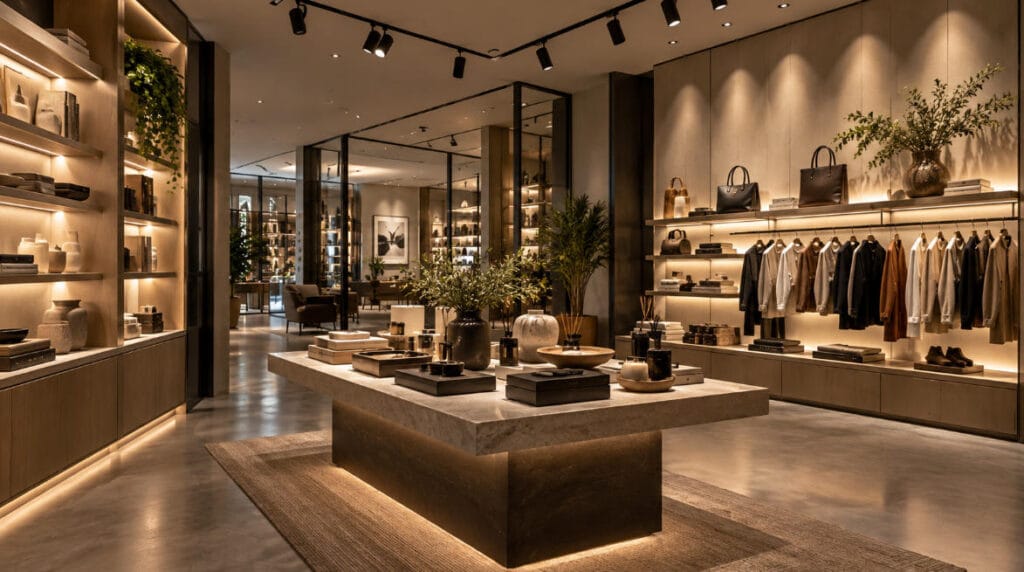
Gewerbliche Räume werden nicht einfach beleuchtet, um Produkte sichtbar zu machen.
Effektive gewerbliche Displaybeleuchtung muss die Aufmerksamkeit der Kunden lenken, Materialqualität kommunizieren, die Markenidentität stärken, wechselnde Warenpräsentationslayouts unterstützen und gleichzeitig praktisch für Installation und langfristigen Betrieb bleiben.
Für Einzelhandelsmarken, Store-Designer, Showroom-Betreiber und Engineering-Auftragnehmer macht dies gewerbliche Beleuchtung weitaus komplexer als die bloße Auswahl einer Leuchte mit der richtigen Wattzahl.
Ein erfolgreiches Beleuchtungssystem muss mehrere Fragen gleichzeitig beantworten:
Wie heben wir wichtige Produkte hervor, ohne den gesamten Store übermäßig hell zu machen?
Wie präsentieren wir Farben, Texturen, polierte Oberflächen, Stein, Keramik, Stoffe, Metall, Glas und andere Materialien präzise?
Wie kann sich die Beleuchtung anpassen, wenn sich Waren oder Store-Layouts ändern?
Wie reduzieren wir Blendung, während wir eine starke visuelle Wirkung beibehalten?
Und wie kann dasselbe Beleuchtungskonzept über mehrere Stores oder Projekte hinweg reproduziert werden?
Bei SUNPOL, betrachten wir diese Fragen als Teil eines vollständigen Beleuchtungssystems, anstatt einzelne Leuchten als isolierte Produkte zu behandeln.
Unsere kommerziellen Display-Beleuchtungslösungen kombinieren anpassbare Akzentbeleuchtung, Stromschienenbeleuchtung, Einbau-Strahler, vertikale Beleuchtung, lineare Beleuchtung und projektspezifische Leuchtenauswahl, um gewerbliche Umgebungen zu schaffen, die visuell effektiv, flexibel und praktisch im Betrieb sind.
Die tatsächlichen Probleme hinter kommerzieller Display-Beleuchtung
Viele Einzelhandelsgeschäfte und Showrooms haben genug Licht, präsentieren Produkte aber dennoch nicht effektiv.
Der Grund ist einfach:
Genug Licht zu haben ist nicht dasselbe wie das richtige Licht zu haben.
Die häufigsten Probleme bei kommerzieller Display-Beleuchtung betreffen in der Regel visuelle Hierarchie, Strahlsteuerung, Produktpräsentation, Flexibilität, Blendung oder falsche Leuchtenpositionierung.
Diese Probleme zuerst zu verstehen, macht es viel einfacher, die richtige Beleuchtungslösung auszuwählen.
1. Produkte werden beleuchtet, aber nichts hebt sich hervor
Das Kundenproblem
Ein Store kann eine ausreichende Gesamthelligkeit aufweisen und dennoch visuell flach wirken.
Wenn Regale, Waren, Verkehrsflächen, Wände, Decken und Aktionsbereiche nahezu die gleiche visuelle Betonung erhalten, haben Kunden keinen klaren Fokuspunkt.
Premium-Produkte können ihren wahrgenommenen Wert verlieren, weil die Beleuchtung sie visuell nicht von der umgebenden Umgebung trennt.
Was geschieht tatsächlich?
Das zugrunde liegende Problem ist in der Regel nicht eine unzureichende Beleuchtung.
Es ist ein unzureichender Kontrast und visuelle Hierarchie.
Einzelhandelsbeleuchtung sollte die Augen des Kunden führen.
Schlüsselprodukte, neue Kollektionen, Aktionsdisplays, Feature-Wände, Schaufensterpuppen, Präsentationstische und Markenelemente sollten normalerweise mehr Aufmerksamkeit auf sich ziehen als Verkehrsflächen oder Sekundärware.
SUNPOL-Lösungskonzept
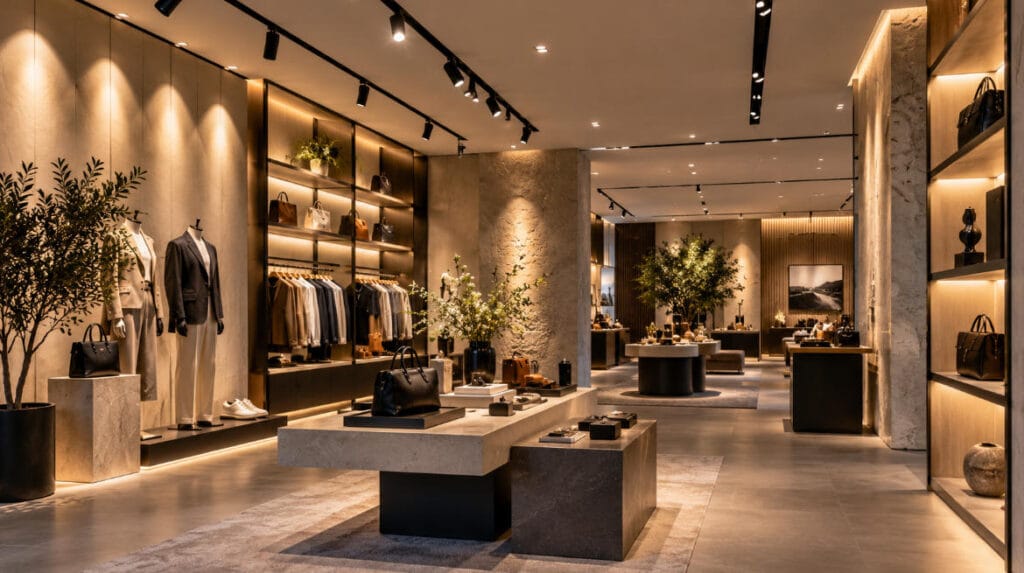
Anstatt die Allgemeinbeleuchtung überall zu erhöhen, empfiehlt SUNPOL, Lichtschichten zu schaffen.
Anpassbare Akzentbeleuchtung kann wichtige Waren hervorheben, während Umgebungsbeleuchtung eine komfortable Gesamtsichtbarkeit aufrechterhält.
Dieser Ansatz erzeugt eine stärkere visuelle Hierarchie, ohne die Gesamthelligkeit des Raums unnötig zu erhöhen.
Für Projekte, die eine flexible Leuchtenpositionierung erfordern, entdecken Sie unsere gewerbliche Beleuchtungsproduktpalette erkunden um Stromschienenbeleuchtung, Strahler und andere Display-Beleuchtungslösungen entsprechend verschiedener Warenpräsentationszonen zu kombinieren.
2. Produktfarben und Materialien sehen nicht richtig aus
Das Kundenproblem
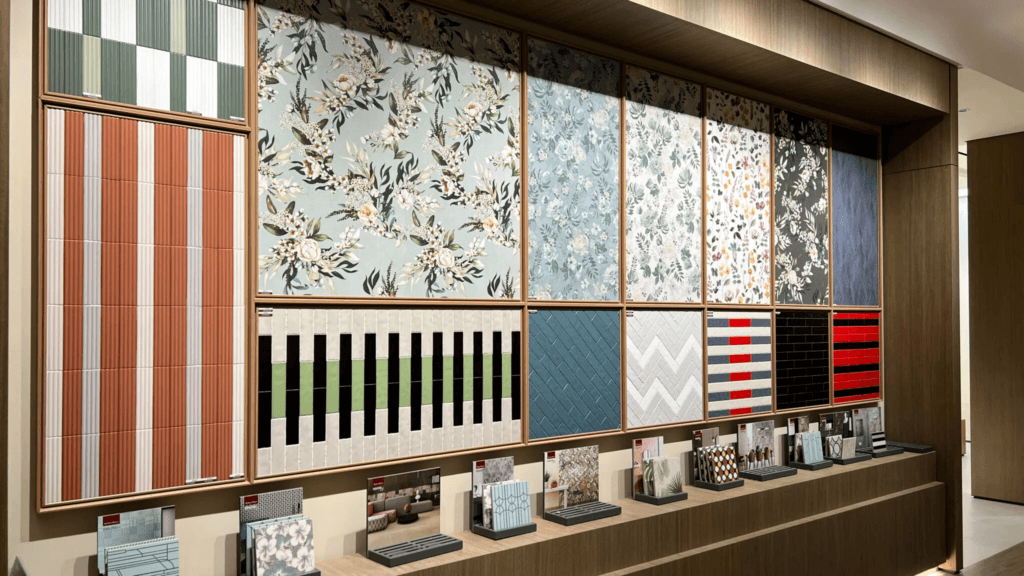
Kommerzielle Displays können Folgendes enthalten:
Stoff,
Leder,
Holz,
Metall,
Keramikfliesen,
Naturstein,
Sanitärkeramik,
Kosmetika,
Möbel,
Glas,
oder andere Materialien mit sehr unterschiedlichen optischen Eigenschaften.
Ein Beleuchtungssystem, das für ein Material gut funktioniert, kann bei einem anderen schlecht abschneiden.
Hochreflektierende Oberflächen können unangenehme Blendung erzeugen.
Dunkle Materialien können eine stärkere gerichtete Beleuchtung erfordern.
Strukturierter Stein und Fliesen hängen oft von der Lichtrichtung ab, um die Oberflächentiefe sichtbar zu machen.
Mode- und Lifestyle-Produkte erfordern eine akkurate Farbwiedergabe.
Was geschieht tatsächlich?
Der grundlegende Fehler besteht darin, die Beleuchtung hauptsächlich nach Wattzahl oder Lumenleistung auszuwählen.
Professional gewerbliche Displaybeleuchtung hängt von mehreren Variablen ab, die zusammenwirken:
Strahlverteilung,
Lichtrichtung,
Farbqualität,
Farbtemperatur,
Position der Leuchte,
Oberflächenreflexion,
Betrachtungsrichtung,
und Kontrast zur umgebenden Umgebung.
Die Frage ist daher nicht einfach:
“Wie hell sollte dieses Produkt sein?”
Die nützlichere Frage ist:
“Welche Beleuchtungseigenschaften ermöglichen es, dieses Produkt korrekt wahrzunehmen?”
SUNPOL-Lösungskonzept
SUNPOL-Beleuchtungslösungen werden entsprechend den Eigenschaften des präsentierten Materials ausgewählt.
Gerichtete Strahler können Form und Textur betonen.
Wall-Washing-Lösungen können große vertikale Displays verbessern.
Lineare Beleuchtung kann in Regale und Schränke integriert werden.
Verstellbare Strahler können auf häufig wechselnde Ware reagieren.
Dieser produktbasierte Ansatz ermöglicht es der Beleuchtung, die Art und Weise zu unterstützen, wie Kunden Ware tatsächlich bewerten.
3. Ladenlayouts ändern sich schneller als feste Beleuchtungssysteme
Das Kundenproblem
Einzelhandelsumgebungen sind selten dauerhaft.
Displays werden verschoben.
Saisonale Kampagnen erscheinen.
Regale ändern sich.
Neue Kollektionen ersetzen alte Kollektionen.
Aktionszonen wechseln von einem Bereich in einen anderen.
Ein Beleuchtungslayout, das am Eröffnungstag perfekt funktioniert, kann mehrere Monate später nicht mehr mit dem Merchandising-Layout übereinstimmen.
Was geschieht tatsächlich?
Das Beleuchtungssystem wurde um das erste Möbellayout herum geplant statt um den langfristigen Betrieb des Ladens.
Feste Leuchten funktionieren gut, wenn die Displayposition stabil ist.
Wenn sich die Ware jedoch häufig ändert, benötigt das Beleuchtungssystem ein höheres Maß an Flexibilität.
SUNPOL-Lösungskonzept
Stromschienenbeleuchtung ist in flexiblen Einzelhandelsumgebungen besonders nützlich, da Leuchten bei Warenänderungen neu positioniert und neu ausgerichtet werden können.
Zum Beispiel kann der SUNPOL SP-GD6290B2 Zylinder-Stromschienenstrahler als Teil einer flexiblen Akzentbeleuchtungsstrategie für kommerzielle Displays eingesetzt werden, bei denen gerichtetes Licht erforderlich ist.
Eingebaute Strahler können im Vergleich dazu für feste architektonische Bereiche geeignet sein, in denen ein saubereres Deckenbild bevorzugt wird.
Deshalb sollte die Wahl zwischen Stromschienenbeleuchtung und Einbauleuchten sowohl auf betrieblichen Anforderungen als auch auf Ästhetik basieren.
4. Übermäßige Blendung beeinträchtigt das Kundenerlebnis
Das Kundenproblem
Manche kommerziellen Räume wirken auf Fotos hell und dramatisch, werden aber als unangenehm empfunden, wenn man sie persönlich erlebt.
Kunden können direktes Licht von der Leuchte sehen.
Reflektierende Ware kann sekundäre Blendung erzeugen.
Helle Hotspots können neben dunklen umgebenden Bereichen auftreten.
The lighting can become tiring rather than inviting.
Was geschieht tatsächlich?
More output is being used to compensate for poor optical control.
The objective of professional display lighting is not to send as much light as possible into the room.
The objective is to deliver controlled light to the intended target.
SUNPOL-Lösungskonzept
Before increasing fixture output, review:
Position der Leuchte,
aiming angle,
Strahlverteilung,
shielding,
customer viewing direction,
surface reflection,
and surrounding brightness.
A well-positioned spotlight with appropriate optical control can often create a stronger display effect than a more powerful fixture positioned incorrectly.
The principle is straightforward:
Put the light on the merchandise, not in the customer’s eyes.
5. The Lighting Design Looks Good but Is Difficult to Execute
Das Kundenproblem
This problem is especially important for contractors and engineering companies.
A concept may look attractive in a rendering but require:
complicated ceiling coordination,
too many different fixture types,
difficult installation,
inaccessible drivers,
or products that are difficult to maintain and replace.
Was geschieht tatsächlich?
The lighting concept was developed separately from the engineering requirements.
Commercial lighting needs to connect visual design with real construction conditions.
Fixture dimensions, ceiling openings, mounting methods, track positions, driver locations, wiring, maintenance access, and replacement strategy all influence the final result.
SUNPOL-Lösungskonzept
SUNPOL treats fixture specification as part of the complete project.
The lighting solution should consider not only visual performance but also installation and long-term operation.
Designers, project teams, and contractors can begin from the SUNPOL commercial lighting product center and select appropriate fixture families according to the application rather than mixing unrelated products without a system.
6. Multi-Store Brands Struggle to Maintain Lighting Consistency
Das Kundenproblem
For retail chains, creating one successful store is not enough.
The lighting concept may need to be reproduced in dozens or hundreds of locations.
However, every store can have different:
ceiling heights,
store dimensions,
architectural conditions,
electrical conditions,
merchandising layouts,
and display systems.
Simply copying the same fixture quantity from one project to another rarely produces consistent results.
Was geschieht tatsächlich?
The brand does not have a repeatable lighting methodology.
A scalable commercial display lighting solution requires design rules rather than simply a fixture schedule.
SUNPOL-Lösungskonzept
A repeatable lighting standard can define:
fixture families,
color-temperature strategy,
beam-distribution strategy,
accent-lighting principles,
vertical-lighting principles,
track-position logic,
display priorities,
glare-control requirements,
and project-specific calculation methods.
The exact number and position of fixtures can then be adapted to each store while preserving the intended brand experience.
The Real Issue: Commercial Display Lighting Is a Visual Communication System
The deeper problem behind all of these challenges is that lighting is often treated as an electrical product rather than as part of the retail communication system.
Customers do not experience wattage.
They do not experience driver specifications.
They do not experience fixture model numbers.
They experience:
brightness and darkness,
contrast,
color,
texture,
depth,
comfort,
atmosphere,
and visual direction.
That is why a professional commercial display lighting guide should not begin with:
“What light fixture should we use?”
It should begin with:
“What should customers notice, understand, and experience in this space?”
Once the desired visual result is defined, the appropriate lighting equipment can be selected.
SUNPOL’s Commercial Display Lighting Philosophy
Light the Merchandise Before Lighting the Space
In most retail and showroom environments, merchandise should remain the primary visual focus.
SUNPOL therefore starts by identifying:
display walls,
shelves,
counters,
mannequins,
product islands,
sample areas,
promotional zones,
and other customer focal points.
Ambient illumination is then coordinated around those priorities.
This prevents a common commercial lighting problem:
making the entire room bright while leaving the merchandise visually weak.
Build Visual Hierarchy With Layers of Light
Professional kommerziellen Display-Beleuchtungslösungen normally require more than one type of illumination.
Ambient lighting
Provides comfortable general visibility and supports customer movement.
Accent lighting
Directs attention toward merchandise, promotional displays, and important architectural elements.
Vertical lighting
Improves the brightness of walls and display surfaces that customers see directly.
Linear lighting
Can be integrated into shelves, cabinets, niches, furniture, or architectural details.
Decorative lighting
Supports the visual identity and atmosphere of the store.
Instead of asking one fixture to perform every function, each lighting layer should have a clearly defined role.
You can explore these different fixture types through the SUNPOL product collection.
Use Flexible Lighting Where Displays Are Likely to Change
Track lighting is particularly valuable in retail environments because the position and direction of the light can be adjusted when merchandise changes.
This makes it suitable for:
fashion retail,
product displays,
shop windows,
furniture stores,
lifestyle stores,
material showrooms,
and frequently changing promotional areas.
A fixture such as the SP-GD6290B2 Zylinder-Schienenstrahler can support this type of flexible accent-lighting strategy.
For areas where the architectural layout is permanent, recessed spotlights may provide a more integrated ceiling appearance.
The lighting system should therefore combine flexibility and architectural integration according to the actual function of each zone.
Commercial Display Lighting Solutions by Application
Solution 1: Retail Product Displays and Feature Areas
The challenge
Retail stores need customers to recognize important merchandise quickly.
A common mistake is illuminating every area uniformly.
When everything receives the same visual emphasis, nothing appears particularly important.
SUNPOL solution
Use adjustable accent lighting to establish focal points while keeping surrounding circulation areas visually quieter.
Track-mounted lighting is particularly effective where merchandise changes regularly.
Different beam distributions can then be selected according to the size of the display.
A relatively focused beam may be appropriate for an individual object.
A wider distribution may suit a product group or larger display.
Recommended solution
SUNPOL Adjustable Track Lighting
Recommended starting product:
SP-GD6290B2 Zylinder-Schienenstrahler
Typical applications include fashion retail, display shelves, promotional zones, furniture displays, lifestyle stores, galleries, and commercial showrooms.
Practical implementation
Position track according to the display line rather than simply following the center of the ceiling.
Aim the luminaires toward the merchandise while considering the customer’s viewing direction.
For frequently changing stores, retain sufficient track flexibility so luminaires can be repositioned without modifying the entire ceiling.
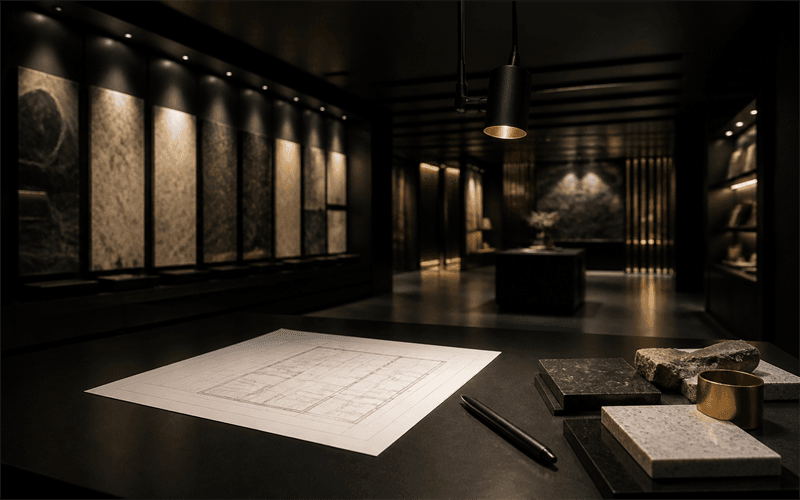
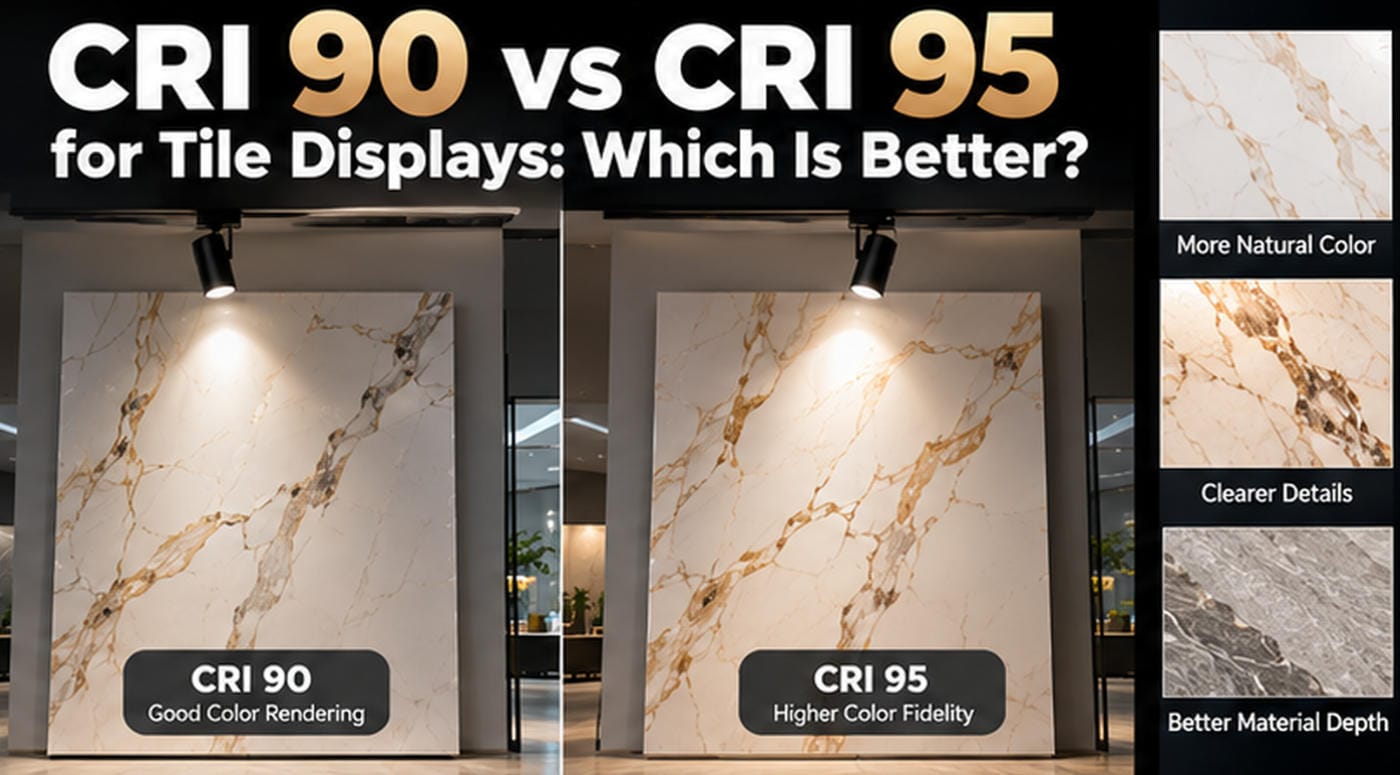
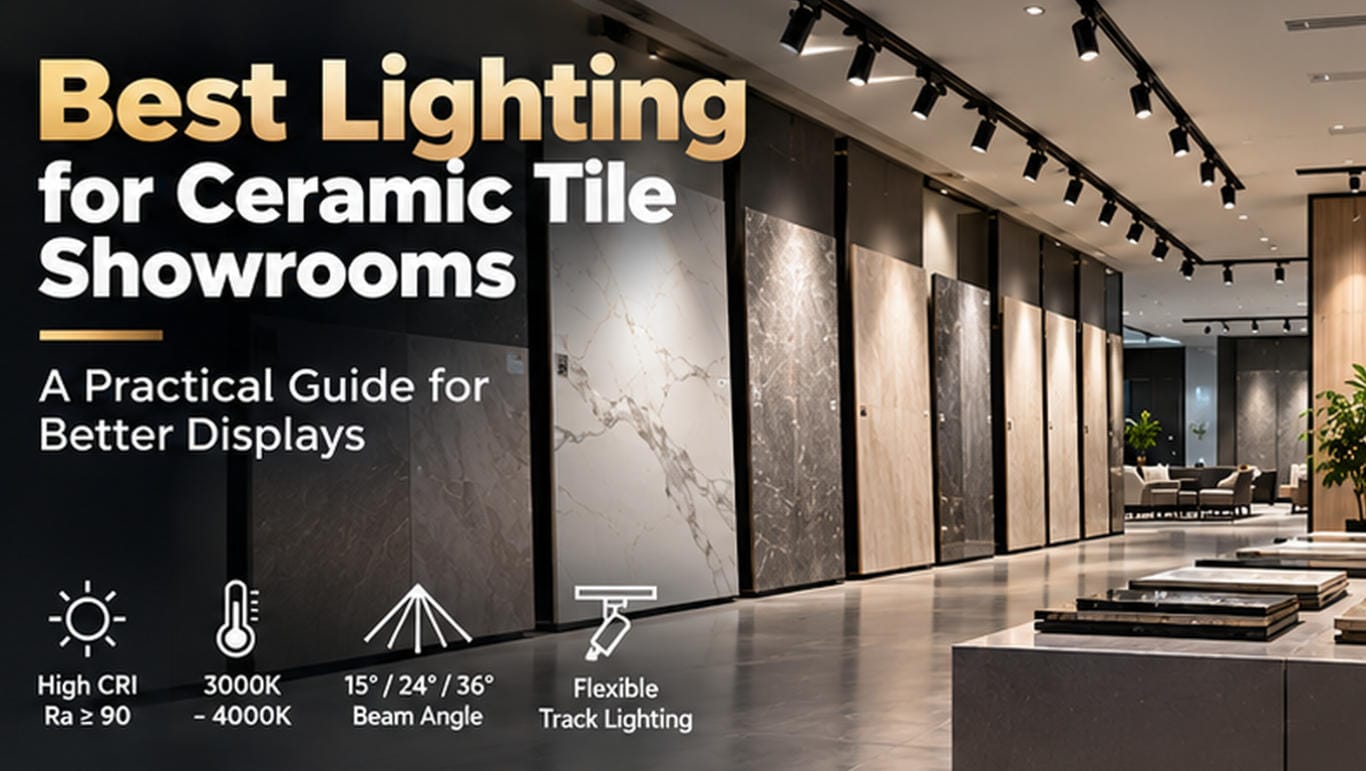
Solution 2: Tile and Stone Showroom Lighting
The challenge
Tile and stone cannot be evaluated through brightness alone.
Customers need to understand:
texture,
surface finish,
color variation,
reflection,
pattern,
and three-dimensional characteristics.
If light reaches textured stone from an ineffective direction, the material may appear visually flat.
Highly polished tile and stone can also generate reflected glare.
SUNPOL solution
Combine directional accent lighting with appropriate vertical illumination.
Directional light can reveal texture by creating controlled highlights and shadows.
For polished materials, fixture position should be coordinated with normal customer viewing positions to reduce unwanted reflection.
Suitable SUNPOL lighting categories can include:
track lights,
adjustable spotlights,
wall-washing lighting,
and linear lighting for material shelves.
Besuchen Sie den SUNPOL lighting products center to compare different fixture families for material-showroom projects.
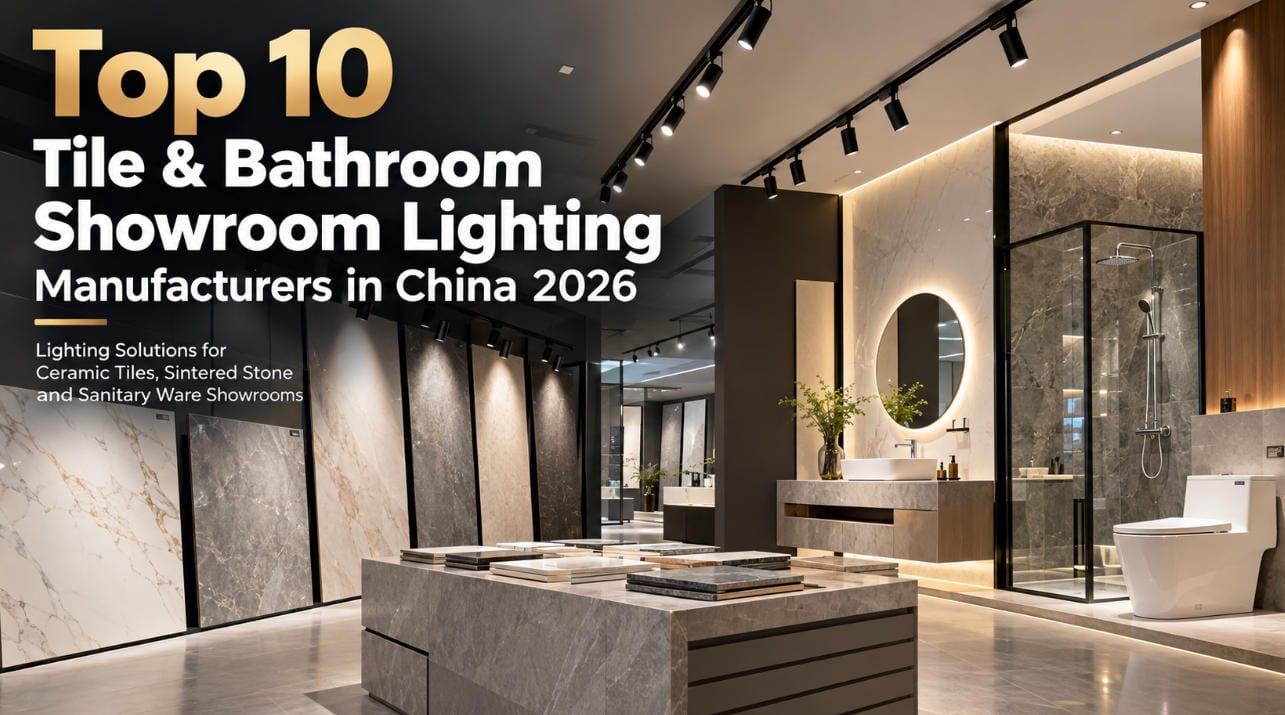
Solution 3: Bathroom and Sanitary Ware Showroom Lighting
The challenge
Bathroom showrooms combine many reflective materials:
white ceramics,
chrome,
Glas,
mirrors,
stone,
and glossy furniture surfaces.
Poorly controlled lighting can create glare while still failing to reveal the three-dimensional form of the products.
Another common mistake is relying only on conventional ceiling downlights.
This may illuminate horizontal surfaces while leaving important vertical displays visually weak.
SUNPOL solution
Combine accent lighting with vertical illumination.
Directional spotlights can reveal the form of basins, faucets, bathtubs, and bathroom furniture.
Wall-oriented lighting can improve the overall brightness of the display background.
Linear lighting can also be integrated into furniture, shelves, niches, and selected architectural elements.
The goal is not to make the bathroom display uniformly brighter.
The goal is to create individual lighting scenes that help customers understand each product combination.
Solution 4: Fashion and Lifestyle Retail Lighting
The challenge
Fashion lighting needs to perform two functions simultaneously:
present merchandise accurately,
and create the desired brand atmosphere.
Customers need to recognize fabric colors and textures, while designers need enough contrast to distinguish mannequins, feature tables, wall displays, and promotional collections.
The additional complication is that merchandise changes frequently.
SUNPOL solution
Use flexible track lighting as the primary accent-lighting layer.
Combine it with recessed or integrated lighting where a more architectural ceiling appearance is required.
Adjustable fixtures can then be redirected after merchandising changes.
The SUNPOL SP-GD6290B2 Zylinder-Stromschienenstrahler is one option for projects requiring adjustable directional lighting within a track-based system.
The lighting hierarchy should normally prioritize storefront displays, hero products, promotional collections, mannequins, feature tables, wall merchandise, and finally general circulation.
Solution 5: Wall Displays and Vertical Merchandising
The challenge
Many commercial lighting designs focus heavily on horizontal illuminance.
But customers spend most of their time looking forward rather than downward.
Brand graphics, shelving, material samples, products, artwork, and promotional messages are frequently located on vertical surfaces.
A store can therefore have sufficient floor illumination while still appearing visually dark.
SUNPOL solution
Treat important vertical surfaces as dedicated lighting targets.
Depending on the display, the solution may involve:
adjustable track lights,
wall-washing lighting,
recessed adjustable spotlights,
or integrated linear lighting.
Fixture position, setback, beam distribution, wall height, and display position should all be coordinated during the design stage.
Solution 6: Stores With Frequently Changing Displays
The challenge
A completely fixed lighting layout limits merchandising freedom.
When shelves, racks, or product islands move, fixed recessed luminaires may no longer correspond with the display positions.
The result can be dark merchandise, wasted light, and unnecessary renovation.
SUNPOL solution
Use track lighting as a flexible lighting infrastructure.
Track-mounted fixtures can move with the merchandising concept.
Recessed lighting can still be used for stable zones such as circulation areas, reception areas, or permanent counters.
The SP-GD6290B2 Zylinder-Schienenstrahler can form part of this type of flexible display-lighting system.
Rather than designing track around only the initial furniture plan, consider future merchandising zones during the planning stage.
Solution 7: Multi-Store Retail Lighting
The challenge
Retail brands expanding to multiple locations need visual consistency.
However, different stores have different architectural conditions.
Simply repeating the same number of lights in every store is therefore not an effective standardization strategy.
SUNPOL solution
Create a repeatable lighting specification instead of a fixed fixture count.
The specification can establish common rules for:
fixture types,
beam distributions,
color strategy,
accent-lighting hierarchy,
vertical lighting,
track layouts,
glare control,
and product-display priorities.
Each project can then adapt those rules according to ceiling height, merchandise layout, room dimensions, and local construction conditions.
Commercial Display Lighting Guide: A Practical Design Process
Step 1: Define the Display Priority
Identify what customers should notice first.
Mark hero products, promotional areas, window displays, display walls, product islands, counters, brand graphics, and circulation paths.
Do this before selecting luminaires.
Step 2: Understand the Product Materials
Determine whether merchandise is:
matte,
glossy,
reflective,
dark,
light,
textured,
metallic,
transparent,
or particularly color-sensitive.
The lighting strategy should respond to merchandise characteristics instead of only the architecture.
Step 3: Select the Appropriate Lighting Layer
Use track lighting where flexibility is important.
Use recessed spotlights where displays are stable and a cleaner architectural ceiling is preferred.
Use wall-washing solutions for larger vertical surfaces.
Use linear lighting for shelves, cabinets, niches, and integrated details.
Use decorative lighting where the luminaire itself contributes to the brand environment.
The SUNPOL lighting product portfolio can be used as the starting point for selecting the appropriate product family.
Step 4: Select Beam Distribution According to the Target
One beam angle should not automatically be used throughout the entire project.
Beam selection depends on:
fixture-to-product distance,
display dimensions,
mounting height,
required visual emphasis,
and surrounding brightness.
Small focal displays generally require more concentrated optical control.
Large merchandise groups or display walls may require wider or overlapping beams.
Step 5: Control Glare Before Increasing Output
If a display appears visually weak, increasing wattage is not always the correct solution.
First examine fixture direction, beam position, shielding, surface reflection, competing ambient light, and background brightness.
Better optical control may improve the presentation more effectively than simply increasing the amount of light.
Step 6: Validate the Lighting Design
For important commercial projects, the final solution should be verified using suitable lighting calculations, drawings, product samples, mock-ups, or on-site aiming tests.
This becomes particularly important for premium retail stores, reflective displays, tile and stone showrooms, large vertical displays, unusual ceiling heights, and multi-store rollouts.
Recommended SUNPOL Commercial Display Lighting System
| Lighting Requirement | SUNPOL Solution | Typical Application |
|---|---|---|
| Flexible accent lighting | SP-GD6290B2 Zylinder-Schienenstrahler | Retail products, displays, showrooms |
| Frequently changing merchandise | SUNPOL Track Lighting | Fashion stores, retail stores, promotional areas |
| Clean architectural accent lighting | SUNPOL Recessed Spotlights | Fixed displays, premium retail environments |
| Vertical display lighting | SUNPOL Wall-Washing Solutions | Display walls, tile, stone and branding surfaces |
| Shelf and cabinet illumination | SUNPOL Linear Lighting | Shelves, cabinets, niches and furniture |
| Decorative visual layer | SUNPOL Pendant Lighting | Counters, lifestyle displays and brand environments |
Different product families can be explored from the SUNPOL Products Center.
Final fixture selection should be based on ceiling height, display dimensions, materials, beam requirements, project layout, and the intended visual result.
Why Work With SUNPOL for Commercial Display Lighting?
Commercial lighting projects require more than a catalogue of luminaires.
They require coordination between:
product presentation,
interior design,
lighting performance,
installation,
merchandising,
and long-term operation.
SUNPOL Lighting focuses on architectural and commercial lighting solutions for retail stores, showrooms, and display environments.
By combining track lighting, recessed spotlights, vertical lighting, linear lighting, and project-specific lighting strategies, designers and project teams can create a complete system instead of selecting independent fixtures without an overall lighting concept.
For retail brands, this approach supports more consistent visual presentation.
For store designers, it provides greater control over visual hierarchy.
For contractors and engineering companies, it creates a clearer relationship between the design intention and the practical installation.
Build Commercial Lighting Around What Customers Need to See
The best gewerbliche Displaybeleuchtung system is not necessarily the brightest system or the one using the largest number of luminaires.
It is the system that delivers the right light to the right product from the right direction.
A properly designed lighting solution should:
help customers notice important products,
improve the perception of colors and materials,
reveal texture and form,
reduce unnecessary glare,
support the brand environment,
and remain adaptable as the commercial space changes.
That is the foundation of SUNPOL’s approach to kommerziellen Display-Beleuchtungslösungen.
Whether the project involves a retail store, tile showroom, stone showroom, bathroom showroom, fashion store, material gallery, or multi-location commercial rollout, lighting should begin with the display objective.
Only then should the project determine the appropriate fixture, beam distribution, mounting method, and lighting configuration.
By combining flexible solutions such as the SUNPOL SP-GD6290B2 Zylinder-Stromschienenstrahler with other products available through the SUNPOL commercial lighting range, retail brands, designers, and engineering teams can create commercial spaces where products are not merely illuminated.
They are intentionally presented.
Talk to SUNPOL About Your Commercial Display Lighting Project
Every display environment has different ceiling heights, merchandise types, surface materials, layouts, and visual objectives.
If you are planning a retail store, showroom, material display space, or commercial lighting project, contact SUNPOL through our website and share your project requirements.
Our team can help you identify an appropriate commercial display lighting strategy and suitable lighting products for the application.